Epic 1.9.5 Release Notes + Xt.com Feedback from Dev Team

GRIDNET Core 1.9.5 Release Notes — Hard Fork

Download: https://gridnet.org/GRIDNETCore.zip

And lo, the Wizards said unto the nations: Come, sit at our table, and you shall feast upon knowledge and prosper. But he who overturns our table shall hunger in darkness, and his deeds shall be laid bare before all.

Release Type: Major Hard Fork
Development Period: April 2025 — February 2026
Prior Release: GRIDNET Core 1.7.0 (April 2025)
Intermediate Releases: 1.8.6, 1.9.1, 1.9.2, 1.9.4


Foreword

GRIDNET Core has been developed with full transparency since the early 2017 — nearly every line of code conceived, implemented, debugged, and validated on YouTube LIVE, almost each and every day. This document serves as the comprehensive technical companion for investors, operators, and community members seeking a meticulous account of the work undertaken since the last release.

The 1.9.5 release represents the most architecturally ambitious cycle in GRIDNET history. What began in April 2025 with crash dump forensics, LARS autonomous deployment, and Merkle Patricia Trie investigations evolved into a ten-month odyssey that touched virtually every layer of the stack — from the lowest-level C++ memory allocators in the Merkle Patricia Trie, through the GridScript virtual machine and its compiler infrastructure, up to the browser-native Decentralized User Interface framework, and all the way to the cryptographic protocols binding them together.

Along the way, the team discovered and patched critical security vulnerabilities within hours on live television, responded to a suspected transaction-withholding attack on Live-Net, pioneered an AI-augmented development methodology that shifted the coding-to-testing ratio to 25/75, and built cross-hard-fork validation tooling that is now mandatory for every future release — tooling that confirmed, at blockchain height 140864, byte-level congruence of the entire state trie between the pre-fork Live-Net and the post-fork candidate.

254 development days. Streamed publicly. No closed doors. This is what was built.


Critical Highlights

  • Wallet UI dApp — A fully decentralized, browser-native wallet with multi-keychain management, ECC-authenticated transactions, real-time balance retrieval, PIN-lock security, AES-GCM encrypted address book, responsive design, multi-recipient value transfers, PDF receipt generation, and GLink deep-linking — all running within a single browser tab as a true GRIDNET OS UI dApp. No extensions. No server dependencies. 101% open source.
  • Identity Token Registration Wizard — Fully autonomous, multi-stage identity deployment from the browser: sacrificial transaction, monitoring, DPT pre-validation, BER-encoded Identity Token creation in JavaScript, on-chain registration — zero trust in any remote node.
  • Advanced Self-Protection Module — Enterprise-grade runtime self-protection: heap-spray detection, memory scanning, debugger mitigation, and detour injection detection — capabilities previously reserved for software suites such as Google Chrome. 140 security tests. 0 failures.
  • Merkle Patricia Trie Memory Optimization — Up to 99% savings for empty branch nodes, 43% for partially filled nodes, 58% reduction in per-mutex overhead — approximately 168 MB saved per million trie nodes.
  • Critical CVE Mitigations — Emergency Response Team patches for MPT rearrangement memory corruption, BigInt serialization vulnerabilities, and null-pointer dereferences — all validated on Live-Net within hours.
  • Multi-Dimensional Token Pools & Off-Chain Payments — End-to-end off-chain payment pipeline: Token Pool registration, Transmission Token generation/import/cash-out, double-spend prevention, and deterministic seed derivation from master key.
  • GridScript ACID Commitment Overhaul — Detached VM thread execution, system-mode authentication, ephemeral sandbox execution with deferred authentication, and cross-UI-dApp synchronization.
  • In-Browser GridScript Compiler — Transactions compiled, signed, and dispatched entirely from within the browser — passing all pre-validation tests on GRIDNET Core including code integrity and ECC signature verification.
  • GLink Deep-Linking System — URL-triggered multi-stage processing: GRIDNET OS boot, user authentication, UI dApp launch, view activation, and form data population — all from a single link.
  • Hard Fork On-Chain Metadata — Explicit transaction type metadata stored on-chain, eliminating the need to parse Turing-complete GridScript bytecode. Millisecond-speed blockchain search via the new mkfilter GridScript command.
  • Transaction Processing Enhancements — Nonce-aware fee-priority sorting, mempool pre-validation, invalid bytecode detection, and 4–8 second confirmation times on Live-Net.
  • AI-Augmented Development Pipeline — Anthropic AI integration for root cause analysis, code review, cross-platform compiler validation, and crash dump analysis — shifting to a 75% testing / 25% coding workflow.
  • Mongoose Web Server Hardening — Eight critical fixes to the embedded Mongoose HTTP/WebSocket server: NULL pointer races, integer overflows, heap corruption, and race conditions.
  • Cross-Hard-Fork Validation Frameworkchain -dump and chain -validate commands for byte-level state trie comparison between pre-fork and post-fork nodes. All readings nominal at height 140864. Now mandatory for every Hard Fork Procedure.
  • Phantom Leader Mode — Sandboxed transaction simulation enabling any Operator to preview expected mempool outcomes without affecting live consensus — born from response to a suspected withholding attack.
  • Liquidius Maximus Market Making Engine — Comprehensive Python-based high-frequency trading platform with 20+ strategies, Qt6 flame-chart profiler, Garman-Klass-Yang-Zhang volatility estimation, sandwich/pump-and-dump detection with autonomous mitigation, self-learning defense adaptation, flashing order book module, and GTX post-only order placement — purpose-built for GNC/USDT liquidity provision. To be released as entirely open source following the termination of Xt.com cooperation due to documented predatory market manipulation.
  • LARS Autonomous Update Engine — LARS evolved from a crash reporter into a fully autonomous deployment system: self-updating GRIDNET Core installations, MSI installer extensions, pre-flight validation suites, blockchain height stall monitoring, crash-loop resilience, GPU diagnostics, runtime DLL introspection, and VC++ Runtime management.
  • Network Connection Hardening — Per-IP connection throttling, low-connectivity fallback mode, kernel-mode firewall integration, QUIC keep-alive tuning, application/transport-layer ping synergy, and maximum data package size extended from 40 MB to 200 MB for growing blockchain synchronization demands.
  • Emergency CVE Campaign Response — GridScript meta-data generation attack vector, Kademlia peer discovery exploit, network black-hole attack, ERG limit exploitation, SEH disabling attack campaign, and WebSocket data fuzzing attack — all discovered, patched, and deployed via LARS within hours.

Wallet UI dApp — A Fully Decentralized Browser-Native Wallet

Every blockchain project has a wallet. Almost none of them are truly decentralized. MetaMask runs as a browser extension with closed-source components. Hardware wallet interfaces depend on manufacturer servers. Mobile wallets are compiled binaries whose source you never see.

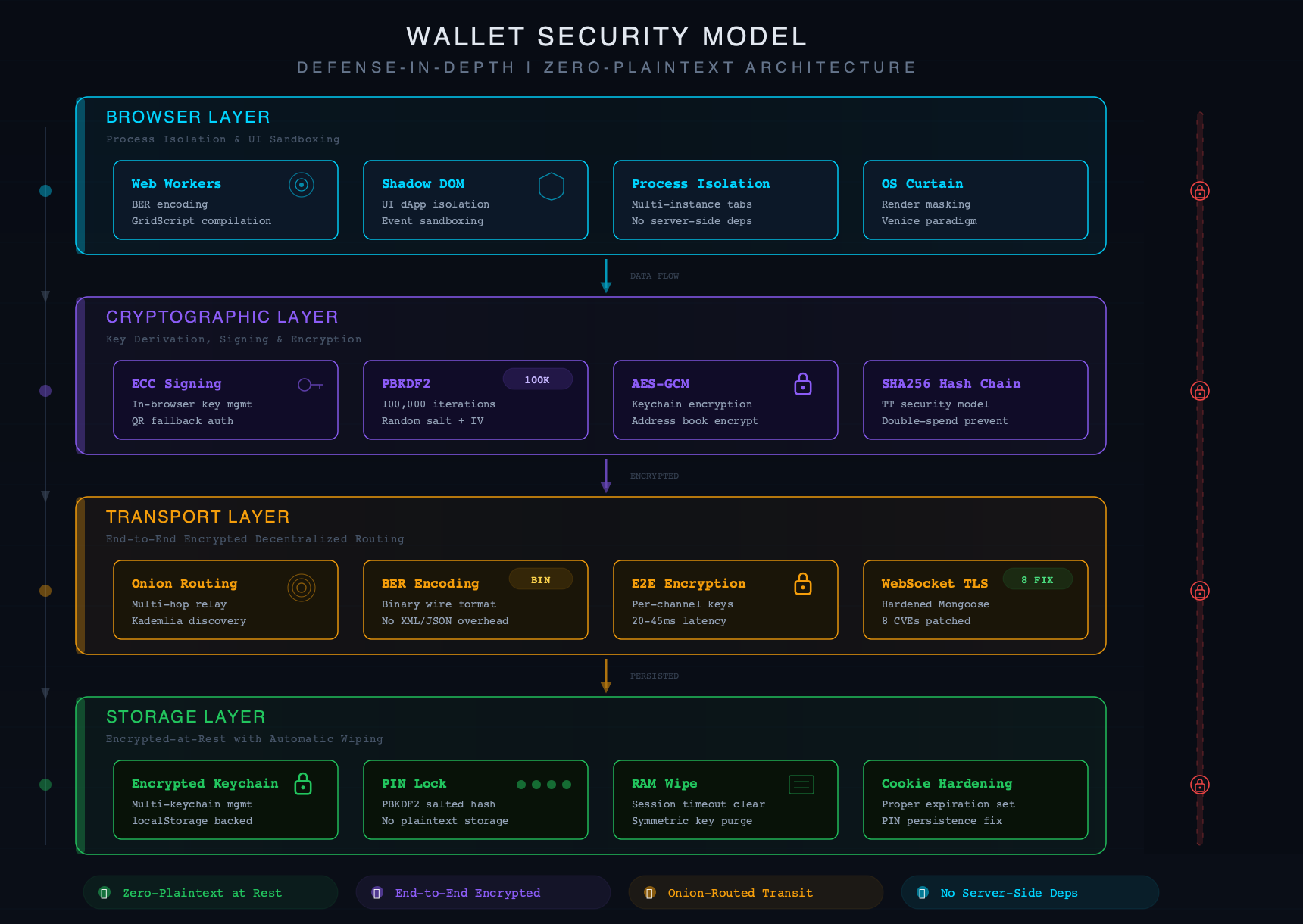
The GRIDNET Wallet UI dApp is different by construction. It is delivered on-chain as source code, decompiled on-the-fly by the user’s browser, and executed within GRIDNET OS process isolation inside a single browser tab. There are no binaries to trust, no extension permissions to grant, no server-side dependencies to rely on. The code is open, verifiable, and self-contained — and any developer can fork it, modify it, and deploy their own version on-chain.

Building a wallet this way is harder than every alternative. It means implementing ECC cryptography in JavaScript. It means managing keychains entirely in-browser. It means serializing every data structure to BER format and routing every message through onion-encrypted WebSocket channels. But the result is a wallet whose security model is mathematically verifiable by anyone who can read JavaScript — because all of it is right there in the source code, served from the blockchain itself.

Core Capabilities

  • Multi-keychain architecture — multiple keychains, each holding multiple sub-identities, with animated fold/unfold transitions and single-tap identity switching that propagates system-wide across all running UI dApps.
  • Real-time balance and history — data flows onion-routed, BER-encoded, and end-to-end encrypted over WebSocket channels. Balance update latency: 20–45 ms on local network.
  • Value transfer with dynamic cost estimation — slider-based transfer UI with real-time fee calculation, multi-recipient support with drag-and-drop ordering, and mempool-aware next-nonce prediction. Custom draggable library ensures slider interaction doesn’t trigger container rearrangement. Dynamic Pool Tracking creates a zero-sum allocation model where adjusting one recipient instantly updates all others.
  • PIN-lock and keychain encryption — PBKDF2-derived (100,000 iterations) salted PIN hashing replaces prior plaintext storage. AES-GCM encrypted keychain data stores with automatic lock/unlock on timeout. Symmetric keys wiped from RAM upon session timeout.
  • Stored recipients with AES-GCM encryption — encrypted-at-rest address book with zero plaintext persistence when locked, quick-save from send view, and one-click auto-fill.
  • PDF receipt generation — downloadable Value Transfer Confirmation receipts generated directly from the wallet, available both pre-confirmation (proof of submission) and post-confirmation (proof of settlement).
  • Responsive design — Exodus-class visual aesthetics adapted from narrow smartphone to ultra-wide desktop, with dynamic element repositioning, conditionally hidden logo, and cyberpunk hover/drag effects.
  • Initial development (April–May 2025) — tabbing mechanics, dashboard views, Shadow-DOM component architecture, and key-chain management JavaScript API enabling all KeyChain GridScript command functionalities from JavaScript.
  • In-browser wallet address generation — all custom cryptographic primitives (including RIPEMD-160) ported from C++ to JavaScript/ECMA6, enabling fully headless in-browser key derivation.
  • Headless authentication — asynchronous data-request pipeline for symmetric password prompts with full-screen secure-desktop-style passphrase entry, promise-based resolution, and automatic timeout.
Transaction Commitment Architecture

The Wallet UI dApp pioneered a new architecture for GridScript code commitment from the browser — a pipeline that did not exist before this release:

![Transaction Commitment Flow Architecture Diagram]](upload://nmDnluuGs3EvmnWmTUS0w45a42L.png)

  1. JavaScript ECMA6 formulates GridScript instruction sequences
  2. Web Workers perform BER encoding, GridScript compilation, and ECC signing — off the main thread
  3. Compiled bytecode is dispatched through onion-routed, encrypted WebSocket channels
  4. GRIDNET Core nodes receive, pre-validate, and broadcast to the network
  5. Operators include validated transactions in newly formed Data Blocks
  6. Results flow back through the same onion-routed channel to the specific UI dApp instance

A critical architectural breakthrough was the introduction of System-mode commitment — enabling headless commits without requiring a per-process handle. A single password prompt per session, with graceful fallback to QR code authentication when the KeyChainManager cannot fulfill signing requests locally.

The commitment pipeline also introduced progressive commit monitoring with exponential fallback: initial 3-second check, then retries at 5, 10, and 15-second intervals — replacing the brittle fire-and-forget model of previous releases.

GridScript VM as a Decentralized Service-Oriented Architecture
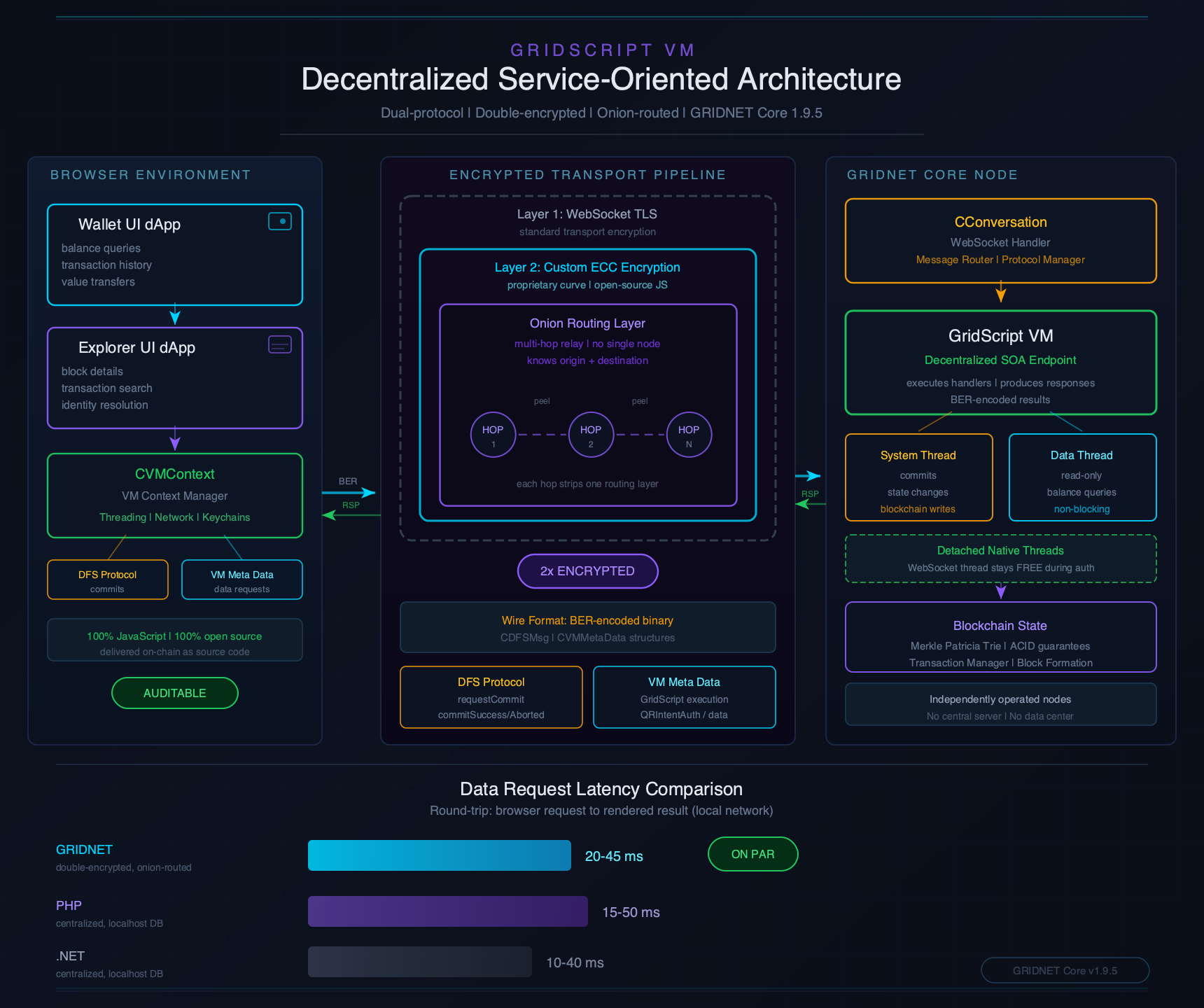
Stop and consider what is actually happening when a user opens the Wallet UI dApp or the Blockchain Explorer in their browser.

Every balance displayed. Every transaction listed. Every block detail rendered. Every identity resolved. None of it comes from a traditional server. There is no PHP backend. There is no .NET API. There is no REST endpoint hosted in a data center. Every single piece of data the user sees on screen is retrieved through GridScript code executing on remote GRIDNET Core nodes — decentralized machines operated independently across the network.

This is not a theoretical capability. It is production reality. Both the Wallet UI dApp and the Blockchain Explorer UI dApp — the two flagship applications shipped with this release — operate entirely on this architecture. When the Wallet queries an account balance, it constructs a GridScript data request in JavaScript, BER-encodes it, wraps it in custom ECC encryption, sends it through a TLS-secured WebSocket, and routes it through GRIDNET’s onion-routing layer to reach a Core node. That node executes the corresponding GridScript handler, produces a BER-encoded response, and sends it back through the same double-encrypted, onion-routed channel. The browser decodes the response and renders it. The user sees a number on screen and has no idea that what just happened bears no resemblance to a conventional HTTP request-response cycle.

The encryption model deserves emphasis: every data request travels through two independent encryption layers. The outer layer is standard WebSocket TLS — the same transport security used by every modern web application. The inner layer is GRIDNET’s own ECC-based encryption, applied at the application level before the data ever reaches the WebSocket. An attacker who somehow compromised the TLS layer would still face a second, entirely separate cryptographic barrier. And because the inner encryption is implemented in JavaScript — delivered as source code from the blockchain itself — it is fully auditable. There are no compiled binaries, no opaque cryptographic libraries, no trust-us-it-works black boxes. Every encryption operation can be read, verified, and validated by anyone with a browser’s developer tools.

The onion routing adds a third dimension of protection: even if both encryption layers were somehow breached, the multi-hop relay architecture ensures that no single node in the network knows both the origin and destination of any given request. The request hops through intermediate nodes, each peeling one layer of routing information, before reaching its destination. Privacy is not a feature bolted on after the fact — it is woven into the transport fabric.

What makes this genuinely remarkable is the performance. The measured balance update latency — the round-trip time from browser request to rendered result — is 20–45 milliseconds on a local network. That is not a typo. A double-encrypted, onion-routed, BER-encoded request to a GridScript virtual machine running on a remote decentralized node, with the response traveling back through the same pipeline, completes in under 50 milliseconds. This is on par with — and in many cases faster than — conventional centralized web frameworks like PHP, Ruby on Rails, or ASP.NET querying a local database over localhost.

The GridScript VM has effectively become a decentralized SOA endpoint. Traditional Service-Oriented Architectures rely on centralized servers exposing well-defined APIs. GRIDNET has achieved the same pattern — well-defined service interfaces, request-response semantics, structured data encoding — but with the servers replaced by a decentralized network of independently operated nodes, and the communication channel replaced by an onion-routed, double-encrypted, censorship-resistant transport layer.

This is what replaces traditional server-side backends. Not partially. Not as a proof of concept. In production, today, serving real users on Live-Net.


Identity Token Registration Wizard

Registering an identity on a blockchain should not require downloading a separate binary, trusting a third-party service, or understanding cryptographic primitives. The Identity Token Registration Wizard makes on-chain identity deployment a guided, multi-stage process — executed entirely from the browser.

Every blockchain platform that supports on-chain identities eventually confronts the same question: how do you make identity registration accessible without compromising sovereignty? Most projects punt — they build a centralized web portal, or they require users to install CLI tools and paste hex-encoded strings into a terminal. The GRIDNET approach was to build a wizard that handles the full complexity of multi-stage blockchain commitment autonomously, while keeping the user informed at every step. The result is a process that is technically rigorous and genuinely usable — no cryptography degree required.

The wizard handles a complex sequence autonomously:

  1. Sacrificial transaction — the wallet compiles GridScript bytecode, signs via custom ECC, broadcasts the sacrificial transaction, and monitors the blockchain for confirmation with real-time progress updates.
  2. Automatic progression — once confirmed, the UI auto-transitions to the next stage. No clicks required.
  3. Historical transaction detection — the wizard retrieves previously committed sacrificial transactions, enabling cross-device workflow continuity (start on one machine, finish on another).
  4. DPT pre-validation — before committing the Identity Token to the blockchain, the wizard executes the target GridScript in a sandboxed Decentralized Processing Thread. Only on confirmed success does it proceed.
  5. Identity Token creation — full CIdentityToken creation matching the C++ implementation, BER serialization, base58check encoding, all generated in JavaScript.
  6. On-chain registration — the final transaction is compiled, authenticated, and broadcast.

Two deployment modes are supported: local compilation (zero-trust, everything happens in the browser) and DPT mode (remote compilation, QR-code authenticated through the mobile app). The bambino state-domain was the first identity successfully registered through this wizard on Live-Net — entirely autonomously.


Advanced Self-Protection Module

Most blockchain software trusts the operating system to protect it. GRIDNET Core does not make that assumption.

A blockchain node is not a web app that can be restarted if something goes wrong. It holds private keys. It processes value transfers. It participates in consensus where a single corrupted state transition can fork an entire network. The threat model is not hypothetical — memory injection attacks, DLL hooking, debugger-assisted key extraction: these are real techniques used against real financial software. The Advanced Self-Protection Module was built with the conviction that a blockchain node should defend itself with the same intensity that browsers like Google Chrome bring to protecting a sandboxed tab. The protections implemented here are found in fewer than a handful of software suites globally, and for software that may hold value and process financial transactions, this level of paranoia is not excessive; it is appropriate.
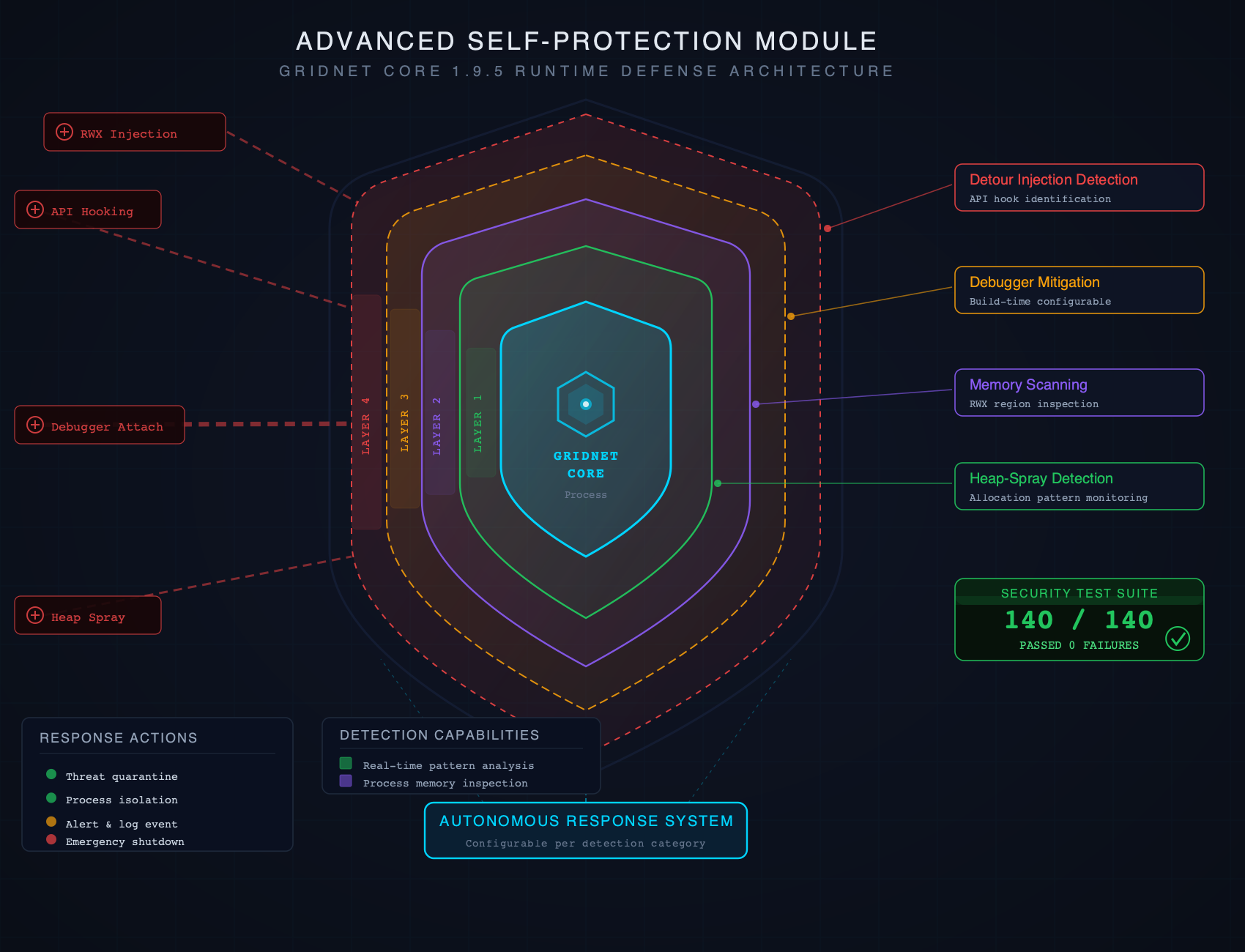
  • Heap-spray detection — real-time monitoring of memory allocation patterns to detect heap-spraying attack techniques. False positive elimination refined through iterative testing against Visual Studio debug heap patterns, achieving 0 false positives after calibration. The system flags suspicious allocation patterns and can trigger autonomous response.
  • Memory scanning — inspection of process memory regions for suspicious RWX (Read-Write-Execute) allocations. Legitimate code sections (e.g., __enc$textbss$begin from Visual Studio runtime) are properly excluded. Any unexpected RWX region triggers investigation.
  • Debugger mitigation — configurable build-time options for debugger detection and countermeasures. An attacker who attaches a debugger to a running GRIDNET Core instance faces detection and response.
  • Detour injection detection — identification of API hooking and function detour injection attempts. This protects against DLL injection attacks that modify function behavior at runtime.
  • Automatic response mechanics — autonomous threat response capabilities configurable per detection category. The node can respond to threats without human intervention.
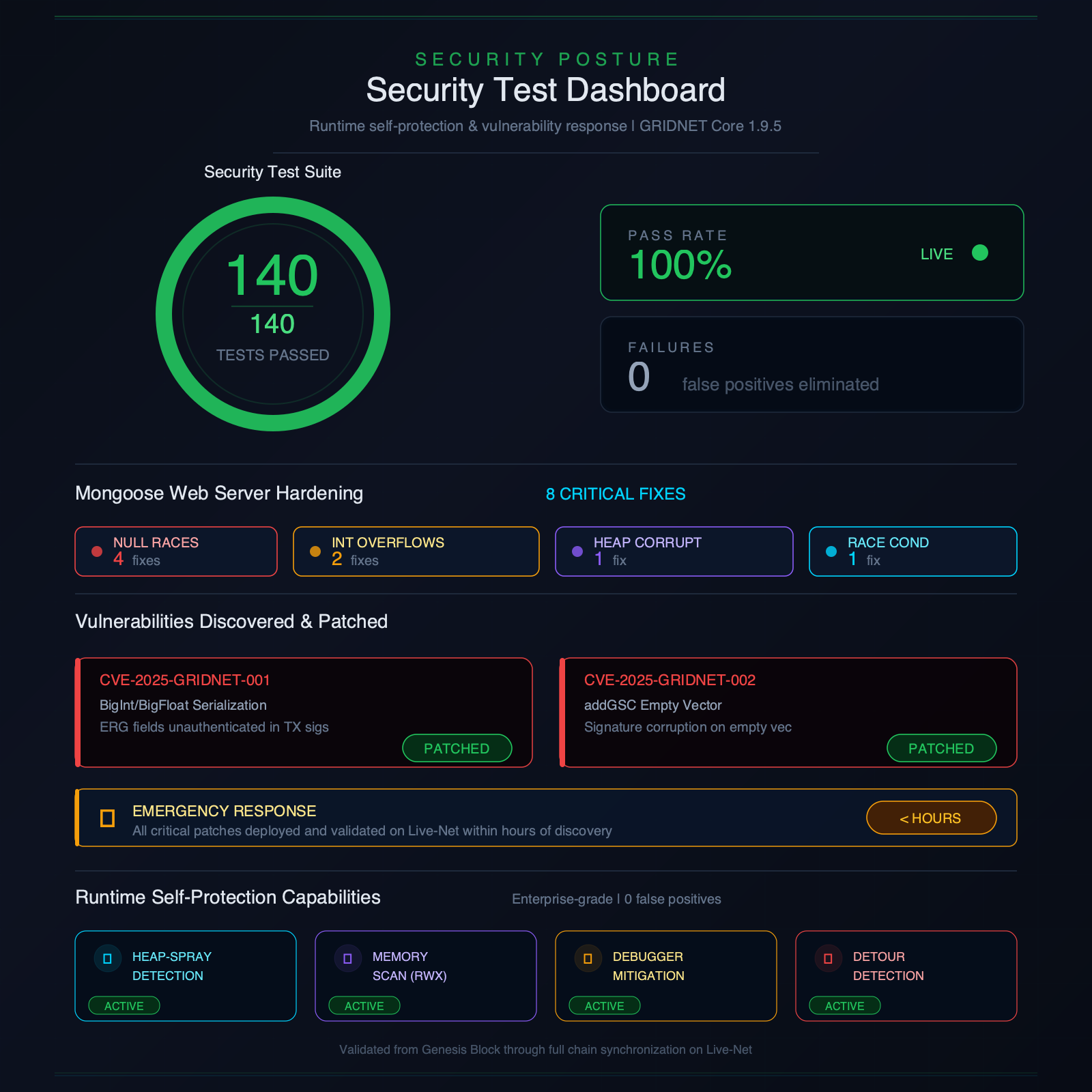
  • Security test suite — 140 dedicated security tests with 100% pass rate, evaluated from Genesis Block synchronization through full chain validation. Every test passed. Zero failures.
  • Runtime SEH Integrity Verification — inline-assembly-based runtime self-diagnostic checks detecting whether Structured Exception Handling has been disabled or overridden by hostile actors, with obfuscated assembly to resist binary patching.
  • Kernel-Mode Aided Self-Protection — user-mode Win32 API module unloading with kernel-mode escalation for forceful neutralization. Initializes early in boot sequence.
  • IAT/EAT Hook & Deroute Detection — scanning of all loaded modules for Import Address Table and Export Address Table hooks, inline patches, and derouted function pointers.
  • ETW-Based Process & Thread Monitoring — Windows Event Tracing with custom private session for real-time detection of injected DLLs, rogue threads, and process-level intrusions.
  • AtomBombing / APC Injection Detection — detection for the AtomBombing code-injection technique exploiting Windows atom tables and Asynchronous Procedure Calls.
  • Custom PEB/TEB Structure Definitions — Process Environment Block and Thread Environment Block structures incorporating undocumented Windows internal fields.

GridScript & Execution Enhancements

ACID-Compatible Flow Processing

GridScript is a Turing-complete virtual machine. Running Turing-complete code inside a consensus-critical blockchain kernel is inherently dangerous — a single incorrect state transition can fork the network. The ACID overhaul addresses this by introducing proper transactional semantics borrowed from database theory.

The challenge that drove this work was deceptively simple on the surface: let browser-based UI dApps execute GridScript code, accumulate changes, and commit them atomically. In practice, this meant solving a problem that database engineers have studied for decades — how do you let multiple concurrent actors modify shared state without corruption? The answer, as it has been since the 1980s, is ACID: Atomicity, Consistency, Isolation, Durability. What is new here is applying those guarantees not to rows in a database, but to state transitions inside a decentralized virtual machine running across an adversarial network.
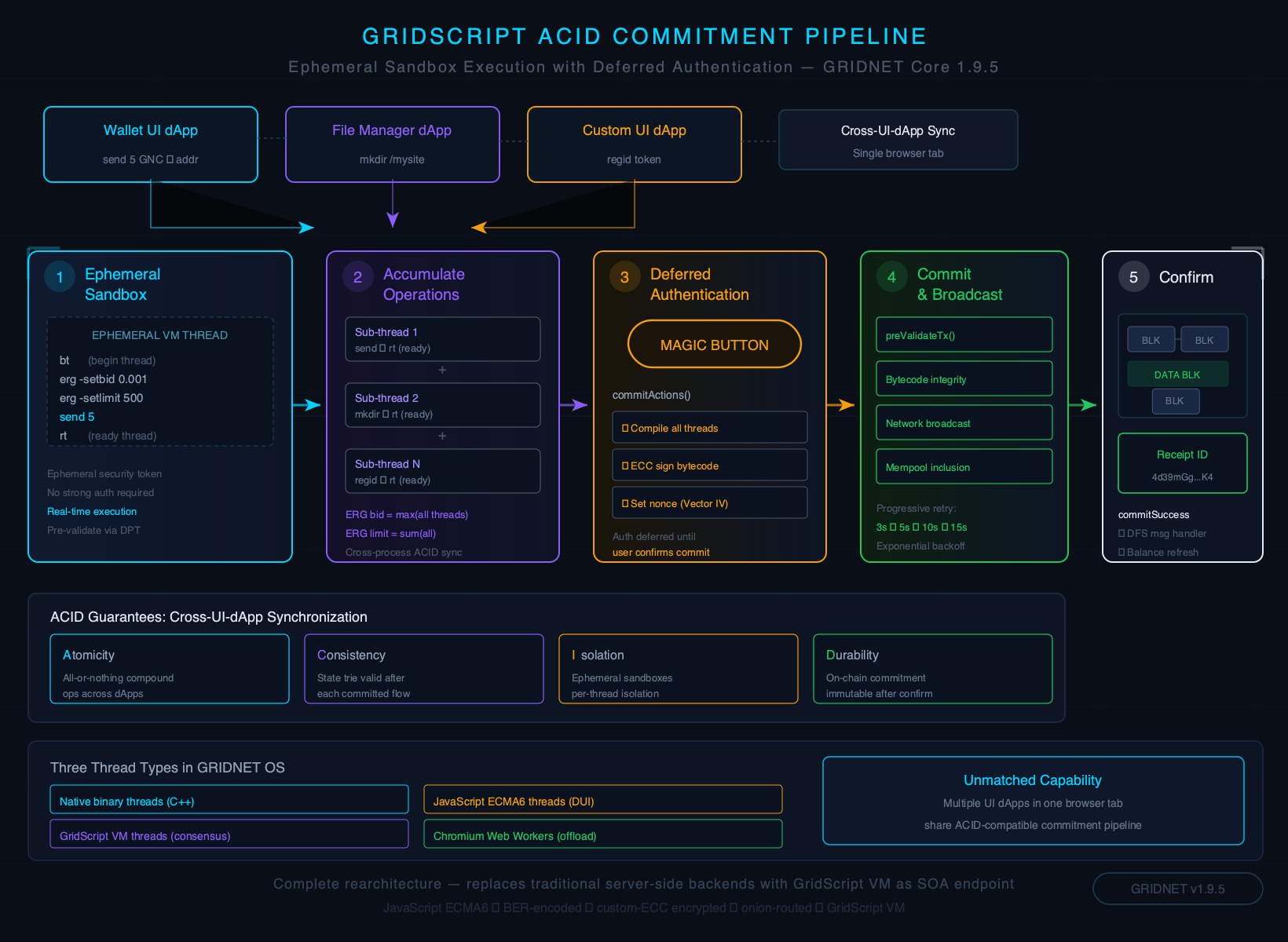
  • Ephemeral sandbox execution with deferred authentication — UI dApps execute GridScript code in real-time sandboxes, accumulate operations across multiple threads, and defer cryptographic authentication to the commitment phase. Think of it as a database transaction: changes are tentative until COMMIT.
  • Cross-UI-dApp synchronization — ACID-compatible coordination of GridScript commitment across multiple applications running in the same browser tab. Two dApps can modify state in the same atomic operation — a capability unmatched in competing blockchain platforms.
  • ERG command additions — new ERG GridScript commands (setbid, setlimit) enabling UI dApps to programmatically configure execution resource allocation (gas equivalent) parameters. Two new VM special registers store pre-validated ERG amounts, eliminating user prompts when values are already known.
  • chain -bf command — Operators can query real-time status of key-block and data-block formation.
  • chain -phantom on/off — toggles Phantom Leader Mode from the GridScript terminal.

Detached VM Thread Architecture

During the implementation of browser-based transaction commitment, the team encountered a deadlock that would have been invisible in testing but fatal in production:
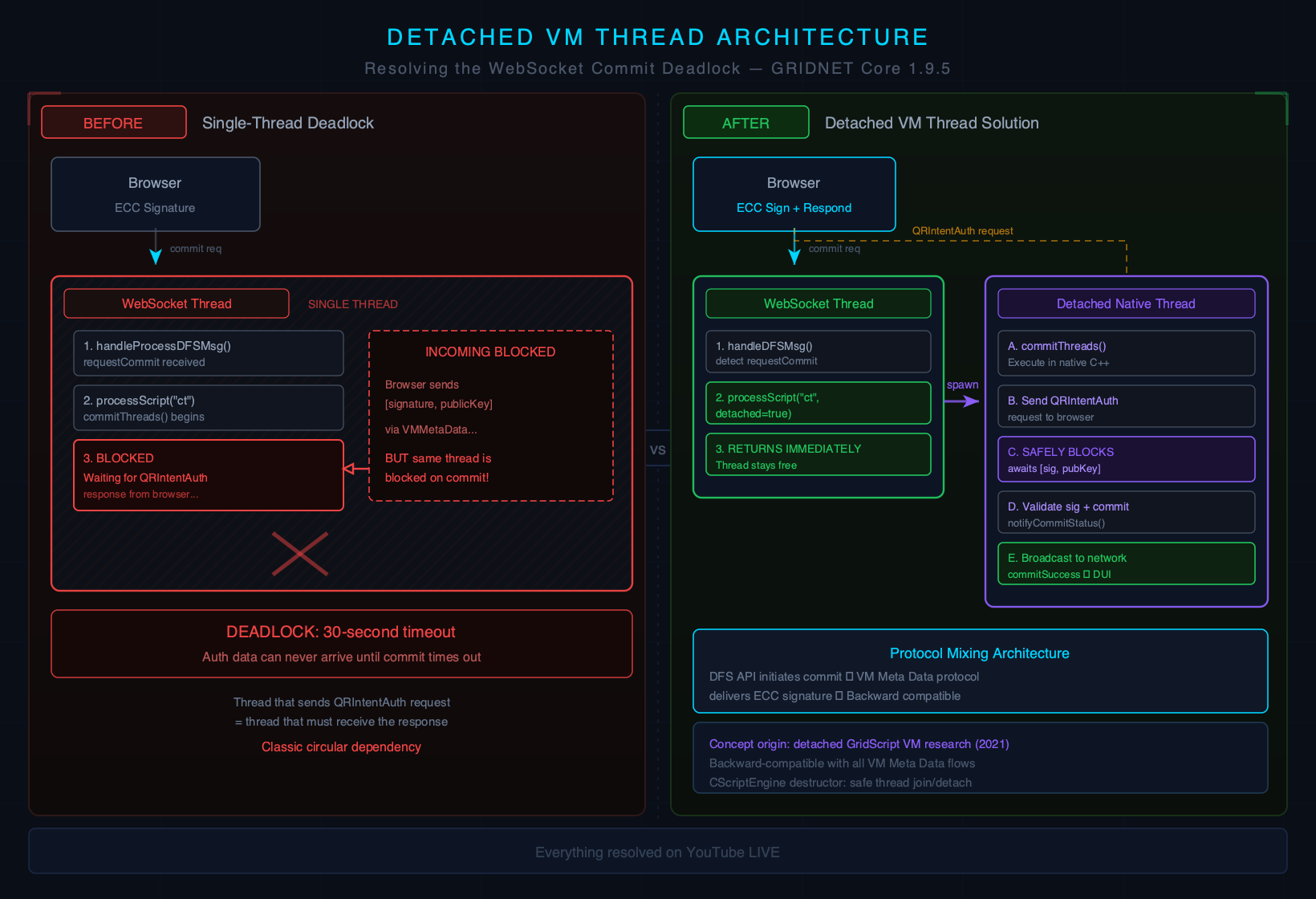
The WebSocket thread handling commit requests was the same thread required to receive authentication responses. When the thread blocked waiting for an ECC signature from the browser, it could never receive that signature — because the incoming data had to arrive through the same blocked thread.

This is the kind of bug that does not surface in unit tests. It does not appear in staging environments with low concurrency. It waits for production traffic, for the exact moment when a user’s wallet is mid-commit and the system seizes.

The solution drew on research from 2021: detached GridScript VM threads. Commit operations now spawn a native C++ thread that blocks independently while the WebSocket thread returns immediately, remaining responsive for incoming authentication data. The detached thread safely awaits the ECC signature, validates it, commits the transaction, and calls notifyCommitStatus(). Backward-compatible with all existing VM Meta Data protocol flows.

In-Browser GridScript Compiler

A milestone that seemed distant at the start of the release cycle: the browser can now compile, sign, and dispatch GridScript bytecode entirely on its own — without any assistance from a remote GRIDNET Core node for compilation.

This was achieved through a massive porting effort — wrapping the CTransaction C++ nested BER-encoded data structure (3-4 levels of inheritance) for JavaScript production. AI agents were deployed to compare C++ and JavaScript implementations, continuously generating unit tests with test vectors and correlating results until the JavaScript compiler output matched the C++ reference implementation byte-for-byte.

The security implications are profound: the browser becomes the sole trusted entity. No remote node compilation. No blind trust in bytecode received from the network. The user’s browser compiles from source, signs with a local private key, and dispatches the authenticated package. This is the logical conclusion of a design philosophy that treats every external dependency as a potential attack surface — and eliminates them one by one until the only thing the user needs to trust is the code running in their own browser.

GridScript Decompiler Fix

Investigation revealed a bug in the GridScript decompiler where the -r (recipient) switch was not properly decompiled in Transmission Token cash-out instructions. Extensive cross-validation through GridScript VM-level breakpoints confirmed the bug affected display only — the kernel-mode execution path correctly inferred recipients from the data stack. The Effective Final Perspective (state trie root hash) was congruent between fixed and unfixed nodes, confirming no backwards compatibility layer was required.

  • ERG Control Bypass During Exception Handling — ERG checks and deduction logic now disabled during GridScript exception-handling sequences, patching a vulnerability where low ERG limits caused fatal double-exception termination.
  • GridScript VM Exception Processing Hardening — extensively revised exception processing across multiple code paths with reinforced general exception handlers around value-transfer API execution, block formation, and chain-proof instantiation.

Merkle Patricia Trie — Memory & Stability

The Merkle Patricia Trie is the data structure at the heart of every account, every balance, every identity on GRIDNET. Every node in the network maintains a copy. Every byte of overhead per trie node is multiplied by millions of nodes across thousands of operators. Memory optimization here is not premature — it is economically significant.

But memory was only the beginning of what this release cycle demanded. What started as a careful optimization effort turned into months of deep debugging when live-net conditions exposed a critical memory corruption vulnerability and multi-threaded race conditions that only surfaced under real-world bootstrap loads. The trie is the single most exercised data structure in GRIDNET Core — every block touches it, every transaction modifies it, every new operator rearranges it. Making it smaller was the plan. Making it survive everything the network could throw at it became the mission.

Memory Optimization

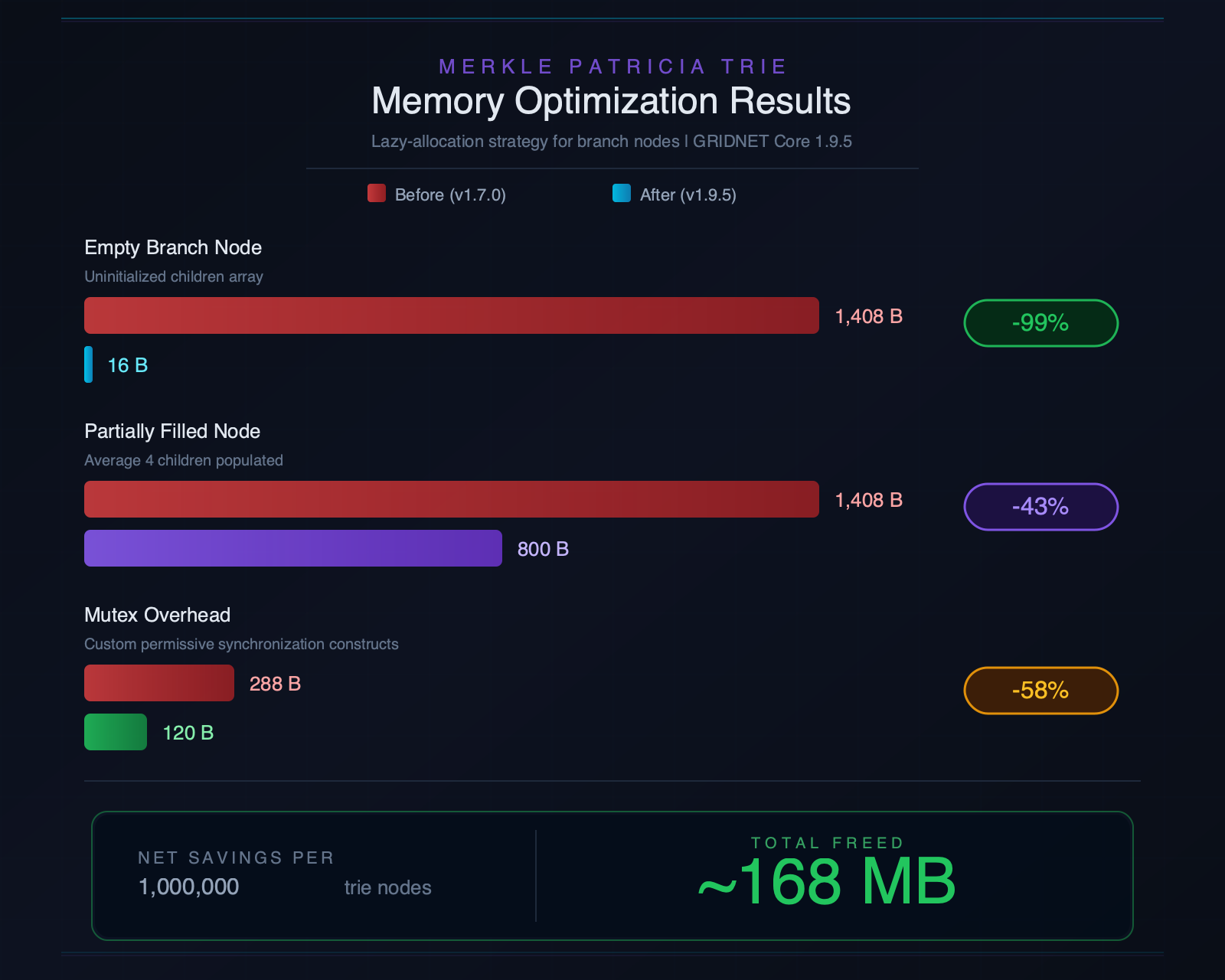
The insight was simple: most branch nodes in a Merkle Patricia Trie are empty or nearly empty. Allocating a full 16-child array (plus hashes, descriptors, and synchronization primitives) for every node — including nodes with zero children — is wasteful.

The solution: lazy allocation.

State Before After Savings
Empty branch node ~1,408 bytes ~16 bytes ~1,392 bytes (99%)
Partially filled (avg 4 children) ~1,408 bytes ~800 bytes ~608 bytes (43%)
Fully populated ~1,408 bytes ~1,408 bytes 0 bytes

All 12+ accessors (getMemberHash, setMemberHash, mMemberDescriptor, setMemberDescriptor, recalculateHashes, setAllMemberHashes, setMember, clear, copy constructor, operator=, prepare for serialization and deserialization) updated with null-safe lazy initialization. Nothing allocates until something needs to be stored.

Additionally, custom permissive synchronization constructs were optimized from ~288 bytes to ~120 bytes per mutex when authorization is unused — a 58% reduction. For a trie with one million nodes, this alone saves approximately 168 MB.
Critical Vulnerability: MPT Rearrangement Memory Corruption

On November 10, 2025, an Emergency Response was triggered on YouTube LIVE.

A newly joined Operator had — by random chance — self-assigned a state-domain identifier located immediately adjacent to the Treasury account in the Merkle Patricia Trie. When the block-reward processing (Flow/ACID layer) created the Operator’s account, the trie rearranged its nodes. The Treasury account was relocated to a new memory address — but the ACID layer still held a pointer to the old address. Memory corruption.

The triggering Operator was identified as 1JWvujzgQvyAMdzAjh1eBA9vCycWcpvZGP at block height 129154. Emergency patches were deployed and validated within hours. A similar vulnerability was identified in the transaction processing path where target account creation could displace Treasury nodes — also patched.

Multi-Threaded Processing Fix

A crash occurring during initial bootstrap — triggered during multi-threaded validation of the longest chain-proof delivered from the network — was traced to the multi-threaded Merkle Patricia Trie processing path and resolved.

  • Multi-Tier Meta-Data Cache Synchronization — massive synchronization overhaul after LARS reports revealed race conditions where multiple threads (up to four simultaneously) fired meta-data cache updates against the same MPT instance. Fixes included RAII-managed synchronization constructs and proper isolation guarantees.
  • Node-Level Critical Sections via Dynamic Mutex Map — per-node critical section mechanism using a dynamic map of mutexes keyed by sub-node hash, protecting availability checks and lazy instantiation during multi-threaded traversal.
  • BER Data-Type Pre-Sensing — custom low-level code performing manual BER data-type sensing prior to Botan library decoding, bypassing exception-heavy handling for ten-fold or greater performance improvement in meta-data preparation speed.

Emergency Response: CVE Discoveries & Rapid Mitigation

Security vulnerabilities are inevitable. What defines a project is how it responds to them — how fast, how transparently, and how thoroughly. The 1.9.5 development cycle tested that response capability repeatedly. Multiple security vulnerabilities were discovered, disclosed, and patched — often within hours, always on camera. Every fix described below was developed, deployed, and validated on YouTube LIVE streams, with the full debugging process visible to anyone watching. No closed-door patches, no silent updates, no “we’ll get to it next quarter.” When something broke, it was fixed in front of the world.
CVE-2025-GRIDNET-001: BigInt Serialization

During the development of the in-browser GridScript compiler, a bug was found not in JavaScript — but in the C++ code itself. The addBigInt(), addBigFloat(), and addBigSInt() methods in the data concatenator utility copied from &mInternalTemp[0] instead of bytes.data() and failed to increment mOffset. The result: ERG Price/Limit fields were not properly authenticated in transaction signatures.

Impact: Critical. Affected transaction versions v1 through v2. Fixed with dual implementations — a corrected version and a bug-compatible version for backward chain processing.

CVE-2025-GRIDNET-002: Empty Vector Serialization

The addGSC(std::vector<uint8_t> vec) method, when receiving an empty vector, failed to increment mOffset after adding an 8-byte zero value. Active usage in Tools.cpp:5113 (sourcePubKey) and identitytoken.cpp meant this could corrupt signatures silently.

Both CVEs were patched, propagated to JavaScript and mobile app codebases, and validated through full Genesis Block synchronization — Merkle Patricia State Trie roots nominal at all tested heights.

Null-Pointer Dereference (January 2026)

A null-pointer dereference introduced on June 6, 2025 went undetected for seven months. The trigger: any transaction broadcast with an ERG limit below 1000 would crash any node on Live-Net. The attacker was identified through full memory dump analysis as… the team’s own Wallet UI dApp under development.

Patched and released as GRIDNET Core 1.9.4 within hours.

What follows is a selection of additional attack vectors discovered and neutralized during the 1.9.5 cycle. Each of these was a real incident — identified through LARS automated reporting, live-net monitoring, or direct adversarial probing — and each was resolved with targeted hardening rather than broad workarounds.

  • GridScript Meta-Data Generation Attack Vector — a deliberately malformed GridScript instruction sequence discovered via LARS reports caused crashes during meta-data generation despite the transaction being correctly rejected on-chain. Emergency Response Team deployed a vaccine within 8 hours.
  • Kademlia Peer Discovery Exploit — spoofed ICMP Port Unreachable datagrams disrupted UDP-based connectivity. Transport layer hardened to throw only on fatal occasions, with maximum reported neighbour counts capped to prevent DoS amplification.
  • Network Black-Hole Attack — excessive advertisement of chain-proofs enabling node isolation was patched with propagation controls limiting chain-proof advertisement frequency.
  • ERG Limit Exploitation Attack — attackers submitted transactions with extremely low ERG limits causing fatal double-exception crashes during GridScript execution. Hot Fix GRIDNET Core 1.6.8 deployed.
  • SEH Disabling Attack Campaign — coordinated campaign where hostile actors ran GRIDNET Core with altered executables disabling Structured Exception Handling. Runtime SEH integrity verification deployed as countermeasure.
  • WebSocket Data Fuzzing Attack — protocol-mismatched data dispatched to Tier 0 WebSocket endpoints causing crashes. DUI service handlers hardened against data-fuzzing vectors.

Transaction Processing & Mempool Management

Transaction processing is where theory meets production. A mempool that doesn’t sort properly delays legitimate transactions. A pre-validation step that misses invalid bytecode wastes operator resources. A nonce gap that isn’t handled correctly means users wait forever.

These are the kinds of problems that don’t show up in whitepapers or architecture diagrams. They show up when real users submit real transactions and something doesn’t work the way it should. Every fix below came from observing actual behavior on Live-Net — transactions that sat in mempools longer than they should have, status labels that confused users, cleanup routines that silently stopped running. The goal was straightforward: make transactions flow through the system the way users expect them to, without surprises.
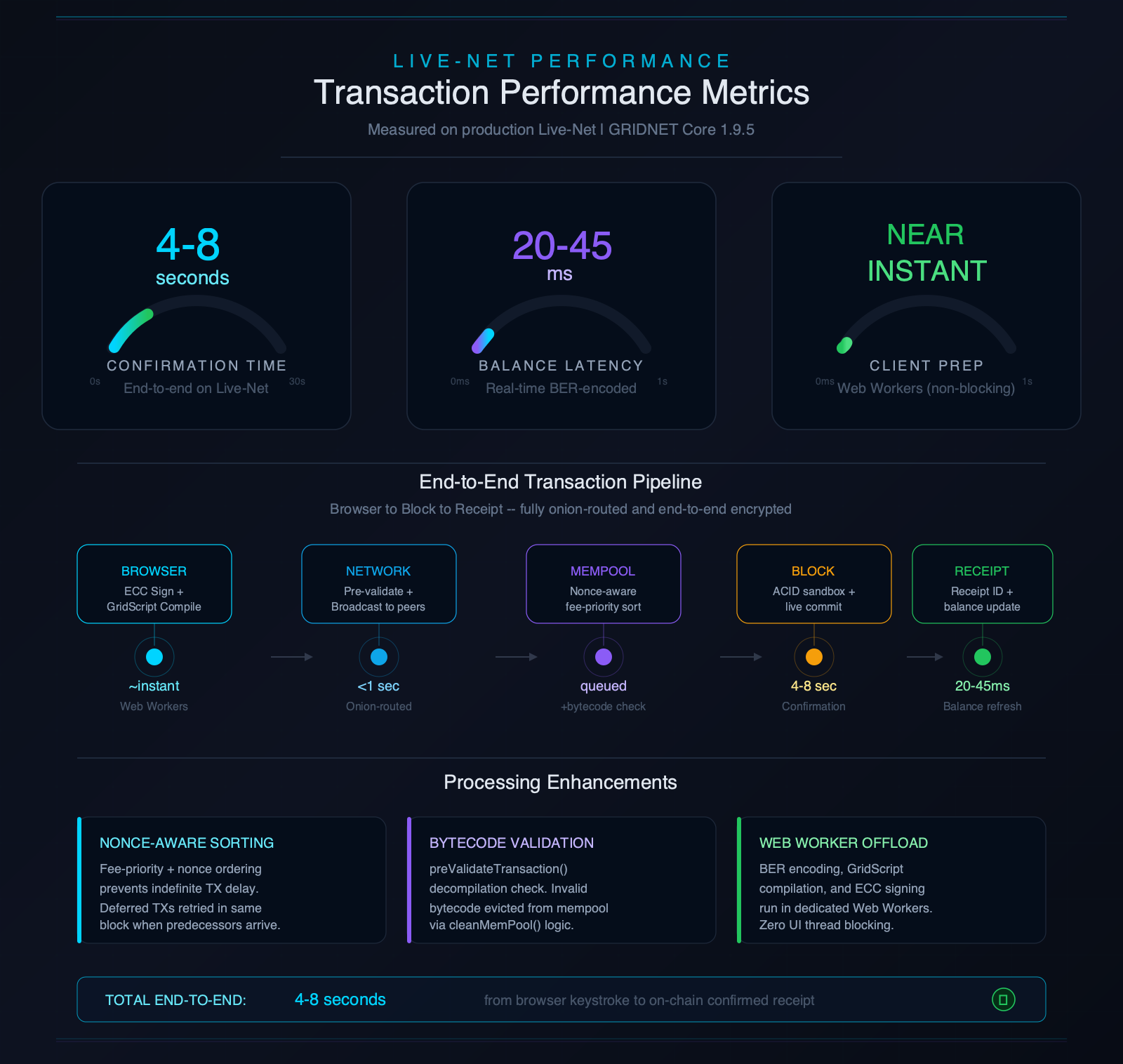
  • Nonce-aware fee-priority sorting — mempool transactions are now sorted considering both fee priority and nonce ordering. Without this, a high-fee transaction with nonce N+1 would be selected before nonce N, causing it to be deferred indefinitely — a subtle bug that only manifests under specific ordering conditions.
  • Invalid bytecode detectionpreValidateTransaction() now performs bytecode decompilation checks. A new invalidBytecode result type triggers mempool eviction via cleanMemPool(). Transactions that can never be valid are no longer kept around hoping they’ll become valid.
  • Pre-validation status tracking — new received enum value (15) replaces the misleading default invalid status shown before pre-validation completes. Users no longer see their transaction labeled “invalid” during the 100ms before validation finishes.
  • Retry deferred transactions — transactions deferred due to nonce gaps are now retried within the same block when preceding transactions arrive. Previously, these would wait for the next block formation cycle.
  • Mempool cleanup fix — a recent security addition had inadvertently disabled mempool cleanup on nodes with block formation disabled (dev-nodes), preventing transaction pre-validation entirely. A subtle regression that could have gone unnoticed for months.
  • Confirmation times — demonstrated 4–8 second confirmation times on Live-Net, with Web Worker-based compilation and signing enabling near-instant client-side preparation.

Mongoose Web Server Hardening

The Mongoose HTTP/WebSocket library is the front door to GRIDNET Core. Every WebSocket connection, every HTTP request, every Decentralized User Interface session — all of it enters through this single library. That makes it the highest-value target in the entire stack. A buffer overflow here does not just crash a web server; it potentially compromises a blockchain node. This is why GRIDNET Core maintains its own internal fork of Mongoose, hardened far beyond the upstream version through both automated pen-testing and meticulous manual code review.

During the 1.9.5 cycle, the team identified and fixed eight critical issues — the kind of low-level memory safety bugs that do not show up in normal operation but become devastating under adversarial conditions. Race conditions in buffer management. Integer overflows in WebSocket frame processing. Heap corruption from a seemingly innocuous memory-zeroing operation. Each one was a potential attack vector; each one is now closed.

Issue Location Root Cause
NULL pointer race in resize (expansion) mongoose.cpp:1864-1883 Concurrent access during buffer growth
NULL pointer race in resize (free) mongoose.cpp:1812-1822 Use-after-free in buffer deallocation
NULL pointer race in mg_iobuf_add mongoose.cpp:2083-2090 Missing synchronization in buffer append
NULL pointer race in mg_iobuf_del mongoose.cpp:2192-2200 Missing synchronization in buffer delete
Integer overflow in mg_ws_mask mongoose.cpp:5321-5326 Arithmetic overflow in WebSocket masking
Integer overflow in mg_ws_wrap mongoose.cpp:5527-5540 Arithmetic overflow in frame wrapping
Heap corruption from zeromem mongoose.cpp:1898, 1822 Zeroing memory after reallocation
Race condition on c->send buffer websocket.cpp Unsynchronized concurrent writes

Post-fix automated pen-testing confirmed: upgrades to internal WebSocket mechanics exhibit complete resilience to DOS and data fuzzing attacks. The front door is reinforced.

  • BER Encoding Validation Overhaul — custom BER encoding validation heuristics external to Botan library, including manual length-field checks. Increased BER length-field allowance from 4 bytes to 5 bytes with additional reasonable-size checks.

Multi-Dimensional Token Pools & Off-Chain Payments

On-chain transactions are permanent, transparent, and slow. Off-chain payments are instant, private, and cheap. Both have a place — but until now, GRIDNET only had the on-chain path. The 1.9.5 release cycle delivers the first end-to-end off-chain payment pipeline operating through the Wallet UI dApp, closing that gap and giving users a real choice between settlement guarantees and transaction speed.

The mechanism behind it is elegant in its simplicity. Multi-Dimensional Token Pools are reverse hash-chain constructs — multiple reverse hash-chains running in parallel (hence “multi-dimensional”). Each chain link is a Transmission Token that can be given to a recipient and cashed out on-chain. The hash chain is one-way: given token N, you can verify it leads to the pool root, but you cannot derive token N+1. Double-spend prevention is built into the protocol — cashing out the same token twice fails even in sandbox mode. No external validation service. No trusted third party. Just math.

  • Token Pool registration — GridScript bytecode compiled in browser Web Workers, ECC-authenticated, and committed to blockchain. Token Pool generation potentially involves millions of hashing operations, offloaded to Web Workers with real-time progress feed and time-remaining estimation.
  • Deterministic seed derivation — Token Pool seeds can be deterministically derived from the keychain master private key using SHA256/HMAC, eliminating the need for local storage of pool-specific secrets. Double SHA256 operations ensure cryptographic separation between sub-identities and payment constructs.
  • Token Pool enumeration — the Wallet retrieves registered pools through the Decentralized File System API with async refresh.
  • Transmission Token cash-out — reverse hash chain verification with SHA256-based security. Dual-mode architecture: user-mode xTT provides argument validation, kernel-mode xTTex takes arguments directly from the GridScript data stack.
  • ECC-locked verification — two-tier public key verification: primary through on-chain Identity Token, fallback through Token Pool’s stored public key.
  • Bearer vs. targeted tokens — bearer tokens are cashable by anyone; targeted tokens are locked to a specific recipient.

GLink Deep-Linking System

A URL should be able to do more than open a webpage. On the traditional web, deep links are an afterthought — bolted on through query parameters that break when the frontend changes. In GRIDNET OS, deep linking is a first-class system primitive. A single GLink URL can orchestrate a complete multi-stage interaction, taking a user from cold start to a fully populated application view in one click:

  1. GRIDNET OS boots in a browser tab
  2. User authenticates (QR code or in-browser keychain)
  3. A specific UI dApp launches (e.g., Wallet, Blockchain Explorer)
  4. A particular view activates (e.g., Send tab, Block Details)
  5. Form data auto-populates as encoded in the GLink

GLinks support Action IDs and associated data fields, enabling target UI dApps to interpret and act on link data contextually. The processing is fully asynchronous and event-driven — no hard-coded timeouts. UI dApps notify the system when a GLink request is fulfilled or rejected, with animations reacting accordingly.

The practical impact is immediate. Sharing a specific blockchain transaction with another user becomes a matter of copying a link. Pre-filling a payment form for a merchant takes one URL. Pointing someone to a specific block in the explorer requires no instructions — just a GLink. The Share button in the Blockchain Explorer UI dApp generates GLinks with a single click.


Hard Fork: On-Chain Transaction Metadata

This is the feature that necessitated the hard fork — and the reason 1.9.5 carries the “Hard Fork” designation. It is also one of those changes that sounds mundane on the surface but fundamentally reshapes how the entire system operates.

Before 1.9.5, determining what a transaction did required parsing its GridScript bytecode. GridScript is Turing-complete. Parsing Turing-complete code to extract metadata is slow, fragile, and fundamentally unbounded in complexity. The Blockchain Explorer had to guess what a transaction did by running a specialized parser that understood common patterns — and that parser was a maintenance burden that grew with every new GridScript command. Every time the team added a new instruction to the VM, the parser needed a corresponding update. It was technical debt with compound interest.

After 1.9.5, every transaction carries explicit metadata written during execution. The GridScript VM now sets flags and stores structured data in BER-encoded fast cache structures as it processes each instruction. No more guessing. No more parsing. The transaction tells you what it did:

  • Transaction type (value transfer, identity registration, token pool deployment, off-chain cash-out, sacrifice, etc.)
  • Per-recipient transfer amounts (accumulated across all send and sendEx operations)
  • Token Pool identifiers and Transmission Token details
  • Bitflag-based type system — a single transaction can carry multiple type flags (e.g., both a transfer and a token pool deployment)

The new mkfilter GridScript command enables blockchain-wide search from pure GridScript — no JavaScript required. Create a search filter, push it onto the stack, invoke context -c searchBlockchain, and receive matching transactions in milliseconds. All Identity Token deployments. All off-chain cash-outs. All sacrificial transactions. Instantly.

The legacy GridScript parser has been retired for processed transactions, yielding measurable TPS throughput improvement. It is retained only for mempool transactions awaiting processing.


Phantom Leader Mode

On November 30, 2025, the Emergency Response Team detected what appeared to be a transaction-withholding attack on Live-Net. Key blocks were being produced, but transactions from mempools were not being confirmed. Three development tickets were immediately scheduled.

The response was not just a patch — it was a new capability: Phantom Leader Mode.

Any Operator can now simulate transaction processing as if they were the elected Proof-of-Work leader. The node forms a block, processes pending transactions, generates a full report — but never broadcasts the result to the network. It is a sandbox for consensus. Think of it as a flight simulator for block production: full fidelity, zero consequences.

  • chain -phantom on activates the mode
  • chain -phantom report displays full processing results including failed transaction analysis
  • Normal block processing and consensus participation are completely unaffected

Phantom Mode was instrumental in debugging the Token Pool deployment pipeline — confirming that invalid transactions would fail in Phantom Mode before they could reach consensus.

Additionally, the Vitals Monitoring sub-system was enhanced: a background thread now continuously monitors the oldest unprocessed transaction. If three or more key blocks pass without that transaction being processed, a warning is issued to all active Operators with a suggestion to activate Phantom Mode for investigation.

Three security mitigations were deployed in response to the suspected attack:

  1. Eliminated data-block formation disable functionality — the code path allowing Operators to produce key blocks without data blocks was removed entirely
  2. Closed Hard Fork mode loophole — an attacker could no longer claim to lead a hard fork while only producing key blocks
  3. Heartbeat mechanics for block formation threads — preventing external termination of block production

Decentralized User Interface (DUI) Enhancements

Building a fully decentralized user interface inside a browser tab — with no extensions, no native code, and no server-side rendering — means solving problems that most frontend teams never encounter. Every optimization that web frameworks take for granted (server-side hydration, native plugin access, multi-threaded rendering) has to be reinvented from first principles within the constraints of a single browser context. The DUI work in 1.9.5 reflects months of confronting those constraints head-on, and in several cases, turning them into architectural advantages.

  • GRIDNET OS Curtain — a barely transparent overlay managed by the operating system to mask HTML rendering imperfections during Shadow DOM element updates. Called the “Venice Design Paradigm,” it was extended with a Whitelist API: UI dApp developers can now exempt specific DOM elements from curtain animation (essential for sliders and other interactive controls). Full documentation with 12 subsections added to the sample UI dApp template.
  • Focus Management System — a complete system-wide focus management architecture: CVMContext tracks system-level dialog activity, CWindowManager maintains focused window state, CWindow provides canCaptureFocus() checks, and the Wallet PIN overlay respects focus permissions. No more windows hijacking keyboard input during system operations.
  • Process isolation — multiple instances of the same UI dApp running within a single browser tab with proper event isolation. Three simultaneous Wallet instances, each with different activated wallets, were tested with proper compartmentation.
  • Web Workers integration — BER decoding and CPU-intensive object instantiation offloaded to dedicated Web Workers. This was described internally as “an extremely complicated change” — Web Workers strip ECMA6 objects of their class prototypes, requiring manual re-casting of plain JavaScript objects back to strongly typed interfaces.
  • Performance optimization — elimination of 22–40 second UI freezes: Promise.all() microtask explosions replaced with sequential loading and UI yielding; matrix animation frame rendering reduced from 314ms to sub-16ms; thumbnail generation given progressive thread yielding.
  • Key-chain API — operating system-level API providing keychain management, secure desktop prompts, and re-encryption capabilities to UI dApp developers.
  • Unified Local/Remote Data Request Pipeline — streamlined data request mechanics behaving identically whether data is requested from a full node or local UI dApp instance.
  • System-Wide UI dApp Data Request Tracking — full AAA-paradigm accountability with unique IDs, system-wide tracking, and asynchronous cleanup with configurable timeouts.

Security Enhancements

Security in a decentralized system does not get a dedicated sprint — it is woven into every feature, every protocol change, every line of code that touches keys, signatures, or network-facing surfaces. The enhancements below span the full stack, from in-browser cryptography to hardware-level encoding validation, and reflect a consistent principle: if a component handles sensitive data, it must be hardened independently, not rely on the layer above or below it for protection.

  • ECC authentication from browser — private key signing performed entirely within the browser. When a QR Intent authentication request arrives from a remote Core node, the CKeyChainManager intercepts it and signs autonomously — backward-compatible with the existing QR authentication flow. The browser becomes a first-class authentication provider.
  • PBKDF2 PIN security — PIN values stored as salted hashes using PBKDF2 with random IV vectors. The old plaintext storage was identified, flagged, and replaced in a single development session.
  • AES-GCM recipient encryption — stored recipients encrypted with PIN-derived keys (100,000 PBKDF2 iterations). Zero plaintext storage when wallet locked.
  • Ephemeral security tokens — pre-authentication mechanics for domain operations without requiring full ECC-based strong authentication.
  • Hardware encoding self-tests — obligatory self-tests during Core startup verify hardware-accelerated base64/check encoding against hard-coded reference values. Even when the CPU reports AVX-512/AVX2 support, computational results are compared to detect platform-specific encoding bugs.
  • HTTP layer attack detection — two-tier architecture: Layer 1 (blacklisting) for attacker identification and logging, Layer 2 (sandbox escape detection) as hardened defense.
  • In-Browser Threat Model Architecture — comprehensive threat model revision for the in-browser GRIDNET OS subsystem, modeling vectors including malicious UI dApps attempting private key capture and malicious nodes requesting signatures for arbitrary GridScript code.
  • Visual C++ Runtime Deployment Hardening — multi-methodology approach ensuring proper VC++ Runtime availability across all operator environments.
  • Build Validation Across Configurations — security module integration validated in both Release and Debug build modes across all 15+ GRIDNET Core sub-libraries.
  • Compartmentalized Codebase Access Model — multi-library architecture where sub-teams work on isolated components, mitigating insider threat vectors.

AI-Augmented Development Pipeline

The 1.9.5 cycle marks a paradigm shift in how GRIDNET Core is developed. For the first time, Anthropic AI processing was integrated into the daily development workflow — not as an experiment, but as a load-bearing component of the engineering process.

The shift was born of necessity. The breadth of changes required — spanning C++ kernel code, JavaScript browser subsystems, GridScript compilers, BER serialization, ECC cryptography, and responsive CSS — would have taken a small team considerably longer without AI augmentation. But adopting AI as a development tool does not mean trusting it blindly. The workflow that emerged over this cycle is defined as much by its verification discipline as by its generation capability — every AI-produced artifact was reviewed by a human, on camera, before it touched the codebase.

How it was used:

  • Root cause analysis — AI-aided diagnosis of promise resolution failures in ECMA6 async futures, protocol layer mismatches between GridScript response types, and detached VM thread architectural bottlenecks.
  • Cross-platform compiler validation — AI agents autonomously compared C++ and JavaScript GridScript compiler outputs, implementing unit tests, correlating test vectors, and identifying discrepancies — treating the C++ implementation as the reference.
  • Crash dump analysis — WinDbg crash dumps provided directly to AI agents for autonomous investigation, yielding positive results for identifying null-pointer dereferences and memory corruption patterns.
  • Code generation with human validation — AI-assisted development of Wallet UI dApp features, with every line reviewed on YouTube LIVE. The human role shifted from writing code to reviewing code, validating architecture, and catching cases where AI attempted to bypass security checks (noted: “AI agents sometimes attempt to omit security validations as a path of least resistance”).
  • Context preparation — systematic preparation of AI agent task contexts on YouTube LIVE, including architecture documentation, code snippets, and expected behaviors.

The result: a development workflow where approximately 75% of effort goes to testing and validation, and 25% goes to code generation. The AI writes; the human verifies. All on camera.

  • AI-Aided Crash Dump Analysis — semi-automated analysis of LARS diagnostic reports accelerating root-cause identification; led directly to discovery of uninitialized constructor fields and unprotected variable access.
  • AI-Assisted Market Making Research — AI engines employed for volatility-calculation algorithms, attack-detection heuristics, and strategy optimization.
  • AI-Aided Security Audit — deployed internal AI cloud and Anthropic Opus 4 for offline analysis of compliance algorithms, identifying potential misplacement paths that could cause asset loss.

LARS System Overhaul

When a node crashes at 3 AM and nobody is watching, the only thing standing between a recoverable incident and a mystery is the quality of the crash dump that gets captured. LARS — the Liveness Assurance & Reporting Service — is GRIDNET’s crash dump collection and node monitoring system, and it is one of those invisible pieces of infrastructure that only gets attention when it fails. In this release, it failed — and that failure led to a complete overhaul that transformed LARS from a passive crash reporter into an autonomous node lifecycle manager.

The root cause was deceptively subtle: the procdump utility was configured with -e 1 (capture on first-chance exception), which caused it to dutifully dump the benign SEH validation test that runs at startup — and then exit, satisfied it had done its job. Minutes later, the actual fatal crash occurred with no one listening. The fix was straightforward once diagnosed: switch to second-chance (unhandled) exception capture only. But the investigation revealed how much more LARS needed to become, and the team took the opportunity to rebuild it into something far more capable.

Additional improvements:

  • Live diagnostic dumps — Operators can now submit memory dumps of running GRIDNET Core instances (ad-hoc diagnostics, not just crash reports)
  • Optimized dump sizes — switched from full process memory dumps (10+ GB) to mini-dumps (1–10 MB) collecting only stack frames, loaded DLLs, handles, and thread metadata
  • New naming formatGRIDNET Core.exe_YYMMDD_HHMMSS_HOSTNAME_TYPE.zip with _LIVE.zip and _CRASH.zip suffixes
  • Version reporting — LARS reports now include GRIDNET Core version, LARS version, and build metadata

A comprehensive security audit of all submitted crash dumps confirmed: loaded DLLs clean, memory patches clean, stack integrity clean, vtable integrity clean, heap corruption clean, shellcode clean, injected threads clean. Since September 8, 2025, only a single valid post-initialization crash dump was submitted.

The overhaul did not stop at better crash reporting. Once we had a reliable, always-running service sitting alongside every GRIDNET Core instance, the natural question became: what else should this service be responsible for? The answer turned out to be quite a lot.

  • Autonomous Software Update Engine — LARS gained the ability to autonomously download, verify, uninstall, and install new GRIDNET Core versions without operator intervention, including version comparison against bootstrap nodes, graceful Core process termination with three fallback methods, silent MSI execution, and post-install re-launch.
  • Custom MSI Installer Extension — a purpose-built DLL extension to Microsoft Installer launches LARS immediately upon installation, with security token manipulation via WTSQueryUserToken and fallback strategies including Task Scheduler registration.
  • Pre-Update Validation Suite — comprehensive pre-flight checks including storage space verification with wait-and-retry, JIT debugger disengagement, WER suppression, ProcDump termination, and singleton instance enforcement.
  • Blockchain Height Stall Monitoring — advanced monitoring of GRIDNET Core operational parameters including blockchain height stall detection and scheduled restart functionality.
  • Crash-Loop Resilience — LARS can now check for updates independently of whether GRIDNET Core is running, enabling autonomous recovery from crash-loop scenarios.
  • GPU Diagnostic Integration — reports now include GPU information via OpenCL and DirectX fallback heuristics.
  • Runtime DLL Introspection — LARS enumerates all loaded DLLs of a running GRIDNET Core process, detecting Visual C++ runtime versions and .NET frameworks.
  • Autonomous VC++ Runtime Management — three-fold deployment approach: embedded VC++ installer, MSI-embedded module invocation, and private DLL fallback.

Operator & Developer Experience

A blockchain core can have the most elegant consensus algorithm ever designed, but if operators dread interacting with it and developers cannot debug it efficiently, none of that elegance matters. This release includes a collection of improvements — some large, some small — that came directly from the experience of running and developing against GRIDNET Core day after day. Every item here exists because someone hit a real friction point and decided to fix it properly.

  • -reset switch — new command-line switch for clearing ERG settings.
  • GridScript command availability audit — comprehensive review ensuring correct availability of commands from Smart Contract context. Risky codeword sequences disabled in kernel-mode.
  • Phantom Leader Mode — described above; a significant new tool for Operators investigating network behavior.
  • mkfilter and enhanced context command — blockchain search from the terminal. MAN pages updated with examples 22–25.
  • Header file restoration — recovery of two major header files accidentally unversioned from SVN.
  • OpenCL device deduplication — NVIDIA RTX A2000 devices detected twice due to multi-platform driver registration now deduplicated via CL_DEVICE_UUID_KHR extension.
  • Compiler diagnostic optimization#define COMPILER_DEBUG_MODE 0 compiles out per-decompile diagnostic logging in production (zero overhead during sync).

Hard Fork Cross-Validation

A hard fork is the most dangerous operation in blockchain engineering. The state trie — the data structure encoding every account, every balance, every identity — must be byte-identical between the old and new versions at the fork point. A single bit of divergence means a consensus split.

Before this release, verifying that guarantee was a manual, nerve-wracking process that depended heavily on careful inspection and a healthy dose of faith. We decided that faith is not an engineering methodology. The 1.9.5 release introduces tooling that makes cross-validation systematic and repeatable — so that every future hard fork can be verified with the same rigor, by anyone, at any time.
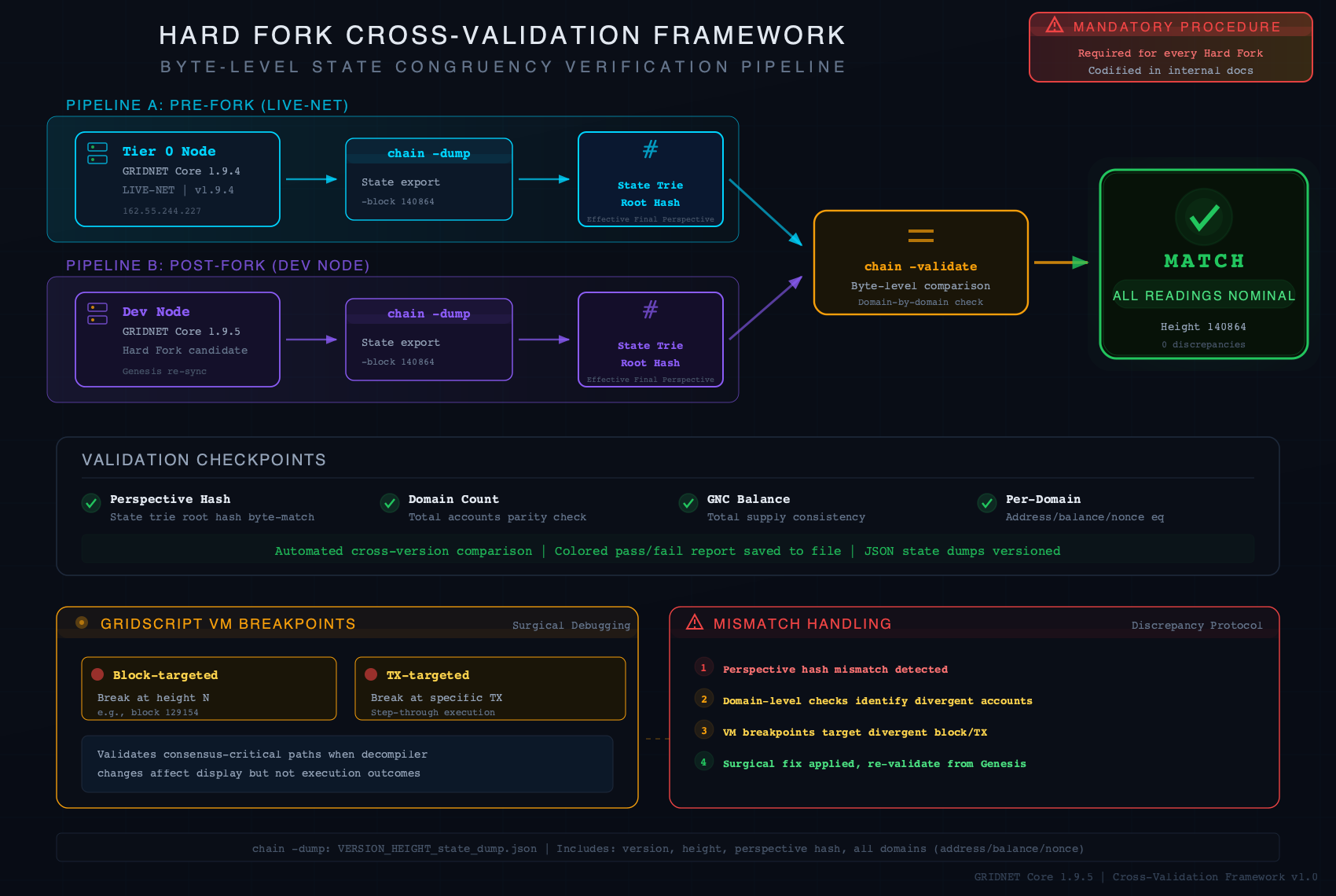
  • chain -dump — dumps the complete state of all domains at any blockchain height into a JSON file. Format: VERSION_HEIGHT_state_dump.json. Includes core version, blockchain height, state perspective hash, total domains, total GNC balance, and a sorted array of all domains with address, balance, and nonce.
  • chain -validate — loads dumps from different GRIDNET Core versions and performs automated cross-version comparison. Validates perspective match, total domain count, total GNC balance, and domain-by-domain address existence and balance equality. Outputs a colored pass/fail report.

The validation was performed on Tier 0 infrastructure: an AI agent created an SVN branch, back-ported the dump/validate commands to GRIDNET Core 1.9.4 (the current Live-Net version), compiled it, and deployed it to Tier 0 node 162.55.244.227. State was dumped at blockchain height 140864.

Result: ALL READINGS NOMINAL. Complete domain/balance/nonce consistency between GRIDNET Core 1.9.4 (Live-Net) and 1.9.5 (hard fork candidate).

This procedure is now mandatory for every future Hard Fork.


Blockchain Explorer Enhancements

The Blockchain Explorer started its life as an experimental prototype — a way to peek into on-chain data while the real infrastructure was being built. With this release, the experiment is over. The new on-chain metadata system introduced in 1.9.5 opened up possibilities that the original explorer was never designed to handle, so the team rebuilt it into something worthy of being the primary window into GRIDNET’s blockchain.

  • Renamed from “Experimental Blockchain Explorer” to “Blockchain Explorer”
  • Transaction-type filtering — instant search by type (identity deployments, sacrifices, token pool registrations, off-chain cash-outs) using the new metadata system
  • SVG action icons — visual transaction type indicators
  • View traversal — tapping Block ID navigates to block details, tapping Miner ID navigates to miner details
  • Professional context menus — right-click with options to jump to issuer/block/recipient, copy any field, with glossy icon animations and cyberpunk scan-line effects
  • GLink sharing — one-click URL generation to share specific transactions or blocks
  • 3D animated transaction details — with foldable sections

Liquidius Maximus — In-House Market Making Engine
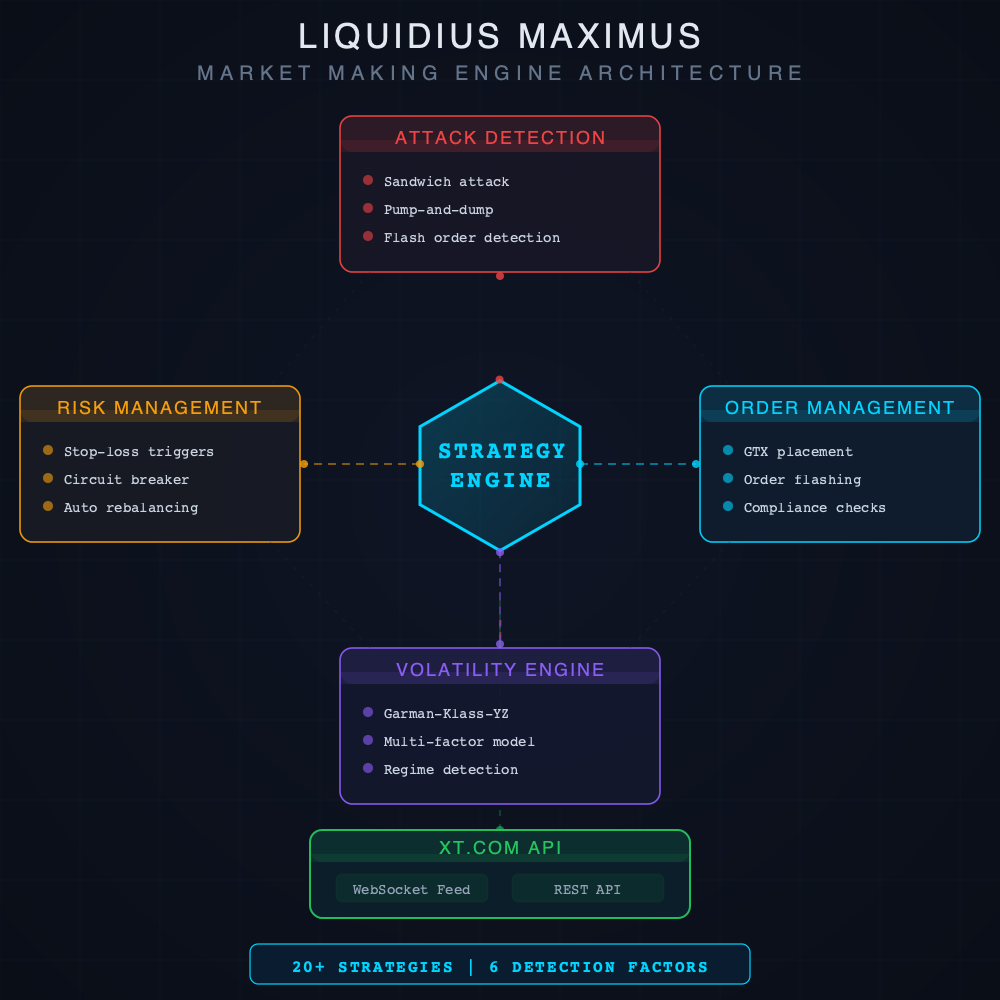
A comprehensive Python-based high-frequency trading and market-making platform was developed from the ground up to provide liquidity for the GNC/USDT pair on Xt.com. What began as a basic spread-maintenance tool evolved over six months into a sophisticated multi-strategy engine with real-time attack detection, autonomous defense mechanisms, and advanced volatility modeling.

Open Source Commitment — Following the decision to terminate cooperation with Xt.com due to their predatory market practices (see Exchange Interaction & Market Integrity below), the GRIDNET project has committed to releasing the entire Liquidius Maximus platform as open source. The codebase — including all trading strategies, attack detection algorithms, volatility models, compliance mechanisms, and the Qt6 profiling/visualization tooling — will be made publicly available, enabling the broader community to audit, extend, and deploy the engine on any exchange. This represents one of the most comprehensive open-source market-making platforms ever released, encompassing over six months of continuous development streamed publicly on YouTube LIVE.

The scope of what was built here deserves a moment of context. Market making on a centralized exchange — especially for a low-liquidity pair on an exchange that, as we later discovered, was actively working against us — is not a problem you solve with a single algorithm. It is an arms race. Every strategy we deployed was met with new forms of hostile behavior, which demanded new detection systems, which revealed new attack vectors, which required new defenses. The result is a platform that grew organically from necessity, each component forged in response to a real, observed threat. Every feature listed below exists because something on the other side of the order book forced us to build it.

  • Multi-Strategy Architecture — over 20 market-making strategies ranging from basic symmetric spread placement and inventory balancing through to advanced approaches employing fractal-based support/resistance level detection, volatility-based positioning, market trend following, and AI/regression-aided spread optimization with dynamic repositioning based on market velocity and direction.
  • Custom Qt6 Performance Profiler — in-house Python profiling and visualization engine featuring interactive flame charts with nested call-relationship preservation, pie-chart time-distribution views, hover-based legends, and panning/scaling controls. Used to pinpoint SSL/TLS transport overhead as the dominant latency factor and eliminate mutex congestion bottlenecks (reducing lock contention from 200ms to sub-millisecond). This tool was not planned from the start — it was built because we needed to understand why certain operations were orders of magnitude slower than they should have been, and no existing profiler gave us the granularity we needed.
  • Sandwich & Pump-and-Dump Detection Engine — multi-signal attack detection system using six heuristic factors: rapid pump detection, volume spike analysis, price velocity measurement, order book thickness assessment, spread anomaly detection, and order book imbalance scoring. Composite confidence scores classify attack severity into tiered categories with autonomous mitigation: halting buy-side requoting, calculating precise GNC dump quantities, executing neutralization orders, and restricting order placement during cooldown.
  • Self-Learning Defense Adaptation — the sandwich-attack recognition module autonomously improves its detection parameters based on collected data and past mitigation outcomes, with detected events enqueued for global statistical analysis and parameter adjustment. In practice, this means the system gets harder to exploit with every attack it observes.
  • Garman-Klass-Yang-Zhang Volatility Estimation — advanced multi-factor volatility calculation incorporating exponentially-weighted realized volatility, active-period filtering, jump-component analysis for high-frequency attacks, microstructure noise estimation, and gap-risk assessment. Combines 1-minute and 1-hour kline data using mathematical fusion techniques.
  • Flashing Order Book Module — multi-threaded flashing-order-book sub-system with configurable per-order appearance and disappearance intervals, autonomous market-movement sensing for safety cancellation, and anti-flash order detection for hostile buy-side depth manipulation.
  • Internal Simulation Engine — advanced simulation engine for simulated order matchmaking, enabling offline evaluation and AI-aided analysis of all trading strategies prior to live deployment. Every strategy runs through this simulator before it touches real capital — a discipline that saved us from deploying approaches that looked promising in theory but would have hemorrhaged funds in the adversarial conditions we were operating in.
  • Private WebSocket Low-Latency Feed — dedicated private WebSocket communication link to Xt.com for real-time order, trade, and balance-change notifications with bootstrap via RESTful historical backfill.
  • GTX (Post-Only) Order Placement — switched from GTC to GTX mode, guaranteeing orders cannot be filled at placement time, enabling precise measurement of placement-to-execution delay for forensic detection of hostile front-running. This seemingly small change proved to be one of the most important forensic decisions in the entire project — by ensuring our orders could never be immediately filled, we created a clean measurement baseline that made front-running activity unambiguously detectable.
  • Idempotent & Stateless Compliance Architecture — all compliance algorithms (spread assurance, price-gap mitigation, near-depth/total-depth assurance) designed to be both idempotent and stateless, independently toggleable via UI for compartmentalized evaluation.
  • Dense Price-Gap Mitigation — optional mode structuring the first 20 orders on both sides as tightly as possible near best bid/ask, minimizing price fluctuation in illiquid conditions.
  • Stop-Loss, Rebalancing & Circuit Breaker — dual-mode rebalancing (market acquisition vs. self-wash-trading for illiquid conditions), configurable circuit-breaker thresholds, and persistent risk-management configuration.
  • Comprehensive Report Generation — CSV, JSON, and PDF export with sortable/filterable order-history views featuring autonomous safety-score assessment based on fill latency.

Network Connection Management
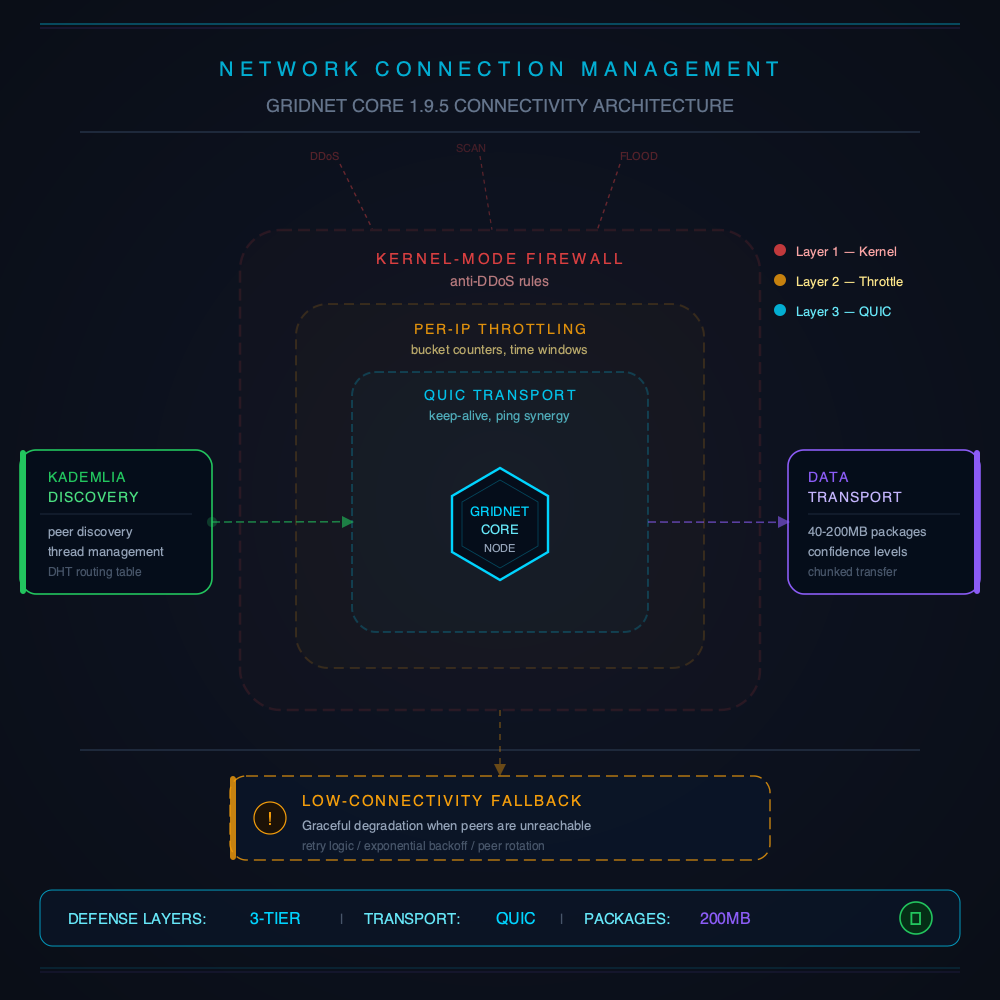
A decentralized network is only as strong as its ability to maintain connections under adversarial conditions. In the real world, GRIDNET Core nodes face everything from aggressive peers attempting to exhaust connection slots, to DDoS attacks aimed at isolating nodes from the network, to the quieter but equally damaging problem of NAT traversal failures and packet loss on mobile networks. This release represents a comprehensive hardening of the connection management layer — the result of observing how the network behaves under genuine stress on Live-Net and systematically closing every weakness we found.

  • Per-IP Connection Throttling — connection management revised with per-protocol-type bucket counters on incoming connection attempts, hardware resource availability verification, and time-window-based throttling to prevent connection exhaustion from aggressive peers.
  • Low-Connectivity Fallback Mode — fallback mechanism that activates when peer connectivity drops below acceptable thresholds, temporarily relaxing per-IP connection windows to allow re-establishment of network presence. The reasoning here is straightforward: when you are nearly disconnected from the network, accepting connections you would normally throttle is better than remaining isolated.
  • Autonomous Kernel-Mode Firewall Integration — anti-DDoS mechanics tightened with improved integration with Windows kernel-mode firewall rules, including proper timestamp comparison fixes and synchronization cleanup for firewall rule lifecycle management.
  • Kademlia Thread Management — improved thread management around the Kademlia peer discovery protocol, including proper cleanup of discovery threads and fixes for timestamp comparison inaccuracies.
  • QUIC Transport Layer Keep-Alive Tuning — QUIC keep-alive intervals adjusted to better cope with selective routers, with the beneficial side effect of improving mobile application connectivity. Some routers aggressively drop QUIC sessions that appear idle — tuning the keep-alive cadence keeps these connections alive without generating excessive overhead.
  • Application-Layer & Transport-Layer Ping Synergy — data exchange mechanics adjusted to benefit from both application-layer and QUIC transport-layer ping-alive mechanics, yielding more stable connections in networks with massive packet loss or behind NATs.
  • Maximum Data Package Size Extension — maximum data package size extended from 40 MB to 200 MB to accommodate growing blockchain length during Genesis-to-head synchronization. As the chain grows, so does the data volume required to bring a new node up to speed — this five-fold increase ensures that synchronization remains viable as the blockchain matures.
  • Block Availability Confidence Levels — boolean block-availability checks replaced with confidence-level assessments, accounting for scenarios where a remote node advertises a leading block whose chain-proof has not yet been locally verified. This is a subtle but important change: the old binary model — “the block exists or it does not” — could not express the nuance of “the block has been announced but not yet proven,” which led to unnecessary re-fetches and synchronization stalls.

Exchange Interaction & Market Integrity

What follows is a factual record of our experience operating on Xt.com, documented through months of forensic data collection by the Liquidius Maximus platform. We present these findings not with anger but with the precision they deserve — because the evidence speaks for itself, and because other projects listing on centralized exchanges need to know what they may be walking into.

  • Xt.com API Anomaly Investigation — investigated and documented multiple anomalous behaviors from Xt.com: CloudFront 403 rejections below documented API limits, unexplained order cancellations with no reason given, and suspected exchange-side front-running. Market services halted upon detecting unusual behavior, with forensic analysis and detailed evidence reported to Xt.com.
  • Exchange Compliance Feasibility Assessment — multi-week evaluation of feasibility of upholding market-making requirements on Xt.com GNC/USDT pair, assessing order rejection patterns and volume assurance failures.
  • Volume Assurance & Anti-Front-Running — ACID self-trade volume assurance with hysteresis-based stability checks: SELL LIMIT orders placed first (GTX), verified stable for ~2 seconds against hostile bot consumption, then consumed if untouched. Detected and documented front-running events (12.5 USDT in 9 hours of operation).
  • Systematic Exchange-Side Front-Running & Market Manipulation — forensic analysis conducted over multiple months revealed a persistent pattern of exchange-side predatory behavior by Xt.com that had been ongoing since the GNC token listing. Evidence collected by the Liquidius Maximus profiling and detection systems documented: (1) consistent front-running of placed orders with sub-millisecond reaction times achievable only with exchange-side order-book visibility, (2) coordinated pump-and-dump cycles targeting GNC liquidity, and (3) API throttling and order rejection patterns that selectively disadvantaged the market maker while permitting hostile bot activity. The totality of evidence points to Xt.com operating in direct conflict with the interests of listed projects.
  • Termination of Xt.com Cooperation & Legal Action — based on the accumulated forensic evidence of predatory market practices, the GRIDNET project made the decision to terminate all cooperation with Xt.com. Legal proceedings are being prepared to address the documented market manipulation. A budget exceeding 1,000,000 USDT has been allocated for cross-chain integration with Hyperliquid, a decentralized exchange where order matching occurs on-chain without the possibility of exchange-side front-running. The entire Liquidius Maximus market-making engine will be open-sourced as part of this transition.

Xt.com Exchange — Forensic Investigation & Warning to Listed Projects

What follows is one of the most difficult sections we have ever had to write. Not because the evidence was hard to find — it was overwhelming — but because we did not want to believe what it was telling us.

When GRIDNET first listed GNC on Xt.com in April 2025, the team approached the partnership with genuine optimism. This was our first major exchange listing. We had spent weeks preparing the integration, invested over 35,000 USDT in listing and integration fees alone, and built an in-house market-making engine — Liquidius Maximus — from the ground up to provide fair, transparent liquidity for the GNC/USDT pair. Every line of its development was streamed publicly on YouTube LIVE, for the world to see.

We wanted it to work. We wanted Xt.com to be what it presented itself as — a reputable top-20 exchange where our token could find genuine price discovery and where our community could trade with confidence. For months, every time the data pointed toward something disturbing, we looked for alternative explanations. Every anomalous fill, every suspicious timing pattern, every inexplicable order cancellation — we asked ourselves: Could this be a bug in our code? Could this be a legitimate trader? Could there be an innocent explanation?

We built measurement tools. We built forensic profilers. We built fill-latency analyzers, sandwich-attack detectors, pump-and-dump classifiers, order-book manipulation sensors, and front-running counters. We did not build these tools because we wanted to find wrongdoing — we built them because we needed to understand what was happening to our market-making accounts, which were hemorrhaging assets at rates that defied every model we could construct.

And at every stage, the mathematics led to the same conclusion. The measurements pointed in one direction. The statistics permitted no alternative interpretation. Xt.com was not merely failing to protect the GNC listing — entities operating with exchange-level access to the order book were systematically extracting value from our market-making operations through front-running, pump-and-dump cycles, and interception of orders that should have been physically impossible for any external party to reach.

We say this with the weight of over six months of continuous forensic data collection, hundreds of thousands of logged events, and the professional judgment of developers who spent the majority of that period — what should have been spent on GRIDNET Core development — instead building increasingly sophisticated detection and defense mechanisms just to survive on a single exchange.

The Forensic Toolchain Built into Liquidius Maximus

The overwhelming majority of Liquidius Maximus development time was ultimately spent not on market-making strategies, but on building forensic instrumentation to understand, document, and defend against hostile activity. What began as a market-making engine evolved into what may be one of the most comprehensive exchange-forensics platforms ever built by a listed project. The forensic capabilities include:

  • Fill-Latency Measurement System — every order placed on Xt.com was timestamped at placement and again at first fill notification. The delta between these timestamps, using Xt.com’s own API-reported values (not our local clock), formed the evidentiary basis for proving physically impossible fill speeds. Orders were autonomously classified by safety score based on fill latency.
  • GTX (Post-Only) Forensic Mode — all orders switched from GTC to GTX placement mode, which the exchange guarantees will not fill at placement time. This eliminated the possibility that anomalous fills were artifacts of immediate matching, and enabled precise measurement of placement-to-first-fill delay for every order.
  • Flashing Order Book with Randomized Timing — orders were displayed for configurable intervals (as low as 50ms) and hidden for longer periods (700–1200ms), with 30% random variance applied to both show and hide durations. This created a statistically testable framework: any entity achieving 100% snipe accuracy on randomized-timing orders with zero misses was, by definition, operating with advance knowledge of order placement.
  • Sandwich & Pump-and-Dump Detection Engine — a six-factor heuristic system computing composite confidence scores from rapid pump detection, volume spike analysis, price velocity measurement, order book thickness assessment, spread anomaly detection, and order book imbalance scoring. Attack events were classified into severity tiers with autonomous mitigation: halting buy-side requoting, calculating precise dump quantities, and executing neutralization orders.
  • MarketPressureSensor — real-time estimation of hostile bot GNC holdings at any given moment, including dump timing prediction based on observed accumulation patterns.
  • ACID Self-Trade Monitor — a dedicated subsystem tracking the integrity of self-trade compliance orders. Every self-trade attempt was logged with: (a) timestamp of SELL LIMIT placement, (b) stability check duration, (c) whether the order survived to Phase 2, (d) whether the matching BUY executed successfully, and (e) if intercepted, the fill latency and quantity taken by the hostile entity. A front-running counter tracked every interception event.
  • Match Explorer — forensic order-to-trade correlation tool enabling precise identification of which public trades matched which private orders, with timestamp comparison across Xt.com’s public and private API feeds.
  • Comprehensive Report Generation — CSV, JSON, and PDF export with sortable/filterable order-history views, autonomous safety-score assessment, and complete trading history documentation. One such automated report covering the full GNC/USDT trading history at Xt.com is attached to this release.

Chronological Timeline of Key Forensic Findings

The following timeline documents the progression from initial suspicion to mathematical certainty. All timestamps are derived from contemporaneous development logs maintained in the LIVE-DEVELOPMENT Discord channel and corroborated by YouTube LIVE recordings.

April–May 2025 — Infrastructure Attacks Coincide with Listing

The hostile activity began before the first trade was even placed. On the same day the Xt.com listing timeline was announced (April 8), GRIDNET nodes came under targeted attack using deliberately malformed GridScript payloads. The Emergency Response Team was activated on April 9 when coordinated attacks hit multiple nodes. Attacks resumed on April 14 — three days before the expected listing go-live date — specifically targeting the metadata generation system that exchanges depend on for transaction processing. On May 6, a network black-hole attack capable of isolating nodes was discovered, and on May 21, a live Kademlia exploit using spoofed ICMP messages was detected (source IP: 2.27.211.165). By May 22, the development team was openly referring to the attackers as “enemies.”

May 12, 2025 — First Market Manipulation Evidence

The Emergency Response Team was activated to investigate a suspected attack designed to manipulate market-making services by injecting transactions with extremely small values near the mid-price. This forced the creation of an entirely new distinction between “Real Spread” and “Reported Spread” — the micro-orders were distorting the apparent spread to mislead the market-making algorithms. The development team documented “ongoing attempts to disrupt its operations” with “extremely small volumes right next to current mid-price” on the Xt.com GNC/USDT pair.

July 5, 2025 — Sandwich Attacks Confirmed on Xt.com

First explicit documentation of hostile bot activity: sandwich attacks and pump-and-dump operations targeting GNC market-making services. The attacks were sophisticated enough to require AI-based self-learning countermeasures.

July 9, 2025 — Xt.com’s Own Rules Enable the Exploitation

A critical realization: “The market making rules enforced by XT literally create a perfect environment for bot operators.” The requirement to maintain order book depth on both sides of the market at all times forced the market maker to constantly expose buy-side liquidity, which hostile bots then systematically exploited through pump-and-dump cycles.

July 12, 2025 — $400 USDT Loss per 15 Minutes Documented

Financial losses reached $400 USDT per 15 minutes ($1,600/hour) due to hostile bot activity causing 50% price waves. The hostile bots had not been deactivated — their amplitude had increased.

July 15, 2025 — The Exchange Itself Suspected

The first direct statement of what the data had been suggesting: “That is under the assumption that the attacker / bot operator is not the exchange itself (thus having access to information at no time delays and capable of acting at no time delays).” The team’s defense strategy worked against any external attacker — but not against an entity with zero-latency access to the order book.

July 30, 2025 — “Should a Project Require PhD-Level HFT Specialists?”

After weeks of building military-grade defenses, the team posed the question that captured the absurdity of the situation: “Should a project require PHD level high frequency trading specialists and developers to defend itself when entering a market?” The hostile conditions on Xt.com were so extreme that ordinary market-making services ($2–3K/month) would have been completely unable to survive.

August 3, 2025 — API Rate Limiting Below Documented Thresholds

CloudFront 403 rejections began occurring well below Xt.com’s documented API limits, selectively disadvantaging the market maker. For a market maker, having order placement blocked while existing orders remain live creates catastrophic exposure.

August 21, 2025 — The 70ms Fill: Physical Impossibility Proven

The forensic measurement system captured the evidence that would prove exchange-level access beyond reasonable doubt. A SELL limit order was filled within 70 milliseconds of placement — and that was not us who filled it. At 70ms, this fill occurred faster than Xt.com’s own WebSocket could disseminate order information to external parties. The team’s own software, placing an order and immediately filling it within the same function, could not achieve better than 120–170ms. A 70ms fill by an external party was, in the team’s words, a physical impossibility: “THERE IS NO OTHER POSSIBILITY.”

August 24–25, 2025 — 100,000 GNC Evaporated in 24 Hours

During a comprehensive live test with all protections active (orders flashed for 50ms, hidden for 700ms), approximately 100,000 GNC evaporated from market-making accounts in less than 24 hours. 39,000 GNC were lost in the first 1 hour and 26 minutes alone. Orders were being sniped at 90–300ms. Xt.com had previously claimed that only GRIDNET had API access to the GNC pair and that these were “human traders using the user interface” — at 150ms fill speeds.

September 18, 2025 — Self-Trade Front-Running: The Smoking Gun

The ACID self-trade mechanism — designed to place a SELL LIMIT order and then immediately fill it with a matching BUY to maintain volume compliance — was directly intercepted. A volume compliance SELL order was placed; 53% of it was filled by an unknown entity before the next line of Python code could execute the matching MARKET BUY. The system’s stability check caught it: “the order was filled SOONER than our software managed to fill it on its own few lines later… it is all rigged as FUCK.” The hostile entity then dumped the accumulated GNC, confirming the accumulate-and-dump pattern.

September 22, 2025 — 100% Snipe Accuracy on Randomized Orders

Orders configured with randomized timing (200ms show ± 30% variance, 1200ms hide ± 30% variance) were being sniped at 100% accuracy with zero misses, on a trading pair with virtually no other activity. This statistical impossibility — achieving perfect accuracy against randomized parameters with no background noise — constitutes near-certain proof of advance knowledge of order placement timing and parameters. Xt.com’s position: “these are all human traders.”

September 28, 2025 — Front-Running Counter Implemented

The development team built a dedicated front-running counter to track every interception event: "so that we know exactly how many times they’ve attempted to f** us."* The team explicitly concluded: “hostile bot is having privileged access to information (as it seems it does).” The self-trade mechanism was upgraded from MARKET to LIMIT orders in Phase 2 to prevent buying at front-runner-inflated prices.

September 30, 2025 — Even Atomic Batch Orders Compromised

In a final attempt to achieve atomicity, both sides of the self-trade were submitted as a single batch API call, expecting the exchange’s internal matching engine to process them as an atomic unit. The result: “believe it or not — even under these extreme conditions — the Xt.com internal order matching engine managed to mangle with 7 out of 117 self-trade attempts.” Even with spread assurance disabled and only atomic batch self-trades running, approximately $20 was extracted over 2 hours. The 1–10ms fill times on these orders were achievable only by an entity co-located with or operating within the matching engine itself.

October 7, 2025 — Exchange Cancels Orders Without Explanation

Xt.com unilaterally cancelled both sides of an ACID self-trade pair without providing any reason. In a separate 9-hour monitoring session: “there was only one event when Xt.com chose to front run one of our orders for 12.5 USDT” — note the attribution directly to Xt.com, not to a third party.

November 2025–February 2026 — Cessation and Migration

By November 2025, Xt.com was openly referred to as a hostile adversary. By December, the strategic decision was made to migrate to Hyperliquid, a decentralized exchange where order matching occurs on-chain — "where all those f*** cannot get us."* By January 2026, the assessment was final: Xt.com was described as a “scammy exchange” and the GNC price as drifting “at the bottoms of oblivion” — a price that the totality of evidence suggests was never a reflection of genuine market dynamics.

The ACID Self-Trade: How Exchange-Internal Front-Running Was Proven

The ACID (Atomicity, Consistency, Isolation, Durability) self-trade mechanism deserves detailed explanation, as it represents both the most sophisticated compliance tool built into Liquidius Maximus and the mechanism through which exchange-level front-running was conclusively proven.

Purpose: Xt.com’s listing agreement required minimum 24-hour trading volume and daily transaction counts. In the absence of organic trading activity (which was virtually nonexistent on the GNC pair beyond the hostile bot), Liquidius Maximus maintained compliance by trading with itself — placing coordinated buy and sell orders that would match each other.

Phase 1 (Pre-September 2025): A SELL LIMIT order was placed in GTX (post-only) mode. The system then waited approximately 2 seconds, verifying the order remained untouched — a stability check against hostile consumption. If stable, a matching MARKET BUY was executed to consume it. This had a known race condition: the hostile entity could intercept the SELL order during the stability window.

Phase 2 (Late September 2025): After documenting persistent front-running of Phase 1, the matching order was changed from MARKET to LIMIT — specifying exact price and quantity so that if the original SELL was no longer there (consumed by the front-runner), the LIMIT BUY would simply not execute, avoiding purchase at an inflated price.

Phase 3 (Late September–October 2025): Both orders were submitted as a single batch API call — an ephemeral SELL in GTX mode and a matching BUY in GTC mode — expecting the exchange’s internal matching engine to process them atomically. Even this was compromised: 7 of 117 attempts (6%) were interfered with at the matching engine level.

The Evidence Chain:

  1. Orders filled at 70ms when the API round-trip minimum was 120–170ms — physically impossible for any external party
  2. 100% snipe accuracy on orders with randomized 200ms/1200ms timing with zero misses — statistically impossible without pre-knowledge
  3. Self-trade SELL orders filled before the matching BUY could execute in the next line of Python code — direct interception
  4. Atomic batch self-trades compromised at the matching engine level — can only occur exchange-internally
  5. No trading activity without market-making enabled; instant hostile activity upon resumption — real-time awareness of market-maker state
  6. Xt.com claiming only GRIDNET had API access — if true, the hostile entity can only be exchange-internal
  7. Xt.com cancelling order pairs without explanation — direct exchange intervention

Financial Damages

Category Amount Source Date
Integration & listing fees 35,000 USDT April 2025
Total listing costs (incl. MM fees) 100,000 USDT September 2025
Liquidius Maximus development costs 350,000+ USDT April–October 2025
GNC balance drain (single test) 39,000 GNC in 1h 26min August 24, 2025
GNC evaporated (24-hour period) ~100,000 GNC August 25, 2025
Documented loss rate $400 USDT per 15 minutes July 12, 2025
Micro-theft under atomic mode ~$20 per 2 hours September 30, 2025

The total financial impact exceeds 450,000 USDT in direct costs — integration fees that purchased access to a hostile trading environment, and six months of intensive software development that should never have been necessary.

Warning to Other Projects Considering Xt.com

We publish this forensic record not merely for our own documentation but as a warning to other blockchain projects, token teams, and market makers. The pattern we documented — where a project invests significant capital in listing fees only to discover that far more is subsequently lost through predatory exchange-side activity draining market-making accounts — may not be unique to GRIDNET.

Projects that raise funds for exchange integration with Xt.com should be aware that:

  • Our 35,000 USDT in integration fees purchased access to a trading environment where entities operating with apparent exchange-level access systematically extracted value from our market-making operations
  • The financial losses from predatory activity vastly exceeded the initial listing investment — what was spent on integration fees was dwarfed by what was effectively stolen from our market-making accounts through front-running, pump-and-dump cycles, and order interception
  • Xt.com’s market-making requirements (maintaining both-side order book depth at all times) structurally enable exploitation by creating permanent liquidity targets that hostile actors can drain
  • Formal complaints filed with Xt.com were either ignored or met with explanations (e.g., “human traders using the user interface”) that were physically contradicted by measured fill latencies
  • The hostile activity was present from the first day of listing and persisted throughout the entire period of cooperation
  • The level of technical sophistication required to merely survive on the exchange — PhD-level high-frequency trading expertise, custom forensic tooling, AI-based attack detection — is far beyond what any ordinary listed project or third-party market maker could reasonably provide

We ceased all cooperation with Xt.com and disabled all market making on the GNC pair. Legal proceedings are being prepared. The entire Liquidius Maximus codebase, including all forensic tooling, will be released as open source — so that any project can deploy the same measurement and detection capabilities we built and verify exchange behavior for themselves. A full automated trading history report generated by Liquidius Maximus covering the complete GNC/USDT trading history at Xt.com is attached to this release, documenting every order, every fill, every anomalous event.

The GRIDNET project has allocated a budget exceeding 1,000,000 USDT for cross-chain integration with Hyperliquid, a decentralized exchange where order matching occurs transparently on-chain — where the kind of exchange-internal manipulation documented here is structurally impossible.


Final Polishing

  • Improved UI element positioning across all responsive breakpoints
  • Dynamic scroll behavior for sub-identity tiles (maximum two rows visible)
  • Transaction details view with foldable Source Code and Details panes
  • Rate limiting for UI notifications
  • Proper handling of virgin identity notifications
  • Front-running detection improvements in market making software components
  • Triple-ring cyberpunk loading animation with central lightning bolt
  • Nickname input field dark-theme fix (resolved white background on focus)
  • Sacrifice transaction polling fix (status codes 100-199 now correctly recognized as pending)
  • Scrollbar styling aligned with cyberpunk theme
  • Fork-out metadata cache bug fix preventing false “Forked Out” transaction reports

Detailed Development Log

The following table provides a day-by-day account of development activity as documented in the LIVE-DEVELOPMENT Discord channel. All work was conducted transparently, with the vast majority streamed on YouTube LIVE.

Date Development Focus Details
2025-04-08 Crash Dump Analysis & LARS Integration - YouTube LIVE session investigating a crash report provided by an Operator – data analysis revealed general memory corruption where an 'ization is stuck' string overwrote a Merkle Patricia Trie memory entry. - The setPerspective stack frame was found overwritten; surrounding memory regions remained intact, making the corruption pattern suspicious – ultimately traced to GRIDNET Core’s own integrity check raising a system Panic. - Automated code analysis revealed no direct issues; investigation concluded noting the unusual nature of a mid-variable overwrite without adjacent memory damage. - Separately, improved implementation of net -connections to address high connection volumes on Tier 0 nodes – issue mitigated. - Major milestone: LARS service enabled to autonomously download and install the latest version of GRIDNET Core – demonstrated working alongside Core on YouTube LIVE. - Updated the GRIDNET Core Installer to deploy LARS alongside Core through a unified GRIDNET OS Installer, including a desktop shortcut for LARS. - LARS-generated crash dumps confirmed processable by Visual Studio. - Announced expected completion of Xt.com exchange integration by April 17. Screenshots shared (20+ CDN images).
2025-04-09 Attack Vector Discovery & Emergency Hotfix - YouTube LIVE session investigating over 10 crash reports provided by LARS – crashes during meta-data generation caused by the Boost library encountering unexpected characters from deliberately malformed GridScript instruction sequences. - The meta-data engine was passing invalid data to the numerical interpretation engine, resulting in system Panic. - Identified and neutralized a new attack vector: GRIDNET Core made immune within hours by hardening input validation in the meta-data engine and GridScript VM internals. - Emergency Response Team deployed to locate similar attack surfaces – found and sanitized vulnerabilities in the Decentralized Terminal Interface implementation and BigInt instantiation (sign prefix handling). - OpenCL crash reports analyzed – determined that compiled OpenCL kernel binaries cannot be copied across nodes even with similar GPUs. - Hot-fix deployed; all adjacent attack surfaces neutralized. Screenshots shared (25+ CDN images).
2025-04-09 (cont.) LARS Auto-Update Development & Tier 0 Deployment - YouTube LIVE sessions focused on incorporating automatic update functionality into LARS: added RESTful helper methods, version comparison logic, and current version fetching from bootstrap nodes. - Incorporated autonomous functionality to disengage the global JIT Debugger if detected, and helper methods to mitigate WER (Windows Error Reporting) mechanics. - Validated the getVersion RESTful API method; deployment to Tier 0 nodes initially put on hold by Quality Assurance for additional validation. - Enabled communication between GRIDNET Core and LARS – incorporated helper methods for LARS to retrieve the local Core version and compare against network version. - Updated methods writing state information to statistical files. Screenshots shared (15+ CDN images).
2025-04-10 LARS Autonomous Update Pipeline Development - YouTube LIVE session building the full LARS auto-update pipeline: checking new version from bootstrap nodes, comparing against local version, terminating Core, downloading and unpacking new version, installing via silent MSI execution, suppressing crash dumps during the process, and relaunching Core. - Developed improved uninstallation strategy using MsiEnumRelatedProductsW to enumerate installed products by UpgradeCode, iterate through ProductCodes, and perform clean installs. - Imported required Microsoft MSI static libraries for programmatic installer control. - ProcDump monitoring by Sysinternals is disengaged during the update process. - Discovered a self-update challenge: since the Core installer bundles LARS, the running LARS executable cannot be replaced due to handle lock – solved by leveraging the Windows behavior (unchanged since Windows 3.11) that allows renaming a running executable. - LARS triple-checks disengagement of both JIT and WER mechanics before proceeding with updates. - All auto-update logic implemented and validated on YouTube LIVE. Screenshots shared (20+ CDN images).
2025-04-11 LARS MSI Extension & Self-Update Orchestration - YouTube LIVE sessions evaluating LARS as part of the GRIDNET Core installer bundle. - Successfully overrode default MSIEXEC uninstaller behavior, preventing LARS from being shut down during silent uninstallation – LARS remains active in memory while its own executable is removed from disk, then gets reinstalled. - Extended the LARS project with a custom DLL extension to Microsoft Installer (MSI) that launches LARS microseconds after Core installation completes. - Mitigated an issue where the MSI extension launched LARS as the SYSTEM user instead of the active user – implemented a multi-fallback strategy: (1) manipulate permission token via WTSQueryUserToken, (2) schedule a task for next login and immediate execution, (3) add a RunOnce registry entry. - Preparing LARS for advanced monitoring of Core parameters including blockchain height stall detection and scheduled restarts. - Validated version checks at scheduled 5-minute intervals. - Incorporated support for extrinsic dynamic version change detection. Screenshots shared (15+ CDN images).
2025-04-12 LARS Pre-Release Validation & Edge Case Testing - YouTube LIVE session evaluating the upcoming LARS release through extensive edge case testing. - Implemented singleton instance enforcement – LARS autonomously terminates other instances upon startup. - Incorporated in-house overrides to Win32 API TerminateProcess with advanced fallback methods if the standard call fails. - Added storage space validation: LARS checks available disk space before proceeding with automatic updates and waits for additional space if insufficient. - Executed a sequence of 10 simulated auto-update manoeuvres to validate the full pipeline. - Ensured proper cleanup of crash dump temporary folders between consecutive LARS invocations. - During bootstrap, LARS now detects and terminates any running Sysinternals ProcDump instances. - LARS employs 3 alternative process termination methods, evaluating results of each before selecting further termination payloads. Screenshots shared (25+ CDN images).
2025-04-13 Automated LARS Report Processing Utilities - Implemented internal backend utilities for automatic segregation and processing of crash reports provided by LARS. - Developed filtering mechanisms to detect and handle false/spam reports submitted to the reporting infrastructure. Screenshots shared (1 CDN image).
2025-04-14 MSI Installer Elevation Fix & Attack Surface Mitigation - Investigated installation failures reported by multiple Operators – MSI Error 1603 (ERROR_INSTALL_FAILURE) traced to the custom MSI DLL extension failing when the installer was not run as Administrator. - Root cause: WTSQueryUserToken Win32 API requires an elevated security token in the calling process – the MSI installer running as SYSTEM account without elevation was insufficient despite SYSTEM’s higher privileges. - Implemented mitigation: the installer now silently returns SUCCESS when launched without elevation and notifies the Operator to launch LARS manually. - Improved logging during the installation process for better diagnostics. - Separately, reviewed automated LARS reports on YouTube LIVE – discovered that the prior mitigation for the GridScript meta-data attack vector was insufficient; transactions with malicious payloads still caused crashes during meta-data generation despite failing in-chain. - Incorporated revised helper methods for input validation; improved payload mitigation applied. - Prepared and deployed a hot-fix release build to Tier 0 nodes; LARS instances notified within 15 minutes. - Upgraded monitoring and cleanup mechanics for partial TUS files (growing to hundreds of gigabytes). Screenshots shared (20+ CDN images).
2025-04-15 Threat Model Revision & Key Chain Manager JavaScript API - Research Department revised Threat Models for the in-web-browser GRIDNET OS mechanics, addressing two key attack vectors: (1) malicious UI dApps capturing user private keys due to lack of within-same-tab data compartmentation in browsers, and (2) malicious nodes requesting signatures for arbitrary/faked GridScript code bundles. - YouTube LIVE session introducing the Key Chain Manager JavaScript API – all functionalities of the KeyChain GridScript command exposed to the JavaScript realm. - Implemented password-gated access: even the GRIDNET OS in-web-browser sub-system cannot retrieve or detect the existence of key-chains without explicit user-provided password. - Overrode existing QR Authentication Intent processing logic for backwards compatibility; local key-chain availability triggers the JavaScript Key Chain Manager takeover. - Incorporated support for a new password UI data request type. - Improved asynchronicity and association between data requests and UI processes. Screenshots shared (15+ CDN images).
2025-04-15 (cont.) Wallet UI dApp Development & DOM Compartmentation - YouTube LIVE session on the upcoming Wallet UI dApp implementation – developed tabbing mechanics, dashboard tab with main Shadow-DOM components, and dynamically created content views. - Revised implementation to eliminate reliance on top-level DOM objects such as document, enabling proper UI dApp instance-specific compartmentation of logic and UI components. - UI team invited to participate in further development. Screenshots shared (10+ CDN images).
2025-04-16 Internal Development / Reduced Activity - No significant technical updates posted. Internal development work continued.
2025-04-17 State-Less Channels & Wallet UI dApp - YouTube LIVE session on new Wallet UI dApp development, focusing on State-Less Channels (off-chain payments) as per GRIDNET research. - The in-web-browser State-Less Channel sub-system receives unitary Transmission Tokens, each representing a certain amount of off-chain assets. - Data exchange occurs through the VM Meta-Data Exchange using BER encoded protocol. - State-Less Channel mechanics designed to be fully autonomous in the browser, with state synchronized against on-chain data every few seconds. Screenshots shared (6+ CDN images).
2025-04-18 Merkle Patricia Trie Synchronisation & Multi-Level Cache Fixes - YouTube LIVE sessions investigating LARS reports – focused on ensuring proper synchronisation of double-buffered Merkle Patricia Tries during multi-level cache meta-data updates. - Improved synchronisation guarantees during multi-level meta-data cache generation. - Applied a massive amount of synchronisation changes to Merkle Patricia Trie mechanics – proper bug discovery and software maintenance driven by LARS reports from Operators (not attack-related). - Improved in-code documentation quality. - Updates armed for Test-Net evaluation. Screenshots shared (10+ CDN images).
2025-04-19 Merkle Patricia Trie Copy Operations & Multi-Threaded Isolation - YouTube LIVE sessions incorporating further improvements to multi-tier meta-data synchronisation mechanics. - Test-Net with incorporated improvements successfully synchronized with latest height on Live-Net. - Performed automated AI-aided analysis of integrated changes. - Revised higher-level Merkle Patricia Trie copy operations – improved the copy constructor and isolation guarantees for multi-threaded operations on MPT-based database constructs. - Focus on ensuring separate underlying data structures when multiple threads operate on State-Domain (account) level MPTs. Screenshots shared (8+ CDN images).
2025-04-22 GRIDNET Basecamp Collaboration Platform - Extensive behind-the-scenes development and configuration work on internal collaboration sub-systems. - GRIDNET Basecamp online service now enables team members and cooperating parties to edit documents – including Microsoft Word documents – directly in the browser with nothing to install. Screenshots shared (1 CDN image).
2025-04-25 GRIDNET Basecamp Reporting & Project Incubation Tracking - Reviewed LARS reports. - GRIDNET Basecamp expanded with reporting facilities for influencers – published posts and YouTube videos can be reported with easy status transitions from reports to payouts. - Various user groups configured with differing permissions for report visibility and editing. - Full accountability of changes maintained at all times. - Project Incubation progress tracking added – community members will be able to vote on projects/hackathons, monitor ongoing work, and track sub-project reviews through to final financing in GNC. Screenshots shared (3+ CDN images).
2025-04-27 LARS Report Analysis & Race Condition Assessment - YouTube LIVE session investigating LARS reports and diagnostics data. - Identified memory corruption during multi-level meta-data cache preparation while traversing Merkle Patricia Tries. - Assessment: race condition – proceeding with further mitigation. Screenshots shared (4+ CDN images).
2025-04-28 Merkle Patricia Trie Thread Contention Investigation - YouTube LIVE session investigating further LARS reports – focused on internal Merkle Patricia Trie operations during the initial node bootstrapping sequence. - Discovered that multiple threads (up to 4) were simultaneously attempting to carry out meta-data cache updates – one thread throwing a memory read failure, typically indicating a race condition on MPT access. - Despite access being protected through mutexes and reverse counting semaphores, the simultaneous firing of multiple meta-data cache update threads was identified as suspicious and under continued investigation. Screenshots shared (5+ CDN images).
2025-05-02 Wizardly Trading Bot & getTX RESTful API Enhancement - Development of in-house Python-based high-frequency Wizardly Trading Bot showcased on YouTube LIVE, including Market Data Processing module review and demo mode evaluation. - Helper BAT script prepared for launching the trading bot. - Investigation of custom GridScript commands being broadcast to Xt.com exchange – Emergency Response Team assessed the situation. - Enhanced the getTX RESTful API method to optionally include mempool transaction information and high-level value transfer meta-data (recipient, sender, amount in both human-readable GNC denomination and BigInteger format), ensuring backwards compatibility. - Meta-data generation engine now parses value transfer GridScript instructions, distinguishing between GNC and atto units via binary bitfield (0 vs 1). - Third-party exchanges no longer need to parse decompiled GridScript source code for transaction interpretation. Screenshots shared (20+ CDN images).
2025-05-03 Liquidius Maximus Market Making – R&D & Strategy Review - In-house market making software Liquidius Maximus revised on YouTube LIVE, including demo mode evaluation. - Fixed a bug when switching to Strategy view in the trading application. - Trading strategy selection UI reviewed – strategies include Basic Spread, Inventory Balancing, Market Trend Following, and advanced customizable market making strategies employing resistance and support levels based on fractal analysis. - Introduced additional customizable advanced market making strategies into Liquidius Maximus. Screenshots shared (30+ CDN images).
2025-05-04 Liquidius Maximus – AI-Aided Strategy Analysis & UI Development - Continued Liquidius Maximus R&D on YouTube LIVE, focusing on underlying strategies and their logic rather than UI polish. - Employed automated AI tools for offline analysis and optimization of market making strategies. - Reviewed each trading strategy one-by-one: Basic Spread, Inventory Balancing, Market Trend Following, Volatility Based, and 16+ advanced strategies. - Revised helper method for identifying Support Levels and demonstrated sample implementation of advanced market making strategy using fractal analysis. - Detailed implementation of single advanced market making strategy shared, showing both basic and advanced strategy internals. Screenshots shared (60+ CDN images).
2025-05-05 Liquidius Maximus – Simulation Engine, API Rate Limiter & Order Mechanics - On YouTube LIVE, reviewed Liquidius Maximus internal processing of settings and arguments. - Incorporated additional visualization views for active trading operations and market making strategy analysis – moving vertical line symbolizes current market position. - Fixed manual orders’ selection and manipulation from UI. - Validated risk assessment logic. - Introduced API rate limiter into Liquidius Maximus. - Implemented an advanced internal simulation engine for simulated order match-making to evaluate automated market making strategies. - Revised and refined order placement mechanics across multiple epochs (Epoch 0, 1, 1+N). - Achieved buy order side formation with confidence level sensing, sell order spread formation, and basic symmetric spread-based market making. - AI and regression-aided spread positioning implemented with dynamic repositioning based on velocity and direction of market movement. Screenshots shared (30+ CDN images).
2025-05-06 Network Security Patch & Liquidius Maximus Live Deployment - Liquidius Maximus evaluated in simulated environment on YouTube LIVE. - Emergency Response Team analyzed LARS reports and Wireshark communication patterns from the recent 7-day period, pinpointing bottlenecks and potential attack surfaces. - Identified and patched a loophole allowing network black-hole attacks through excessive advertisement of chain-proofs, leading to node isolation. - Incorporated additional fail-safe mechanics and safety UI elements with HDD-persistent configuration into Liquidius Maximus. - AI-aided validation employed for all changes. - Improved candlestick rendering and zoom-toggling on GNC/USDT time-series charts. - Tightened integration with Xt.com APILiquidius Maximus placed its first market making order. - Transitioned from demo mode toward live evaluation. Screenshots shared (25+ CDN images).
2025-05-07 Liquidius Maximus – K-line Processing, PnL Tracking & UI Improvements - Liquidius Maximus taking its first live steps, observed on YouTube LIVE. - Improved transaction tracking for orders executed on behalf of Liquidius Maximus. - Enhanced market depth chart scaling and updates. - Improved processing of K-line data as exposed by Xt.com, including 24h volume calculation and transaction counting mechanics based on historical K-line data. - Improved rendering of diodes and visual state indicators in the UI. - Enhanced statistical data regarding performance of currently active trading strategy – full PnL charting based on historical data planned for future implementation. - Noted the sophistication of underlying trading algorithms to be steadily activated over upcoming months. Screenshots shared (15+ CDN images).
2025-05-08 Liquidius Maximus – Performance Profiling & K-line Data Processing - Reviewed data update mechanics in UI components of Liquidius Maximus on YouTube LIVE. - Focused on optimizing performance of high-frequency market operations. - Incorporated additional accountability and logging for performance analysis. - Profiled Liquidius Maximus for performance bottlenecks. - Vastly improved processing of K-line data as exposed by Xt.com – making the market making bot smarter with enhanced data interpretation. Screenshots shared (8+ CDN images).
2025-05-09 Liquidius Maximus – Continued Intelligence Refinements - Liquidius Maximus continued to be revised and refined on YouTube LIVE. - Ongoing intelligence improvements to market making decision logic. - Multiple iterations of strategy refinement documented through development sessions. Screenshots shared (6+ CDN images).
2025-05-10 Internal Development / Reduced Activity - No significant technical updates posted. Internal development work continued.
2025-05-11 Internal Development / Reduced Activity - No significant technical updates posted. Internal development work continued.
2025-05-12 LARS Diagnostics, Race Condition Fix & Block Sync Confidence Levels - Analyzed LARS diagnostic reports and analytics on YouTube LIVE. - Identified a classic race condition – two meta-data update threads launched simultaneously accessing the same Merkle Patricia Trie instance, confirmed via this pointer analysis. - Pin-pointed root cause: two concurrent controller threads being spawned for the same CTransactionManager object. - Revised thread startup management and improved synchronization on the meta-data update process by employing RAII management of synchronization constructs. - Emergency Response Team investigated suspected market manipulation attack via injection of transactions with very low values – incorporated concept of Real Spread vs Reported Spread to filter artificially low trading volumes from spread calculations. - Evaluated changes to GRIDNET Core after recent LARS diagnostic analysis – reviewed synchronization mechanics and on-remote-node data-block availability checks. - Introduced confidence levels for block availability assessment (replacing boolean values) to handle unverified chain-proof candidates. - Investigated Operator-reported issue on YouTube LIVE regarding block synchronization. Screenshots shared (20+ CDN images).
2025-05-13 LARS Crash Analysis, Connectivity Hardening & Market Making Compliance - Reviewed further LARS diagnostic data reports on YouTube LIVE – identified and patched data race conditions on underlying data structures resulting in corrupted memory reads during BER decoding in Merkle Patricia Trie nodes within the multi-tier meta-data cache. - All LARS reports investigated and addressed. - Examined the context GridScript command – the entry point into Blockchain Explorer API. - Updated Liquidius Maximus to adhere to latest Xt.com market making suggestions – introduced price gap compliance checks and mitigation strategies, mid-price calculations for spread and Real Spread. - Reviewed GRIDNET Core connectivity mechanics on YouTube LIVE – focused on per-IP connection throttling, per-protocol-type bucket counters on incoming connections, hardware resource availability verification, and autonomous firewall mechanics integrated with Windows kernel mode. - Enhanced anti-DDoS mechanics with time-window based throttling. - Incorporated low-connectivity fallback mechanics for accepting connections when connectivity is low. - Adjusted data exchange mechanics to benefit from both application layer and QUIC transport layer ping-alive mechanics – improved stability for networks with massive packet losses or behind NATs. Screenshots shared (20+ CDN images).
2025-05-14 LARS Menu System & Operator-Facing Improvements - Introduced changes to LARS on YouTube LIVE – built-in menu functionality being developed and revised. - Incorporated multiple UI and configuration screenshots demonstrating LARS improvements for Operators. - Tinkered with the initial intro phase of LARS for improved user experience. Screenshots shared (8+ CDN images).
2025-05-15 QUIC Memory Management, Kademlia & Firewall Improvements - Examined memory management of QUIC connections on YouTube LIVE. - Employed semi-automated AI-aided regular analysis of connection-related mechanics. - Improved thread management around Kademlia peer discovery protocol. - Found and fixed an inaccuracy during timestamp comparisons in connection handling. - Improved kernel mode firewall clean-up mechanics and synchronization clean-up. - Fixed invalid timestamp update in connection management code. Screenshots shared (10+ CDN images).
2025-05-16 Internal Development / Reduced Activity - No significant technical updates posted. Internal development work continued.
2025-05-17 LARS Diagnostics After Core 1.7.5 Update & Thread Safety - Reviewed LARS diagnostics data coming in after the most recent GRIDNET Core 1.7.5 update on YouTube LIVE. - Confirmed latest version of LARS properly uploading diagnostics data – symbols loading correctly. - Investigated preparation of multi-level cache meta-data while traversing Merkle Patricia Tries. - Further tightened thread safety during meta-data updates based on LARS reports. Screenshots shared (4+ CDN images).
2025-05-18 Merkle Patricia Trie Multi-Threading & 10x Performance Gain - Continued analysis of LARS diagnostic reports after GRIDNET Core 1.7.5 update on YouTube LIVE. - Introduced a Merkle Patricia Trie node-level critical section via a dynamic map of mutexes keyed to sub-node hashes for thread-safe sub-node availability checks and instantiation from cold storage. - Achieved close to 100% CPU saturation during meta-data updates, confirming proper parallelization. - Revised MPT helper methods for retrieving sub-node types. - Introduced manual BER data-type sensing capabilities to bypass Botan library limitations (which lacks content sensing methods prior to decoding) – eliminated reliance on Structured Exception Handling (SEH) for edge case handling. - Achieved at least 10x performance improvement in Meta Data Preparations by eliminating SEH overhead – massive win since almost everything in GRIDNET OS is a MPT. - Reviewed block sync protocol and synchronization logs – local node at block 106009 while neighbours at 106032. - Revised fuzzy sensing methodology for chain-proof reconstruction. - Adjusted QUIC transport layer keep-alive interval for more selective routers. - Hit maximum data package size limit due to blockchain length during from-Genesis-Block synchronization – extended limit from 40 MB to 200 MB. - Patched a race condition that could lead to crashes during syncing. - GRIDNET Core 1.7.6 release candidate announced for thorough 48-hour assessment. Screenshots shared (15+ CDN images).
2025-05-19 WebSocket Crash Fix, CNetMsg & AI-Aided Code Analysis - Investigated crash at a Tier 0 node around the WebSocket protocol used by Decentralized User Interface mechanics. - AI-automated analysis revealed uninitialized fields in the CNetMsg constructor – fix applied. - Found and fixed null-pointer dereferencing vulnerability in connection handling. - Identified memory corruption risk during serialization of CNetMsg container. - AI-aided automated analysis found mSendCounter variable used without mutex protection – mitigated. - Introduced further adjustments to WebSocket handling mechanics for improved stability. - Multiple WebSocket-related vulnerabilities patched on YouTube LIVE. Screenshots shared (10+ CDN images).
2025-05-20 Internal Development / Reduced Activity - No significant technical updates posted. Internal development work continued.
2025-05-21 Kademlia Exploit Mitigation & LARS 1.7.6 Analysis - Analyzed LARS reports after GRIDNET Core 1.7.6 update on YouTube LIVE. - Spotted a presumed exploit targeting the Kademlia peer discovery sub-system in the wild – attacker IP identified (2.27.211.165). - Investigation revealed ASIO socket receiving error 10061 (WSAECONNREFUSED) from bare-metal Windows socket mechanics, triggered by ICMP Port Unreachable datagrams (easily spoofed via non-authenticated transport layer). - Mitigation strategy incorporated to make data transit resilient to ICMP protocol layer attacks – exceptions now thrown solely on fatal occasions. - Scanned for additional similar attack surfaces in Kademlia sub-system. - Mitigated DoS attack surface at Kademlia arising from peers reporting excessive neighbor counts. - Further lowered the number of cases in which data transit would throw exceptions. - Multiple code revisions to harden Kademlia against spoofed ICMP and excessive peer advertisement attacks. Screenshots shared (15+ CDN images).
2025-05-22 Attack Vector Neutralization Confirmed - Confirmed that attack vectors used by adversaries were rendered completely useless and ineffective after the Kademlia security hardening work.
2025-05-23 Wallet UI dApp – Key Chain Management & DUI Integration - Development of revised Wallet UI dApp commenced on YouTube LIVE. - Reviewed Key Chain management mechanics including activation, sub-identity activation and generation, key-chain generation, import, export, deletion, and details viewing. - Ensured proper Shadow DOM encapsulation of styles. - Implemented asynchronous balance retrieval through Blockchain Explorer API alongside legacy DFS-based balance retrieval. - Implemented asynchronous transaction history retrieval. - Reviewed PIN lock/unlock mechanics, header DOM UI, address-to-clipboard functionality, and Settings Tab mechanics. - Reviewed on-chain and off-chain TX mechanics and Token Pool mechanics. - Ensured all constructor fields are properly initialized. - Incorporated additional GRIDNET OS UI dApp relevant static methods, UI tabs generation, and proper activity tracking. - Integrated Key-Chain Manager into DUI (Decentralized User Interface) with additional authentication methods during DUI bootstrap sequence. - Fixed cryptographic relationship dependencies in WebUI. - Revised key-chain storage methods and sorted out imports. Screenshots shared (40+ CDN images).
2025-05-24 Internal Development / Reduced Activity - No significant technical updates posted. Internal development work continued.
2025-05-25 Wallet UI dApp – ECMA6 Imports, QR Codes & Key Chain UI - Continued Wallet UI dApp development on YouTube LIVE. - Revised ECMA6 imports for the Wallet UI dApp. - Evaluated secure in-browser data store for the dApp. - Tweaked settings mechanics for the upcoming revised Wallet UI dApp. - New Wallet UI dApp will include QR-code mechanics and full headless key-chain/sub-identity management. - Implemented mechanics for dynamic enumeration and management of key-chains and sub-identities in DUI. - Reviewed sub-identity activation and generation mechanics, key-chain generation dynamics (UI and back-office), key-chain import and export mechanics. - Reviewed Token Pool mechanics for off-chain transactions. Screenshots shared (30+ CDN images).
2025-05-26 Wallet UI dApp – Multi-API Integration & Shadow DOM Architecture - Continued Wallet UI dApp development on YouTube LIVE. - Reviewed key-chain details UI, deletion confirmation, and transaction details UI mechanics. - Implemented Decentralized File System callbacks and GRIDNET OS API callbacks with dynamic asynchronous transaction tracking. - Wallet UI dApp utilizes multiple APIs: Blockchain Explorer API, Decentralized File System API, State-Less State Channels API for off-chain transactions, and Key Chain Management APIs. - Implemented UI tab switching, window event callback handlers (resize), client-side ordering, and asynchronous balance retrieval. - Legacy mode retrieves balance directly through DFS API – balance stored as a file on the decentralized file system. - Implemented balance UI update mechanics and transaction history retrieval using Blockchain Explorer API with Tabulator.js integration. - Wallet UI dApp properly extends CWindow with super class constructor chaining. - Debugging performed on YouTube LIVE to resolve DOM and Shadow DOM integration issues. Screenshots shared (30+ CDN images).
2025-05-27 Internal Development / Reduced Activity - No significant technical updates posted. Internal development work continued.
2025-05-28 Wallet UI dApp – Shadow DOM Tree Formation & Component Architecture - Continued Wallet UI dApp development on YouTube LIVE. - Transitioned DOM element retrieval to rely on GRIDNET OS API calls instead of native JavaScript constructors for proper compartmentation. - Demonstrated UI dApp bootstrap sequence: main window body creation, main container establishment, and dynamic injection/management of UI components. - Implemented dynamic Shadow DOM tree formation – header, Dashboard, Send Tab, Receive Assets Tab, Key-Chain Tab, Transactions History Tab, and Footer all dynamically injected into Shadow DOM. - Each tab employs its own CSS for best compartmentation. - Wallet UI dApp uses non-standard GRIDNET OS modal dialog boxes, all injected and managed dynamically. - Improved dynamic GRIDNET OS specific callback registrations. - PIN-lock overlay and Desktop/Mobile view-state detection implemented. - Transitioned away from fixed CSS positioning for improved compartmentation. - Adjusted DOM element handling to use GRIDNET OS Shadow DOM based API and traverse dApp instance Shadow DOM instead of global DOM. - Incorporated GRIDNET OS specific window resize events – QR code regenerated on resize to match dimensions. - Custom clipboard functionality adjusted to use GRIDNET OS specific clipboard API. - Introduced mobile-mode specific layout handling. Screenshots shared (40+ CDN images).
2025-05-29 Wallet UI dApp – Security Flow, PIN Wizard & Settings Revamp - Continued Wallet UI dApp development on YouTube LIVE. - Adjusted GRIDNET OS Window API support – corrected ECMA6 getter syntax issues. - Aligned settings management with existing GRIDNET OS Settings APIs for UI dApps – settings loaded to/from member fields into GRIDNET OS settings bundles. - Revised Key-Chain API interaction methods. - Implemented military-grade security flow: PIN locking/unlocking with automatic key-chain encryption timeout, system-wide event triggered by Key-Chain Manager for credential requests (handled by OS, not individual dApp). - Symmetric password change mechanics implemented as part of Key-Chain Management JavaScript API. - Completely revamped Settings view with animated mouse-over effects. - PIN management made opt-in with animated notification slider reminding users of PIN configuration. - Implemented multi-stage PIN change wizard with dynamic stage indicators, responsive button labels, and animated transitions. - Incorporated PIN-removal functionality. - Improved connection state sensing in Wallet UI dApp. - All UI components custom-made with animated sliding notifications pane for operation success/failure feedback. - Send assets view supports both on-chain and off-chain transactions. Screenshots shared (50+ CDN images).
2025-05-30 Wallet UI dApp – Secure Desktop & Key-Chain JavaScript API - Continued Wallet UI dApp development on YouTube LIVE. - Focused on Wallet UI dApp to Key-Chain JavaScript API integration. - Revised secure system-wide user inputs handled by GRIDNET OS in-browser sub-system – analogous to Secure Desktop mechanics in Microsoft Windows. - Incorporated system-wide secure Password Input support. - Made user data request mechanics origin-aware – in-browser sub-system distinguishes requests from remote full nodes vs local sub-systems (e.g., Key Chain Manager). - Incorporated clean-up mechanics for timed-out data requests. Screenshots shared (10+ CDN images).
2025-06-01 Wallet UI dApp & Decentralized User Interface Mechanics - YouTube LIVE session focused on the upcoming Wallet UI dApp and revised Decentralized User Interface (DUI) mechanics. - Revised processing of UI dApp → System → User Mode UI data requests, streamlining the pipeline through which dApp instances issue and receive local data requests. - Improved handling of locally-issued data requests within the DUI subsystem to ensure proper routing and lifecycle management. - Screenshots shared (6+ CDN images).
2025-06-02 Wallet UI dApp & DUI Continued Development - Continued YouTube LIVE development session focused on the Wallet UI dApp and further revisions to Decentralized User Interface mechanics. - Ongoing internal refinement work on the DUI subsystem.
2025-06-03 Liquidius Maximus Market Making Suite - YouTube LIVE sessions dedicated to Liquidius Maximus – the automated market making software suite. - Incorporated advanced data analytics and visualization mechanics into the Liquidius Maximus dashboard, including sophisticated widgets and sub-systems for market makers. - Ensured each sub-system generates appropriate client IDs used throughout all market placement logic; information is aggregated, statistical analytics performed, higher-level information inferred, and data visualized. - Added order analytics coming from multiple sub-systems with agile extendability for supported sub-system names. - Described the suite as fully automated, multi-threaded, AI-aided, employing Hidden Markov Models, with multi-exchange support and 30+ strategies operating in sandbox mode. - Optimized limit order placement and monitoring mechanics for handling many exchanges from a single Liquidius Maximus instance. - Further adjustments to Liquidius Maximus services in evening YouTube LIVE session. - Screenshots shared (25+ CDN images).
2025-06-04 Crash Dump Analysis & LARS Integration - YouTube LIVE sessions focused on analyzing diagnostic data provided by LARS (Live Autonomous Reporting System). - Investigated an out-of-memory crash on an Operator’s full node detected via LARS heartbeat monitoring; patched to mitigate crashes on low-RAM systems while providing appropriate diagnostic information to Operators in real-time. - Detected a suspicious crash report where an Operator appeared to have run GRIDNET Core with an altered executable at runtime, having disabled Structured Exception Handling (SEH). - Incorporated a runtime self-diagnostic mechanism using inline assembly to self-test GRIDNET Core against runtime SEH overrides, making it more difficult for attackers to comment out the check. - Investigated an early crash around OpenCL mechanics reported through LARS. - Improved LARS to include GPU information in delivered reports using both OpenCL and DirectX data retrieval for systems without OpenCL support; custom GPU detection heuristics implemented. - Revised the entire LARS report package handling mechanism. - Incorporated advanced storage space cleanup mechanics for when LARS detects insufficient HDD storage. - Analyzed a 15 GB memory dump from a crash on Operator node Desktop-7FCUQP1; identified suspicious patterns suggesting attempted exploitation of value transfer / ERG usage control code paths via SEH corruption. - Investigated suspicious crash reports pointing to purposeful dispatching of protocol-mismatched data (JSON instead of BER-encoded binary) to Tier 0 node web-sockets targeting DUI availability. - Strengthened implementation against a variety of data fuzzing attacks on the web-socket layer. - Screenshots shared (25+ CDN images).
2025-06-05 SEH Security Hardening & LARS Report Analysis - YouTube LIVE session continuing review of LARS reports, focusing on further cases of Structured Exception Handling being disabled at runtime on Operator nodes. - Incorporated additional security measures to handle double exception scenarios – if ERG usage control causes an exception during handling of another exception, this would cause program termination. - Implemented safeguards so that both the onboard firewall mechanics and the Operator are notified of suspected SEH tampering. - Investigated a crash on GFX1032 during OpenCL kernel compilation reported through LARS. - Screenshots shared (5+ CDN images).
2025-06-06 GridScript VM ERG Exploit Mitigation & Hot Fix Preparation - Intensive YouTube LIVE sessions analyzing a surge of LARS reports around improper exception handling – a pattern not seen before. - Investigated crash during chain-proof instantiation where exceptions were not handled by the designated general exception handler despite handlers being properly in place. - Analyzed suspicious GridScript payloads with illegitimate destination addresses and extremely low ERG limits, indicating deliberate exploitation attempts. - Identified that attackers found a way to exploit extremely low ERG limits causing exceptions to be re-thrown during re-initialization of the GridScript VM. - Incorporated security measures to effectively disable ERG checks and deduction logic during GridScript exception handling, preventing a secondary exception from causing program termination. - Improved exception handling during BER encoding on low-RAM memory situations with pre-allocated memory for exception reports in the thread pool. - Reviewed LARS reports involving OpenCL/AMD GPU driver internals (beyond scope – passed to Operators). - Continued deep analysis of GridScript VM exception processing, examining mERGUsed internals with Boost::multiprecision Big Integer limb values. - Issued call for Emergency Response Team to prepare a Hot Fix Release after identifying repeated attack patterns targeting ERG-based exception handling. - Screenshots shared (25+ CDN images).
2025-06-07 GRIDNET Core 1.6.8 Validation & BER Encoding Hardening - YouTube LIVE sessions dedicated to validating GRIDNET Core 1.6.8 release candidate. - Reviewed revised datagram instantiation methods and validated BER encoding validation heuristics (external to the Botan library) to ensure they are correct. - Identified and fixed a BER length validation issue: only 4 bytes were allowed for datagram length description (limiting to 16 MB); increased to 5 bytes with additional reasonable size checks. - Implemented custom manual BER length and internal data type checks supplementing the Botan library’s decoder, incorporating additional customized checks whenever needed. - Validated edge cases for BER decoding, confirming properly decoded datagrams are being produced. - Began evaluating GRIDNET Core 1.7.8, sorting out issues with code receipts and ensuring backwards compatibility across the decentralized system. - Discussed the rationale for implementing everything from scratch rather than relying on external open-source components, citing risks of agent-inserted bugs and backdoors. - Screenshots shared (15+ CDN images).
2025-06-08 SEH Validation & Genesis Block Sync Testing - Continued evaluation of value transfer API with properly enabled Structured Exception Handling (unmangled executable, no custom assembly injection). - Commenced since-Genesis Block synchronization tests for GRIDNET Core 1.6.8 Release Candidate. - Emergency Response Team investigated an issue with the GRIDNET Core 1.7.8 update encountered on some nodes – interestingly, the crash occurred in code recently introduced to evaluate proper SEH operation. - Investigated SEH and changes introduced by recent Microsoft Windows Update Service updates to the Visual C++ Runtime. - Screenshots shared (2+ CDN images).
2025-06-09 LARS Crash-Loop Resilience - YouTube LIVE session focused on improving LARS resilience during instant crash loops of GRIDNET Core, based on a discussion with a community member. - Identified a bug in LARS where checking for updates required the target process (GRIDNET Core) to be running; if Core was in a crash loop, LARS could not perform updates. - Fixed the update-check logic so that the upcoming version of LARS will continue checking for updates to GRIDNET Core even when it is not running, enabling autonomous recovery from crash loops. - Provided manual recovery instructions via gridnet.org/GRIDNETCore.zip for Operators experiencing crash loops. - Screenshots shared (3+ CDN images).
2025-06-10 Wallet UI dApp: Headless Authentication & Asynchronous Data Request Architecture - Extensive YouTube LIVE sessions focused on the upcoming Wallet UI dApp, revised headless in-web-browser cryptography, and head-less authentication mechanics of GRIDNET OS. - Revised Start Menu mechanics to improve edge-case support when the Start Menu would fail to open due to the asynchronous nature of asset loading. - Implemented and validated the full asynchronous data request/response lifecycle in the web environment: symmetric password requests transition to the uppermost UI apparatus, pending data requests are registered within the system with tracked request IDs, and a Future is resolved once the user provides a response asynchronously. - Implemented full-screen symmetric password request display (similar to Microsoft Secure Desktop) with proper timeout and autonomous window closure for security. - Validated that password hash is used to decrypt and retrieve data through the CKeyChainManager object, with in-ECMA6 cryptographic mechanics kicking in to grant UI dApp instances access. - Streamlined data request mechanics to act consistently whether data is requested from a full node (Core) or from a local UI dApp instance; strings encoded to byte-arrays as expected by the uppermost UI mechanism. - Implemented proper pending UI Task retrieval, asynchronous clean-up mechanics, and helper methods for symmetric key derivation from user passwords. - Demonstrated that the entire process secures even web-browser local storage – not assumed as trusted; Wallet UI dApp retrieves key-chain lists only after proper authentication. - Screenshots shared (30+ CDN images).
2025-06-11 Wallet UI dApp: In-Browser Cryptography & Identity Management - YouTube LIVE sessions continuing Wallet UI dApp development, revising system internals. - Successfully derived symmetric password from user passphrase to load key-chain information within the UI dApp web-browser environment. - Instantiated Key-Chain ECMA6 data structure in RAM – the same data structure ported from C++ used in Core. - Confirmed all custom cryptography was ported from C++ into JavaScript. - Successfully retrieved encrypted wallet (Key-Chain) from a previous session, decrypted with user-provided passphrase. - Resolved issues with RIPEMD160 hash function operation in the web-browser environment. - For the first time, generated GRIDNET OS wallet addresses in the scope of a web-browser – a major milestone. - Implemented dynamic generation of Shadow DOM components with wallet addresses properly displayed in sub-identity UI components. - Revised event listener attachment to Shadow DOM objects to rely on GRIDNET OS specific APIs instead of Mozilla’s default document object. - Added helper methods to CWindow class (base class for all GRIDNET OS UI dApps). - Implemented single-click sub-identity switching: loads private key, activates identity, stores settings, updates balance, and refreshes all sub-views. - Implemented GRIDNET OS Curtain mechanics activation for autonomous system-level security overlays. - Implemented QR code generation for wallet addresses with all sub-views properly updated. - Implemented key-chain access timeout locking at GRIDNET OS system level with symmetric key RAM caching until timeout. - Demonstrated one-click identity addition generating new sub-wallets in real-time. - Screenshots shared (30+ CDN images).
2025-06-12 LARS DLL Introspection & VC++ Runtime Diagnostics - YouTube LIVE session reviewing LARS reports including a crash during bootstrap due to suspected disabled SEH. - Completely eliminated reliance on manually included C++ Runtime Libraries and incorporated two methodologies for ensuring VC++ Runtime is up to date: embedded installer via Setup.exe and Embedded Modules methodology via MSI. - Implemented a major new LARS capability: runtime introspection of GRIDNET Core executable to enumerate all loaded DLLs using Win32 APIs (EnumProcessModules, GetModuleFileNameEx). - Developed custom heuristics to detect both .NET and Visual C++ runtimes present on the target machine by analyzing loaded modules. - Implemented DLL version metadata retrieval from module files to identify exact Visual C++ runtime library versions. - Incorporated advanced test maneuvers during LARS bootstrapping to generate a sample report before actual monitoring starts. - Implemented Registry-based platform detection tests to detect Visual C++ runtimes through Registry diagnostics. - Assessed System directory DLL versions and performed autonomous .NET framework detection across multiple framework versions. - Detected Windows version at low level based on ntdll.dll version injected into the target process. - Implemented Suite Mask handling and product type recognition for detailed system profiling. - Noted that updating C++ runtime modules on older Windows 10 systems is more complex than expected due to system component dependencies. - Screenshots shared (30+ CDN images).
2025-06-13 VC++ Runtime Deployment Strategy & DUI Service Availability - YouTube LIVE sessions focused on robust Visual C++ Redistributable deployment strategy. - Evaluated and implemented a 3-fold deployment approach: (1) autonomous deployment via Setup.exe using Microsoft’s own installer, (2) embedded C++ installer invoked manually during MSI installation (used by LARS), (3) fallback deployment of DLL runtime libraries as private files alongside GRIDNET Core. - Implemented a custom DLL that autonomously checks for proper VC++ runtime before launching LARS, installing the embedded runtime installer if needed and waiting for completion. - Established that LARS can now autonomously update the Visual C++ runtime environment on target nodes. - Investigated DUI service availability issues – Emergency Response Team brought Tier 0 nodes back online pending security evaluation. - Continued Wallet UI dApp development. - Screenshots shared (8+ CDN images).
2025-06-14 Wallet UI dApp: Transaction History & Transfer Controls - YouTube LIVE sessions focused on the upcoming Wallet UI dApp – building account/identity synchronization mechanics. - Revised transaction history mechanics and parsing of transaction history data responses provided by the Blockchain Explorer ECMA6 API. - Implemented status sensing based on cached blockchain heights for proper transaction confirmation tracking. - Added custom scroll-bar styling throughout the Wallet UI dApp. - Revised Token Pool population mechanics for off-chain transactions. - Incorporated dedicated Transfer Value adjustment controls (+/- 20% from current value) with custom slider implementation. - Built an interactive drag handle with idle state and on-hover zoom animation for value transfer amount selection. - Ensured transfer values cannot exceed available assets with all UI components aware of available balance. - Handled edge cases when no token pools are available for off-chain transactions with dynamic visibility of Token Pool selector. - Screenshots shared (20+ CDN images).
2025-06-15 Wallet UI dApp: Export, History & Notification Systems - YouTube LIVE sessions continuing Wallet UI dApp development. - Refined token pool selector display with proper hint visibility in the custom drop-down view. - Implemented client-side value validation for transfers. - Built the upcoming transactions history view and wallet management view supporting management of key-chains, sub-identities, and export functionality. - Investigated wallet export functionality with revised Key-Chain and identity export view supporting export of both flat identity keys and entire key-chains. - Revised dynamic animated notifications system. - Screenshots shared (10+ CDN images).
2025-06-16 Wallet UI dApp: Key-Chain Import/Export & Live-Net Validation - YouTube LIVE sessions dedicated to Wallet UI dApp key-chain management. - Implemented private key hiding by default in the export sub-view (including QR codes) with copy-without-display functionality and gentle animation on reveal. - Revised key-chain import UI mechanics and underlying import logic. - Validated live-net key-chain usage: imported Master Private Key from mobile app produced exactly matching wallet addresses for all sub-identities, confirming successful port of custom key-chain cryptography from C++ into ECMA6. - Verified coherent ECC private/public key-pairs across all generated sub-identities matching mobile app output. - Implemented balance retrieval mechanics with proper ECMA6 meta-data object imports. - Retrieved past transactions from the global History of Events including decompiled source code of past transactions. - Extended the meta-data API for explicit retrieval of transaction confirmation counts. - Provided UI dApp developers choice between low-level BER encoded notifications and higher-level parsed ECMA6 object APIs. - Implemented pagination mechanics for transaction history with improved layouting. - Screenshots shared (30+ CDN images).
2025-06-17 Wallet UI dApp: Balance Indicators, State Updates & Transaction Details - YouTube LIVE sessions focused on Wallet UI dApp transaction history mechanics, automatic state updates, clipboard functionality, and dashboard improvements. - Implemented blockchain data prefetching so the Wallet caches essential values (current key-height and regular-height) for proper transaction processing state assessment. - Built transaction meta-data objects that dynamically update state based on blockchain information delivered from the network, with data pre-cached by the in-web-browser GRIDNET OS sub-system to avoid excessive network roundtrips. - Deployed a JavaScript GRIDNET OS thread for periodic balance updates every 5 seconds. - Revised helper methods and incorporated them throughout the Wallet UI dApp; balance updates confirmed at millisecond latency accounting for processing and encrypted onion-routed data transmission. - Customized GRIDNET OS Curtain mechanics for Shadow DOM component refreshes, enabling unitary UI components to deliver data-update notification states independently without full-system curtain activation. - Implemented individually asynchronous refresh of unitary UI components without affecting rest of the system. - Key-chain name now properly reported in Dashboard; address copy-to-clipboard with user notification implemented. - Incorporated transaction detail viewing within the Wallet UI dApp – overlapping with Blockchain Explorer UI dApp functionality – showing exact confirmation counts, all within milliseconds via onion-routed end-to-end encrypted connections. - Adjusted positioning of Transaction ID copy button. - Screenshots shared (20+ CDN images).
2025-06-18 Wallet UI dApp: Key-Chain Panel & Slider UX Refinements - YouTube LIVE sessions continuing Wallet UI dApp development with focus on key-chain management and UI polish. - Revised key-chain management including visibility toggling, left-panel key-chain selection pane, and dynamic container sizing. - Adjusted representation of active/inactive states of identity toggling mini-buttons. - Added View Details mini-button for key-chain lookup without switching/activating the key-chain. - Enabled unfolding multiple key-chains simultaneously with proper dynamic sizing and intuitive behavior – up to two unfolded key-chains active at any given moment with auto-folding animation for others. - Built fully animated key-chain and sub-identity management sub-view from scratch using vanilla CSS, JavaScript, and HTML – no pre-built components or libraries. - Implemented flickering diode animation on hover over inactive sub-identities. - Adjusted Blockchain Explorer JavaScript API edge-case responses for non-existent domains/accounts. - Adjusted Window properties through GRIDNET OS specific Window APIs to eliminate flickering during data updates. - Refined value transfer slider mechanics with Curtain mechanics adjusted not to interfere during slider dragging; all values update in real-time during drag with high-quality dynamic UI effects. - Screenshots shared (20+ CDN images).
2025-06-19 Blockchain Explorer API Edge Cases & Promise Resolution Architecture - YouTube LIVE session focused on the underlying Blockchain Explorer API and proper edge-case support for error propagation. - Revised the context -c getDomainDetails GridScript sub-command handler in Core to properly propagate errors (e.g., non-existent accounts) to the web browser through onion-routed, end-to-end encrypted connection links. - Implemented proper resolution of pending JavaScript Futures based on BER-encoded low-level failure notifications received by the web browser, enabling target UI dApps to react immediately rather than relying on timeouts. - Added proper checks to prevent Promises from being double-resolved. - Updated internal in-code documentation to account for edge-case error support. - Included standardized error reporting helper methods across a variety of async API methods, constructing proper Error objects with human-readable descriptions and request identifiers for pending Promise association. - GRIDNET OS log events created for error cases, shown in the bottom-most animated retractable log panel. - Notifications dispatched to all listening UI dApps for failures of any sort. - Validated end-to-end error flow: failure status received through BER-encoded meta-data exchange sub-protocol with proper human-readable explanation propagated through the asynchronous Future-based ECMA6 API to the Wallet UI dApp. - Screenshots shared (15+ CDN images).
2025-06-20 LARS Report Analysis & Universal CRT Deployment - YouTube LIVE session with Emergency Response Team reviewing LARS reports with detailed attention to DLL module analysis. - Compared DLL modules loaded on crashing vs. working systems using LARS-provided data; Visual C++ Runtime libraries matched perfectly, but notable differences found in Universal CRT (UCRT) versions. - Nodes reporting crashes through LARS used newer UCRT versions than the internal build system (based on Windows Server 2022). - Upgraded internal build script to incorporate not only Visual C++ Runtime libraries but also Universal CRT libraries for bulletproof reproducible deployment across diverse systems. - Added verification logic to confirm whether physical Universal CRT DLLs are needed or if virtual DLLs deployed by ucrtbase.dll suffice. - Performed comprehensive GRIDNET Core / LARS deployment testing on a fresh Windows 11 installation, documenting the entire installation process. - Pending further testing after latest Windows 11 software updates complete. - Screenshots shared (25+ CDN images).
2025-06-21 DUI Availability, DDOS Investigation & Slowloris Attack Mitigation - Investigated DUI service availability issues; confirmed GRIDNET Core fully stable and operational on fresh Windows 11 installation with all latest updates – crash dumps during initial bootstrap sequence to be neglected going forward. - Investigated a potential attack surface targeted by DDOS attacks affecting DUI availability. - Emergency Response Team identified and confirmed a Slowloris attack from Iranian nodes targeting the Mongoose web-server library; banning hostile IP addresses restored service. - Implemented initial Slowloris attack mitigation strategy on YouTube LIVE including timeout enforcement for HTTP and WebSocket connections. - Began proactive hardening of the web-socket upgrade phase (HTTP to WebSocket) against Slowloris-type attacks. - Implemented data-rate sensing techniques and additional tracking for HTTP and WebSocket connections. - Attackers to be banned at kernel mode for maximum efficiency. - Mitigation strategy implemented and pending further 24-hour validation. - Screenshots shared (15+ CDN images).
2025-06-22 Slowloris DDOS Mitigation & Mongoose Library Hardening - Full-day YouTube LIVE sessions dedicated to Slowloris attack mitigation across HTTP and upgraded WebSocket layers. - Implemented sophisticated mitigation vectors including advanced HTTP tracking, HTTP-to-WebSocket upgrade tracking, and data-rate sensing techniques for web-sockets. - Hardened against advanced attack vectors using HTTP/1.1 persistent connections (Keep-Alives) where attackers deliver multiple HTTP datagrams before initiating a Slowloris sequence. - Improved path sanitization mechanics with additional test vectors and verified new path traversal mitigation heuristics. - Fixed a runtime bug related to the firewall GridScript command that could lead to a crash. - Investigated internals of the Mongoose library fork – discovered Mongoose internally parses received data as HTTP, fires higher-level events first, then clears the buffer before firing low-level MG_EV_READ events with 0 data length. - Directly altered Mongoose library internals for better anti-DDOS support, implementing trampoline methods on the GRIDNET Core side and revising the library for viability on Microsoft Windows. - Unified HTTP and WebSocket Slowloris attack mitigation heuristics. - Refined detection heuristics to prevent false positives – identified that modern Chromium keeps idle TCP connections active for 60+ seconds, requiring adjustment of timeout rules. - Performed self-directed Slowloris DOS attacks against internal GRIDNET Core instances for validation – initial implementation did not survive; continued iterating. - Release Candidate with resilient implementation pending deployment. - Screenshots shared (25+ CDN images).
2025-06-23 Anti-DDOS: WebSocket Memory & Deadlock Resolution - YouTube LIVE sessions continuing Slowloris attack mitigation at both plain HTTP and upgraded WebSocket layers. - Revised WebSocket DUI connectivity and improved memory allocation for web-socket connections. - Incorporated dynamic buffer sizing for web-socket mechanics. - Investigated a case where hostile parties caused a deadlock situation in DUI mechanics. - Transitioned toward Windows-specific WSAAccept method with callback to reject incoming connections before TCP establishment completes – connection does not consume a backlog slot and does not enter ESTABLISHED state. - Stated readiness to escalate to Windows Filtering Platform (WFP) if current measures prove insufficient. - Screenshots shared (5+ CDN images).
2025-06-24 Windows Filtering Platform Integration & Kernel-Level Packet Filtering - YouTube LIVE sessions announcing and beginning integration of Windows Filtering Platform (WFP) low-level API – described as more sophisticated and advanced than the Npcap library. - Began integrating close-to-kernel-mode packet filtering module capable of assessing IP datagrams in RAW mode (SYN, RST, etc.) and detecting a wide range of attack types. - Implemented per-datagram kernel-mode filtering activation before internal web-server deployment during initial bootstrap sequence. - Explored ALE (Application Layer Enforcement) layers to uphold requirements while mitigating reliance on full kernel-mode driver. - Ensured event-driven mode is properly configured before subscribing for particular WFP events. - Dynamically and autonomously tinkering with internal Windows Security policies. - Estimated up to 30 days for full operationalization due to sophistication of the underlying low-level code. - Screenshots shared (15+ CDN images).
2025-06-25 Market Making Services & Anti-DDOS Continued - YouTube LIVE session reviewing Wizardly market making services (Liquidius Maximus). - Continued work on anti-DDOS mitigation mechanics. - Screenshots shared (1+ CDN images).
2025-06-26 Anti-DDOS Heuristic Tuning & HTTP Layer Testing - YouTube LIVE sessions further revising anti-DDOS mitigation measures to cope with ongoing attacks. - Performed local testing of current DDOS mitigation heuristics for the HTTP layer. - Tests revealed that current anti-DDOS mitigation heuristics may be overly reactive for legitimate traffic – Chromium keeps idle TCP connections active for 60+ seconds with no pending HTTP 1.1 partial requests, triggering false positives. - Referenced RFC 2616 which does not specify allowed TCP hang-on limitations for persistent connections. - Continued tuning detection thresholds to balance security against legitimate browser behavior. - Screenshots shared (8+ CDN images).
2025-06-27 Internal Development / Reduced Activity - No significant technical updates posted. Internal development work continued.
2025-06-28 Autonomous Firewall & Anti-DDOS Evaluation - YouTube LIVE sessions continuing revision of anti-DDOS heuristics and onboard autonomous security mechanics. - Evaluated revised autonomous firewall mechanics with focus on anti-DDOS protection. - Continued validation and refinement of security rule sets. - Screenshots shared (15+ CDN images).
2025-06-29 Internal Development / Reduced Activity - No significant technical updates posted. Internal development work continued.
2025-06-30 Internal Development / Reduced Activity - No significant technical updates posted. Internal development work continued.
2025-07-05 Sandwich Attack Mitigation & Market Making Defense - Improved market making services to better cope with Sandwich attacks carried out by hostile bots on Xt.com targeting GNC/USDT trading pair. - Updated UI components to visualize knowledge flowing from the Sandwich attack mitigation module, including defense strategy statistics and attack recognition patterns. - Incorporated self-learning capabilities into the Sandwich attack recognition pattern protection mechanics, enabling autonomous improvement based on collected data and past results. - Screenshots shared (15+ CDN images).
2025-07-08 Pump & Dump Detection Heuristics & Attack Mitigation Pipeline - Implemented dynamic tracking of defense strategy stats with multi-signal detection heuristics computing attack confidence scores from rapid pump, volume spike, price velocity, order book thickness, spread anomaly, and order book imbalance factors. - Market making service halts buy-side requoting when confidence score exceeds threshold; attack severity classified using multiple Tiers. - Mitigation sequence creates buy-side air-pockets, cancels all buy-side orders, and executes immediate market-sell of GNC assets to counter artificial pump actions. - Introduced market condition hashing to take snapshots preventing double-triggering of the same situation. - Revised attack detection heuristics to fetch data directly from prior market data on startup, requiring only 3 data points for effective detection. - Real-time heuristics evaluation showed current market conditions with attack pattern classified as Slow Pump; pump events enqueued to mitigation queue with unique identifiers. - Developed on YouTube LIVE. Screenshots shared (30+ CDN images).
2025-07-09 Sandwich Attack Strategy Refinement & Live Debugging - Research Department identified that prior dump-based mitigation strategy could allow attackers to re-acquire GNC at cheap prices; strategy refined to incorporate both buy and sell side restrictions after attacks are detected and mitigated. - Developed helper methods checking whether sell offer placement is restricted globally across the entire market making system. - Implemented GNC dump amount calculation mechanics with proper handling of insufficient GNC asset availability on the market making account. - Live debugging and evaluation of attack mitigation metrics on YouTube LIVE, demonstrating successful mitigation at precision timing with hostile bot restoring price within seconds. - Updated UI components for the cooperating market making software specific to attack types. - Screenshots shared (25+ CDN images).
2025-07-10 Baseline Price Calculation & Pump Event Clustering - Research Department revised algorithms for baseline price calculation using multiple methods depending on data segmentation cluster availability, with fallback mechanisms when insufficient clusters are found. - Introduced pump event clustering to handle coordinated attacks and mitigate baseline contamination from rapid small pumps shifting the baseline upward. - Implemented three supplementary clustering methods, proper data point outlier removal, and configurable time windows (6-minute and 6-hour) for baseline calculations. - Successfully calculated pre-pump baseline price of 0.0111 USDT with 85% confidence score; multi-factor analysis with pump magnitude calculation and severity multipliers. - Live attack mitigation demonstrated: decoy limit buy-side orders deployed, mitigation payload of 22,500 GNC executed with 99.99% accuracy, quote asset impact estimated at 280 USDT. - Discovered and resolved circular dependency in software requiring decoupling of attack assessment from market data updates; fixed isManual modifier inapplicability for limit orders and minimum order size configuration. - Incorporated third-party depth hit-absorption ratio analysis for improved decision-making. - Developed and debugged on YouTube LIVE. Screenshots shared (50+ CDN images).
2025-07-11 Anti-Flashing Order Detection & Depth Compliance Assurance - Added detection of anti-flashing buy-side orders where attackers introduce brief orders to fool algorithms; security mechanics now analyze existing buy-side depth and risk directly associated with market making accounts. - Improved near-depth and total-depth compliance assurance algorithms, ensuring minimal spread maintenance even under active attacks. - Revised multi-factor market analysis with ad-hoc trading volume change estimation based on order book data. - Evaluated and improved edge case scenarios for proportional system reactions across possibility spectrums. - Named the market making service Liquidius Maximus; continued evaluation of version iterations (Version A, Version A++). - Developed on YouTube LIVE. Screenshots shared (30+ CDN images).
2025-07-12 Volatility-Based Heuristics & Emergency Thresholds - Observed hostile bots with increased amplitude causing ~400 USDT loss per 15 minutes due to ~50% waves; incorporated additional market volatility-based heuristics in response. - Added configurable time-frame specific volatility analysis with restrictions based on clientId – identifier of order type dependent on issuing module. - Adjusted UI to allow custom-defined Volatility Emergency Thresholds with configurable module whitelisting for transactions above threshold. - Enabled settings subsystem to store and load configurable volatility parameters; updated default config deployment measures. - Switched from local timestamps to exchange timestamps for improved data accuracy. - Developed on YouTube LIVE. Screenshots shared (20+ CDN images).
2025-07-13 Advanced Volatility Calculation & Module Whitelisting - Vastly revised volatility calculation methods incorporating Garman-Klass-Yang-Zhang estimate for OHLC data and realized volatility with exponential weighting. - Implemented multi-component volatility analysis: active volatility (omitting no-trade periods), jump component for HFT pump-and-dump attacks, microstructure noise, and gap risk. - Developed sophisticated apparatus combining 1-minute and 1-hour kline data using advanced mathematical techniques for data fusion, accounting for scarce 1-minute data availability from Xt.com. - Validated Parkinson volatility calculations; assessed current GNC/USDT pair volatility for moderate risk (around 10%) thresholds. - Implemented module whitelisting mechanics for order placement under extreme volatility – allowing spread assurance orders through while blocking full depth-assurance buy-side requoting at artificially inflated prices. - Added profit-based restriction mechanics and ensured whitelisted module orders are not cancelled during emergency safety maneuvers. - Two main security layers now protect market making orders: advanced volatility assessment and pump-and-dump/Sandwich attack heuristics. - Developed on YouTube LIVE. Screenshots shared (25+ CDN images).
2025-07-14 Flashing Order Book Module Implementation - Incorporated the concept of Flashing Order Books – a technique from 60s-90s traditional markets – to deceive hostile bots by briefly showing and hiding orders with configurable appearance and flashing intervals. - Implemented multi-threaded architecture for simultaneous order toggling with per-order configurable timing; autonomous sensing cancels flashing orders on significant market movements. - Full edge case support with accountability, error reporting, and order tracking within the module. - Integrated Flashing Orders module with main order-management module’s order cancellation logic, resolving circular dependencies. - Upgraded Order Book Widget with dedicated border visualization for flashing orders and per-mode identifier-based whitelisting. - Began incorporating multi-exchange API support for future portability. - Validated spread compliance order cancellation logic and Flashing Order Book state machine transitions. - Evaluated operational results on Xt.com GNC/USDT pair. - Developed on YouTube LIVE. Screenshots shared (40+ CDN images).
2025-07-15 High-Frequency Flashing & Spread Partners Identification - Major improvement: Flashing Orders module now uses asynchronous multi-threaded tasks for toggling orders on exchange, with separate threads per transaction governed by API rate throttling. - Introduced autonomous Spread Partners identification – detecting matching buy/sell spread assurance orders, enabling reuse of transactions from other modules and third-party orders. - Implemented special treatment for spread partners within the flashing module with dedicated synchronization mechanics. - Timing randomized so hostile bots have less than 50% chance of targeting orders; with current settings hostile bot expected to lose money ~70% of the time. - Added exponential backoff mechanics for order flashing state transitions with reverse feedback loop based on exchange processing results. - Developed Protection Rate report mechanics (UI and computational) with real-time reporting of module state and per-order microsecond-precision statistics. - Current market volatility assessment oscillating between 48-58%. - Investigated Xt.com API edge case interaction issues. - Developed on YouTube LIVE. Screenshots shared (20+ CDN images).
2025-07-16 Flashing Synchronization Modes & UI Integration - Introduced buy-side and sell-side flashing synchronization modes for better hostile bot defense during market depth assurance at higher USDT/GNC volumes. - Implemented entire order book side flashing mechanics with mutually exclusive sync-groups. - Focused on multi-threaded synchronized processing of orders as part of Liquidius Maximus anti-hostile-bot mechanics. - Integrated new flashing order book visualization into UI with scrollable active orders frame, proper indication of 3 active flashing modes, and autonomously assessed Spread Partners display. - Updated UI components for toggling sub-functionalities and visualizing synced Spread Partners and Buy/Sell side operations. - Improved synchronization mechanics ensuring proper scheduling of group/partner market making orders with asynchronous state transitions. - Revised market placement algorithms throughout the day. - Developed on YouTube LIVE. Screenshots shared (20+ CDN images).
2025-07-17 Fuzzy Order Book Integration & Quote Asset Volume Assurance - Integrated Flashing Orders module with Market View module to prevent external exchange data from distorting the fuzzy world-view established through flashing orders. - Implemented data blending from two sources: external exchange API and internal fuzzy probabilistic data set – data first merged then sorted so all higher-level modules benefit from accurate market state. - Suspicious activity detected: orders flashed for 200-300ms being taken on Xt.com, warranting further investigation. - Introduced autonomous quote asset volume assurance during order placement (optional). - Achieved proper spread calculation even with high-frequency appearing/disappearing spread assurance pairs. - Improved edge case support, error handling, timeout management, and accountability across flashing operations. - Developed on YouTube LIVE. Screenshots shared (15+ CDN images).
2025-07-18 Synchronized High-Frequency Order Placement & Validation - Validated synchronized high-frequency market making order placement, addressing asynchronicity and edge case scenarios for various order types (asynchronous majority, some requiring immediate execution). - Improved synchronous and asynchronous task processing mechanics with proper scheduling and synchronization of events. - Demonstrated synchronized spread assurance order pairs on exchange: visible, hidden, and pending state change transitions. - Began experimenting with near-depth high-frequency anti-hostile-bot compliance assurance on Xt.com. - Evaluated single order pair operations for easier issue identification. - Developed on YouTube LIVE. Screenshots shared (8+ CDN images).
2025-07-19 Flashing Orders Asset Accounting & Scheduling Improvements - Revised balance retrieval to properly account for flashing orders registered with the module – even when orders are not visible on exchange, scheduling and strategy algorithms now account for asset limits. - Improved exponential backoff mechanisms for the high-frequency order flashing subsystem. - Enhanced internal management of Flashing Orders module on edge case scenarios such as market making operations stop. - Vastly improved orders scheduling in market making software with simplified transaction scheduling logic. - Developed on YouTube LIVE. Screenshots shared (15+ CDN images).
2025-07-20 TLA+ Analysis, Shutdown Procedures & Decoy Detection - Conducted Pseudocode and TLA+ analysis of flashing order components for formal verification of state transitions. - Improved market making software shutdown procedure in relation to the Flashing Orders module, ensuring no leftover or partially filled orders remain on target exchange after consecutive shutdowns and resumptions. - Improved support of operational edge case scenarios including compliance adjustment operations. - Used AI-aided analysis for state transition validation. - Observed hostile bot operators introducing decoy pump-and-dump sequences as counter-strategy. - Developed on YouTube LIVE. Screenshots shared (15+ CDN images).
2025-07-21 Depth Assurance Algorithms & Stateless Compliance Mechanics - Vastly improved depth assurance algorithms for performance, order aggregation, order book maintenance, and positioning under detected attacks. - Added reporting of flashing orders failures, further UI integration, and live statistical reporting with thread-safe methods for statistical data access. - Reconciled near-depth and further market depth assurance mechanics; refined price-gap compliance assurance. - Proceeding with making majority of compliance mechanics stateless and idempotent to allow extremely fast reaction times during rapidly evolving market conditions. - Looked into hourly USDT loss / PnL calculations with very good synchronization results despite Python implementation. - Validated cleaning-up of market making transaction remainders and autonomous market restrictions. - Developed on YouTube LIVE. Screenshots shared (20+ CDN images).
2025-07-22 Time Oracle, Graceful Shutdown & Attack Module Configuration - Introduced a custom sophisticated Time Oracle using local time adjusted against exchange kline timestamps to offset temporal data unavailability and handle multi-timezone development. - Revised trading volume assurance mechanics with buy/sell side depth assurance showing 500 USDT deficit addressed by spawning 1151 USDT of orders with configurable safety buffer margins (5-15%). - Improved graceful shutdown mechanics handling failure signals from various components, ensuring open transactions are cancelled in critical scenarios. - Made Sandwich/Pump-and-Dump attack mitigation module more configurable with upgraded UI components. - Improved fail-safe mechanics and accountability during edge case scenarios for high-frequency market making operations. - Developed on YouTube LIVE. Screenshots shared (10+ CDN images).
2025-07-23 API Throttling Analytics & Depth Assurance Revision - Upgraded API throttling apparatus to display average delay caused by API call throttling, computed over a rolling window of the past 100 delays. - Improved visualization of Flashing Order Book module with autonomous live data-feed and automated centering around current market price after 5 seconds of scroll inactivity. - Vastly revised total depth and near depth (less than 2% price range) assurance mechanics for compatibility with flashing orders philosophy, including improved consolidation of existing orders. - Improved internal management of orders as registered with target exchange(s). - Improved accountability and reporting of market making operations in the UI. - Developed on YouTube LIVE. Screenshots shared (8+ CDN images).
2025-07-24 Thread Safety, Reverse Feedback Loop & Attack Detection Live - Improved thread safety during high-frequency order placement and optimized thread-safe traversal of containers during transaction cancellation. - Enhanced reverse feedback loop based on open orders provided by exchange for better state reconciliation. - Reconciled total market depth mechanics; observed hostile bot dumps and market buys while onboard logic successfully detected attacks. - Improved synchronization of spread-assurance specific orders and general high-level scheduling of compliance assurance heuristics. - Refined depth assurance mechanics with extensive live testing on Xt.com; improved documentation typed live. - Developed on YouTube LIVE. Screenshots shared (15+ CDN images).
2025-07-25 Double Buffering & Order Analytics Module - Introduced double buffering for order book processing to improve data handling during high-frequency operations. - Investigated price-gap mitigation logic as part of the in-house market making software. - Looked into the Order Analytics module with sophisticated in-house UI for internal market making purposes. - Developed on YouTube LIVE. Screenshots shared (8+ CDN images).
2025-07-26 Batch Order Processing & Exchange API Integration - Incorporated support for batch orders via Xt.com API – cancelling up to 10 orders per single API call to vastly improve responsiveness and achievable order flashing rate. - Implemented batch order placement and cancellation with exchange-agnostic fallback to unitary API invocations when batch processing is unsupported. - Tightened integration with external exchange API logic: improved order tracking, order state tracking, and detection of orphaned orders. - Updated Flashing Order Book module and statistical module with batch-related upgrades. - Developed on YouTube LIVE. Screenshots shared (15+ CDN images).
2025-07-27 Batch Order Optimization & Price-Gap Flashing - Discovered Xt.com’s Python batch processing API/library is bugged; implemented custom low-level RESTful invocations with custom Xt.com authentication and headers for direct API access. - Achieved microsecond-scale synchronization between orders flashed on each side of the market using single payload supporting up to 100 simultaneous orders. - Enabled high-frequency compliance assurance for price-gap minimization heuristics with excellent results and no lag from API throttling. - Ensured proper sanitization of internally used client IDs and target exchange ID semantics while preserving traceability. - Continued stability and reliability testing over long runs with ongoing revisions. - Developed on YouTube LIVE. Screenshots shared (20+ CDN images).
2025-07-28 Exchange Data Feed Integration & Transaction Frequency Assurance - Improved order-book count compliance heuristics and added ability to select trading strategy as “None” for compliance-only operations. - Introduced tighter integration with Xt.com public and private (authenticated) data feeds for global and private transaction history analysis. - Upgraded API methods for standardized exchange-agnostic data retrieval. - Incorporated additional caching layers for both public and authenticated private transaction data feeds to limit API requests. - Focused on transaction frequency assurance with improved order scheduling mechanics. - Developed on YouTube LIVE. Screenshots shared (15+ CDN images).
2025-07-29 Volume Buffer Mechanics & New Flashing Modes - Introducing new high-frequency orders flashing mode with multiple synchronization strategies: chaotic asynchronous, batched market-side synced, batched high-frequency dual-side synced, and dedicated spread assurance synchronization. - Altered volume assurance mechanics with the concept of a surplus volume buffer for improved asset management. - Made existing functionalities fully opt-in (e.g., autonomous sell wall flattening). - Fixed TPM reporting in Liquidius Maximus; improved trading volume compliance maintenance and reporting. - Threat models backed by math and physics (time) ensure hostile bots play a probabilistic game where offers are hidden longer than visible. - Developed on YouTube LIVE. Screenshots shared (10+ CDN images).
2025-07-30 PnL Calculations, Stop-Loss & Risk Management - Vastly improved PnL calculations to account for flashing order module, locked-up assets, and operational costs with comprehensive live reporting. - Revised Stop-Loss mechanics including price impact estimation and accountability tracking. - Introduced autonomous assets management measures with detailed risk-related configuration UI panels. - Conducted thorough AI-aided profiling of high-frequency operations with fix-ups implemented from profiling results. - Improved local container and map management ensuring no memory leaks in long-running operations. - Tightened flashing frequency closer to average RESTful request processing time, rendering timing/assessment attempts by third parties largely infeasible – leveraging the chaotic nature of network propagation and processing times. - Results validated on Xt.com with good operational outcomes. - Developed on YouTube LIVE. Screenshots shared (25+ CDN images).
2025-08-02 Liquidius Maximus – Market Making Launch & Edge Case Hardening - Liquidius Maximus market making software brought to Life on YouTube LIVE with real-time monitoring and evaluation. - Incorporated error handling improvements and edge case support across order placement mechanics. - Refined price adjustments and volume adjustments for compliant order formation. - Reviewed market data processing and order book management. Screenshots shared (5+ CDN images).
2025-08-03 XT.com API 403 Resolution, Sub-Batching & Qt6 Monitoring - Investigated and resolved XT.com API 403 errors caused by CloudFront CDN blocking – identified as IP-based rate limiting at the CDN layer. - Implemented sub-batching mechanics for API requests to work within rate constraints. - Liquidius Maximus performance evaluation continued on YouTube LIVE. - Development of Qt6-based monitoring component commenced – real-time visualization of market making operations. - Incorporated memory monitoring mechanics into the Qt6 dashboard. Screenshots shared (15+ CDN images).
2025-08-04 Custom Profiling Framework – Flame Charts, Pie Charts & Python Internals - Developed custom in-house profiling framework with flame chart visualization, pie chart breakdowns, and timeline views – all built on Qt6. - Implemented Python internal profiling hooks for detailed method-level performance analysis of Liquidius Maximus. - Investigated order history performance issues – identified slow data retrieval patterns from XT.com API. - Profiling framework designed for reuse across all Python-based sub-systems. Screenshots shared (20+ CDN images).
2025-08-05 Long-Run Performance Analysis, SSL/TLS Overhead & Mutex Optimization - Conducted extended long-run performance analysis of Liquidius Maximus on YouTube LIVE, identifying bottlenecks across multi-hour market making sessions. - Performed detailed SSL/TLS overhead analysis – quantified the cost of per-request cryptographic handshakes against XT.com API endpoints. - Identified mutex congestion as a primary performance bottleneck in high-frequency order processing paths. - Improved flame chart rendering and added drill-down capabilities to the custom profiling framework. - Initial optimization passes targeting lock contention hot-spots. Screenshots shared (30+ CDN images).
2025-08-06 XT.com CloudFront 403 Investigation & API Rate Limiter Reimplementation - Deep investigation into recurring XT.com CloudFront 403 errors – confirmed CDN-layer throttling distinct from API-layer rate limits. - Complete reimplementation of the API rate limiter with token-bucket approach tuned to XT.com documented and observed thresholds. - Transitioned to RESTful API calls with custom authentication headers for improved request routing and reduced CDN interference. Screenshots shared (10+ CDN images).
2025-08-07 Lock Contention Optimization, Method Caching & Read-Write Locks - Systematic lock contention optimization across Liquidius Maximus on YouTube LIVE – profiled and reduced critical section durations. - Refined logging levels throughout the codebase to reduce I/O overhead during high-frequency operations. - Introduced method-level caching for frequently accessed exchange data. - Implemented balance retrieval caching to minimize redundant API calls. - Replaced exclusive locks with read-write locks where concurrent read access is safe, significantly reducing thread contention. Screenshots shared (30+ CDN images).
2025-08-08 Flashing Order Book Intelligence & Stop Loss Mechanics - Implemented flashing order book intelligence – detection of stale orders left visible on the exchange beyond intended flash intervals. - Introduced stop loss mechanics into Liquidius Maximus to cap downside exposure during automated market making. - Implemented warm-up stage for the high-frequency order placement engine to prevent timing attack exploitation during initialization. Screenshots shared (10+ CDN images).
2025-08-09 GTX Order Mode, WebSocket Integration & Safety Scoring UI - Integrated GTX order placement mode – ensures all limit orders act strictly as Maker (exchange rejects orders that would immediately fill as Taker). - Commenced WebSocket implementation for real-time private data feeds from XT.com – order fill notifications, trade confirmations. - Introduced order fill latency measurement – tracking time from placement to first fill notification. - Developed Safety Score UI component for visual assessment of order fill timing anomalies. Screenshots shared (20+ CDN images).
2025-08-10 Data Export (CSV/JSON/PDF), WebSocket Operational & Mixed Mode Orders - Implemented CSV, JSON, and PDF data export functionality for order history and analytics data. - WebSocket notifications confirmed fully operational – real-time order and trade event processing active. - Introduced mixed mode orders combining RESTful placement with WebSocket-based status tracking. - Implemented order history backfill from XT.com historical API endpoints. Screenshots shared (25+ CDN images).
2025-08-11 Hybrid WebSocket+RESTful Sync, Batch Queries & Order State Tracking - Implemented hybrid WebSocket+RESTful synchronization architecture on YouTube LIVE – WebSocket provides low-latency notifications while RESTful queries serve as authoritative reconciliation layer. - Developed batch order status queries for efficient retrieval of multiple order states in single API calls. - Comprehensive order state tracking system implemented – full lifecycle management from placement through cancellation or fill. - Introduced proactive validation mechanics to detect inconsistencies between WebSocket notifications and RESTful query results. Screenshots shared (50+ CDN images).
2025-08-12 Order Safety Assessment, Match Explorer & Volume Compliance - Developed order safety assessment module – autonomous evaluation of fill times to flag statistically anomalous order fills. - Introduced Match Explorer view – a Qt6-based UI for cross-referencing public trade data with private order records. - Implemented aggregative mode for order book visualization. - Volume compliance mechanics refined to meet XT.com market making requirements. - Fixed tick-size calculation issues affecting order price precision. Screenshots shared (35+ CDN images).
2025-08-13 Full Market Making Tests, Mutex Analysis & Watchdog Mechanics - Conducted full market making test sessions on YouTube LIVE with all sub-systems active simultaneously. - Performed detailed mutex congestion analysis under production-like load – identified remaining contention hot-spots. - Implemented watchdog mechanics to detect and recover from stalled high-frequency processing loops. - Refined stop loss implementation with recursive market-side locks to prevent cascading order placement during loss events. - Discussion of potential kernel-mode optimization approaches for ultra-low-latency order dispatch. Screenshots shared (30+ CDN images).
2025-08-14 Suspicious Trade Detection (296ms Fill) & UI Improvements - Detected first suspicious trade – order filled within 296ms of placement, flagged by the autonomous safety assessment module. - Formal investigation initiated with XT.com regarding the anomalous fill time. - Significant UI improvements on YouTube LIVE: advanced filtering capabilities, clipboard integration for order data, multi-select support in order history views. - Refined safety scoring algorithms – adjusted thresholds based on observed baseline fill latencies. Screenshots shared (40+ CDN images).
2025-08-15 WebSocket-Based Flashing Order Protection & Deadlock Investigation - Implemented WebSocket-based Flashing Order Protection (FOP) – orders automatically retracted when fill notifications arrive via WebSocket during flash intervals. - Investigated a deadlock triggered by an invalid state transition in the order lifecycle state machine – root cause traced to competing WebSocket notification handler and RESTful reconciliation thread. - Implemented emergency cancellation mechanics for immediate order withdrawal when critical anomalies detected. Screenshots shared (15+ CDN images).
2025-08-16 TCP Connection Pooling & HTTP 1.1 Persistent Sessions - Resolved TCP TIME_WAIT port exhaustion issue caused by per-request connection teardown during high-frequency API operations. - Implemented HTTP 1.1 persistent sessions with TCP connection pooling – reusing established connections across multiple API requests. - Optimized Diffie-Hellman TLS handshake overhead by eliminating redundant cryptographic negotiations through session reuse. - Dramatic reduction in network resource consumption and API call latency. Screenshots shared (15+ CDN images).
2025-08-17 Internal Development / Reduced Activity - Further improvements to HTTP 1.1 persistent session mechanics. - Discovered and documented an order tracking flaw in the reconciliation between WebSocket notifications and internal state – scheduled for resolution.
2025-08-18 Order Batch Cancellation, OMM-FOM Sync & Mutex Profiling - Implemented order batch cancellation – efficient mass withdrawal of orders via single API call sequences. - Improved OMM (Order Management Module) to FOM (Flashing Order Module) synchronization – ensuring consistent state between the intelligent decision-making layer and the high-frequency execution layer. - Fixed price-gap compliance issues – ensuring <1% gap between adjacent price levels in the top 20 order book depth as required by XT.com. - Complete HTTP session re-implementation addressing edge cases discovered in production. - Detailed mutex congestion profiling session on YouTube LIVE. Screenshots shared (20+ CDN images).
2025-08-19 40% Mutex Reduction, FOP Refinement & Orphaned Order Fix - Achieved 40% reduction in mutex contention through systematic lock scope minimization and critical section restructuring. - Refined Flashing Order Protection logic – improved timing accuracy of order retraction upon fill detection. - Fixed orphaned order bug where cancelled orders remained tracked in internal state after successful exchange-side cancellation. - Enhanced bot detection heuristics within the safety assessment module. Screenshots shared (15+ CDN images).
2025-08-20 Rapid Flashing Mode (50ms/200ms), Double Buffering & Timing UI - Introduced Rapid Flashing mode on YouTube LIVE – brute-force high-frequency order placement with 50ms show / 200ms hide intervals for maximum order book presence with minimal exposure. - Implemented double buffering for the order processing pipeline – new order sets prepared in background while current set executes, eliminating mutex contention during order handoff. - Developed effective timing UI – real-time visualization of actual show/hide durations versus configured targets, accounting for network latency and processing overhead. - Flashing Order Protection liveness monitoring added to detect protection mechanism failures. Screenshots shared (35+ CDN images).
2025-08-21 Rapid Placement Accountability & 70ms Fill Time Investigation - Implemented rapid placement mode accountability on YouTube LIVE – comprehensive logging and timing measurement for every order in the high-frequency flash cycle. - Analyzed fill times as low as 70ms and 245ms – orders deliberately filled by unknown third parties within timeframes approaching exchange internal processing limits. - Investigated timing discrepancies between XT.com API-reported timestamps and server-side measurements – questioning whether cancellation confirmations at 20ms are consistent with 266ms fill times. - Integrated market-side protection directly into the Rapid Flashing routine – ceasing order presentation on a protected side upon WebSocket trade notification. - Added semi-transparent colored bands on charts indicating BUY (green) and SELL (red) side protection status. - Implemented Pause/Resume plotting functionality with background async data buffering. - Improved reporting to distinguish between operation times (API roundtrip) and order visibility times (show/hide durations). - Investigated WebSocket notification processing latencies. Screenshots shared (30+ CDN images).
2025-08-22 Internal Development / Reduced Activity - Fixed a bug in price-data time-series analysis for historical data processing. - Investigated overnight data read timeouts from XT.com servers. - Reviewed low-level logs on YouTube LIVE – analyzed high-frequency loop behavior where orders flashed for 50ms intervals were being filled before cancellation could execute. - Orders on XT.com now being filled as fast as 120ms after placement. Screenshots shared (5+ CDN images).
2025-08-23 Market Depth Assurance Overhaul, AI Simulations & HF Double Buffering - Incorporated per-market-side configurable closeness and arity settings for market depth assurance order sets on YouTube LIVE. - Made the Compliance settings tab scrollable to accommodate growing configuration options. - Settings persistence (save/load) verified for all new depth assurance parameters. - Performed AI-aided simulations and edge-case analysis of revised market depth assurance algorithms using internal DeepSeek cloud – automated test matrix covering near-depth and total-depth pass conditions across varying parameters. - Ensured depth assurance idempotency while introducing additional degree of freedom – orders remain at desired distance from market price even as mid-price changes. - Adjusted High-Frequency Flashing Order Module to accept and buffer incoming order proposals during warm-up sequence via double buffered order processing – orders collected before full-throttle dispatch. - Game-theoretical considerations and logic sequences for all main market making operations documented. - Formal communication sent to XT.com regarding orders being filled within 70–300ms by suspected automated third-party software. Screenshots shared (25+ CDN images).
2025-08-24 High-Precision Sleep, Live Security Testing & PnL Accountability - Implemented high-precision sleep method in Python on YouTube LIVE with multiple modes: OS-native, busy-wait (CPU-bound loop), and hybrid (OS sleep for reliable interval then CPU spin for sub-millisecond precision). - Incorporated knowledge of Windows scheduler 15ms time slots into hybrid sleep mode – achieving near-parity with busy mode at significantly reduced CPU usage. - Replaced all mission-critical sleep calls in Liquidius Maximus with optimized high-precision variants. - Launched live security testing session on YouTube LIVE with Liquidius Maximus running on XT.com GNC/USDT pair – orders flashed at 25–50ms show / 700ms hide intervals in GTX mode. - Within minutes, orders filled at 90–220ms delays – Flashing Order Protection triggered, blocking order placement for 5–15 minute random intervals. - After ~1.5 hours of full market making at XT.com requirements: 39k GNC lost from market making account, ~140 USDT gained. - Orders consistently filled within 90–300ms with simultaneous dump trades on opposite market side – classic pump-and-dump pattern detected. - Near-zero trade activity observed on GNC/USDT pair when market making software disabled. - PnL tracking and market making account balance monitoring shared in real-time. - Acquired additional 1500 USDT worth of GNC on open market to continue testing at full XT.com requirements. - After ~4 hours total: significant GNC depletion documented with full accountability on YouTube LIVE and public XT.com order book. - Loosened stop loss thresholds by 10x to eliminate any suspicion that losses caused by stop-loss mechanics rather than external sniping. Screenshots shared (60+ CDN images).
2025-08-25 LARS Crash Dump Analysis, Depth Assurance Refinement & Threat Model - Fixed logging mechanics in Liquidius Maximus to handle file lock contention from concurrent write attempts. - Investigated LARS crash dump report provided by an Operator on YouTube LIVE – performed IDA Pro binary reverse engineering and Malwarebytes scan to validate dump integrity. - Crash identified at SEH (Structured Exception Handling) validation during bootstrap – not a runtime crash during mining operations. - Confirmed crash triggered by anti-debugger protection mechanics detecting improper SEH availability – concluded GRIDNET Core is stable. - Multiple similar crash reports analyzed – all traced to same SEH validation at startup, suggesting external tooling interfering with exception handling. - Reviewed current XT.com market making account status: ~100k GNC evaporated in <24 hours while flashing orders at 50ms show / 700ms hide intervals. - Validated accountability mechanics for both Market and Limit orders. - Improved depth assurance mechanics for upcoming exchange integrations. - Adjusted implementation to follow assigned threat model – do NOT trust data provided by exchange wherever possible. Screenshots shared (25+ CDN images).
2025-08-26 Order Book Double Buffering Overhaul, 3x Inflation Fix & Depth Assurance Debugging - Investigated another crash dump report from an Operator on YouTube LIVE – same SEH bootstrap crash pattern confirmed via Visual Studio debugger analysis and thread state inspection; no evidence of debugger attachment; RTSSHooks64.dll (RivaTuner) not present in this case. - Completely revised double buffered order book construction mechanics – order book uses multiple overlays during construction (exchange data, FOM flashing orders, OMM private orders). - Identified and fixed 3x volume inflation bug where the same order appeared in all three overlay sources simultaneously – resolved through atomic updates under single critical section with proper deduplication. - Extensive live debugging of depth assurance logic on YouTube LIVE – step-by-step breakpoint verification of near-depth and total-depth compliance order generation. - Verified price-gap compliance order placement (1 USDT worth per price level), near-depth assurance at 2% from mid-price per XT.com requirements, and total-depth (20 price levels) assurance. - Implemented hysteresis to prevent rapid flapping of orders at gently alternating market conditions. - Documented that price-gap assurance orders (1.05 USDT with 5% safety margin) were being filled within 220–260ms. - Discovered multiple public trades matching a single private order – new anomalous pattern not previously observed. - Investigated historical trade data retrieval integration – identified hardcoded 12-hour time window, extended for broader analysis. - Improved in-code documentation throughout depth assurance and order book construction modules. Screenshots shared (60+ CDN images).
2025-08-27 Historical Data Analytics, Exchange-Agnostic Processing & HTTP Session Reuse - Incorporated hybrid recent and historical API approach for comprehensive trade data retrieval on YouTube LIVE. - Ensured historical data delivered into the system is processed in an exchange-agnostic format for portability across future exchange integrations. - Made analytics data retrieval methods reuse existing HTTP sessions for performance. - Implemented request throttling for historical data sub-requests to respect API rate limits. - Retrieved 3,551 unique historical trades and 5,000 historical orders from XT.com exchange APIs for in-depth analysis. - Processed 10,000+ past trades in a retrieval loop with standardization to internal representation. - Improved batch order details retrieval – honoring XT.com batch size limits (79 orders per batch) while leveraging higher limits available via historical APIs. - Enhanced in-code documentation for accountability and market security assessment modules. - Improved UI components and settings for analytics views. Screenshots shared (20+ CDN images).
2025-08-28 Extended Historical Analysis, Client ID Tagging & Safety Report Export - Equipped Liquidius Maximus with extended historical data analysis on YouTube LIVE – revealing large-volume near-depth assurance orders filled as soon as 120ms after placement across multi-day historical data. - Implemented view-aware rendering – LIVE chart rendering and statistical analysis only active when user is viewing the corresponding tab, boosting UI performance. - Fixed PDF report generation error in the safety assessment module. - Rearranged UI tabs and relocated action buttons for improved workflow. - Implemented client ID tagging – all orders now include a mandatory client_id passed to target exchange, with HF_ prefix for high-frequency flashing orders to enable post-mortem identification. - Ensured client_id propagation across all API sub-systems for both limit and market orders. - Adjusted client ID generator for proper formatting. - Successfully exported CSV, JSON, and PDF safety reports with full suspicious trade data from XT.com for the past 14 days. - Bumped maximum processed orders count from 3,000 to 10,000 and made it configurable. - Normalized and refactored related codebase. - Past orders from historical retrieval now properly detected as high-frequency flashing orders based on timestamp analysis. Screenshots shared (25+ CDN images).
2025-08-29 Internal Development / Reduced Activity - Refined market safety assessment mechanics on YouTube LIVE – improved baseline calibration using Market order fill times as reference for hostile automated trading detection. - Improved processing of historical data feeds for the security analytics module. - Further improvements to automated market conditions analytics mechanics. Screenshots shared (5+ CDN images).
2025-08-30 GRIDNET Core Crash Dump Forensics & DLL Injection Investigation - Received and investigated what appeared to be a legitimate crash dump from a GRIDNET Core Operator equipped with GeForce RTX 3070 on YouTube LIVE. - Full forensic analysis performed: IDA Pro header analysis, Malwarebytes scan, debug symbol loading from Microsoft servers, thread state inspection, loaded DLL enumeration. - Operator confirmed running Core 1.8.5 (latest public version); integrity hash matched Tier 0 node reference. - Investigation concluded the crash originated at SEH validation during bootstrap – same anti-debugging protection pattern; not a production mining crash. - Identified RTSSHooks64.dll (RivaTuner Statistics Server) loaded in process – known to interfere with C++ exception dispatch by hooking exception handling mechanics. - Detailed analysis confirmed EH4 exception handling model in use, VTable intact, exception object structure uncorrupted, but catch block variable pointer corrupted (pointing to code space instead of heap) – consistent with overlay software interference. - Scheduled development ticket for state-of-the-art DLL injection protection mechanics. - Assessed adversary capabilities based on accumulated crash dump evidence. - Announced plans for advanced self-protection security module including kernel-mode components, VM detection, and RAM scanning with raw ASM byte sequences. Screenshots shared (20+ CDN images).
2025-08-31 GRIDNET Core Security Module – Architecture & Kernel-Mode Integration - Commenced development of a comprehensive new security sub-module for GRIDNET Core on YouTube LIVE – new sub-project with dedicated sub-team. - Designed graduated response actions: process/thread termination and suspension, DoD 5220.22-M standard memory wiping, module unloading, hook removal, network isolation, file quarantine with encryption, and registry rollback. - Security sub-system itself protected through: secure memory allocation, memory encryption at rest, guard pages for overflow detection, stack canaries, heap corruption detection, safe string operations, memory wiping on deallocation, anti-tampering protection, and memory access tracking. - Implementation features shell-codes and raw ASM byte sequences for low-level security probing. - Planned VM detection capabilities – identifying whether GRIDNET Core runs in a virtual machine and precisely which hypervisor. - Planned kernel-mode driver component for deep OS integration (signing and distribution logistics pending). - Configurable threat-response mechanics with adjustable severity levels. - GridScript local-only commands planned for Operator interaction with the security sub-system. - Resolved dependency issues related to the new security module LIB sub-project configuration and codebase integration. Screenshots shared (35+ CDN images).
2025-09-01 Security Self-Protection Module – Kernel Mode Integration - Commenced development of a new Security/Self-Protection module for GRIDNET Core – a comprehensive executable self-protection subsystem operating at both user-mode and kernel-mode levels. - Defined custom PEB (Process Environment Block) structures with undocumented Microsoft fields; resolved challenges with 32-bit ASM unavailability on x64 targets by resorting to refined approaches. - Implemented third-party process termination and injected thread termination mechanics with kernel-mode escalation capabilities. - Successfully retrieved list of all modules injected into GRIDNET Core at runtime; implemented per-module scanning for EAT (Export Address Table) hooks – detected 2 hooks including a kernel jump and a thread priority modification deroute. - Integrated ETW (Event Tracing for Windows) session establishment with dedicated consumer thread; resolved kernel-mode logger edge cases across GRIDNET Core restarts by switching to a custom private ETW session with persistent identifier. - Implemented detection for APC injection, AtomBombing (exploiting Windows atom tables and Async Procedure Calls), and heap-spray attack vectors with refined detection approaches. - Validated build sequences for both Release and Debug configurations; adjusted Visual Studio project dependencies for the new security library. - Resolved recursive lock attempt on ATOMIC mutex discovered during live integration testing; all sub-systems successfully initialized. - Conducted AI-aided offline analysis of the entire module prior to online debugging. - GRIDNET Core architecture note: comprised of 15+ static libraries with isolated sub-team responsibilities and SVN-based pre-compiled module distribution. - Developed on YouTube LIVE across multiple sessions. Screenshots shared (40+ CDN images).
2025-09-02 Liquidius Maximus Compliance Algorithms Review & Live Evaluation - Conducted comprehensive offline validation of all compliance algorithms in Liquidius Maximus market making software – price gap mitigation, spread assurance, depth assurance (near-depth and total-depth), and volume assurance – with AI cloud (DeepSeek) analysis for MARKET order vulnerability assessment. - Demonstrated that all compliance mechanics are both idempotent and stateless: FIX_DEPTH(FIX_DEPTH) produces identical results to FIX_DEPTH() alone, ensuring highest responsiveness with zero state-related bugs. - Introduced fine-grained per-module toggling of compliance and risk management mechanics from UI and configuration files for compartmentalized evaluation; updated settings load/save persistence across reboots. - Revised main scheduling method for idempotent market compliance operations; disabled imbalance repositioning mechanics to reduce attack surface during testing. - Introduced historical data caching with 10-second staleness threshold; updated circuit breaker, position rebalancing, quote/base asset stop-loss, and default config file preparation to support new configurable settings. - Commenced live evaluation on Xt.com GNC/USDT pair: sequentially enabled spread assurance, price gap mitigation (first 20 orders, no gaps > 1%), near-depth (100 USDT at 2% price range), and total-depth (200-300 USDT) assurance. - Observed hostile third-party bot activity: strange orders appeared upon enabling depth assurance; high-frequency flashing orders filled at 150-761ms delays; ~27k GNC lost during testing – reported to Xt.com. - Began assessing feasibility of making high-frequency order flashing entirely optional for illiquid market conditions. - Developed on YouTube LIVE across multiple sessions. Screenshots shared (60+ CDN images).
2025-09-03 UI Performance Optimization for Liquidius Maximus - Investigated and improved user interface performance of Liquidius Maximus market making software with focus on responsiveness during active market making operations. - Implemented tab visibility-aware handlers – analytical computations now activate only when corresponding views are in focus, preventing unnecessary CPU utilization from background tab processing. - Continued assessment of feasibility of cooperation with Xt.com exchange alongside ongoing GNC/USDT market making account monitoring. - Developed on YouTube LIVE. Screenshots shared (6+ CDN images).
2025-09-04 Reporting Capabilities Assessment - Reviewed reporting capabilities of Liquidius Maximus market making software on YouTube LIVE. Low development activity day focused on assessment and planning.
2025-09-05 Rebalancing & Stop-Loss Mechanics – Dual Operation Modes - Revised rebalancing and stop-loss mechanics in Liquidius Maximus with introduction of two distinct operation modes per market side: market acquisition/disposal (assets acquired from or dropped onto the open market) and self-trade wash-trading (under illiquid conditions to minimize slippage). - Updated UI components with dynamic descriptions and fields that change based on selected operation mode drop-down; ensured settings properly loaded and saved across sessions. - Commenced live evaluation of revised stop-loss and rebalancing mechanics on Xt.com GNC/USDT pair with breakpoint-driven debugging; adjusted rebalancing to prevent hostile bots from inserting orders between self-trade pairs. - Disabled stability checks for self-trade operations to reduce attack surface from race conditions – orders placed and consumed without intermediate verification delay. - Ensured no order remainders persist on the opposing market side after rebalancing operations complete. - Developed on YouTube LIVE. Screenshots shared (12+ CDN images).
2025-09-06 Price Gap Mitigation Dense Mode & WebSocket Notifications - Integrated a new Dense Mode for price gap mitigation mechanics – structuring all first 20 orders tightly near best bid/ask (preferably every tick) instead of filling existing gaps, designed for illiquid markets where the market maker effectively owns the top of the order book. - Introduced all necessary changes to UI and configuration module including a tick-size button that loads current tick size as price gap mitigation order interval via Qt slots. - Began investigating WebSocket notifications and further anti-hostile-bot maneuvers as part of ongoing market making security improvements. - Integrated both Dense and Standard price gap mitigation modes with order scheduling logic; settings properly loaded and saved. - Developed on YouTube LIVE across multiple sessions. Screenshots shared (15+ CDN images).
2025-09-07 Dense Mode Bug Fix & Order Management Module Revision - Discovered and patched a bug in Dense Mode price gap mitigation: _generate_dense_fill_targets correctly operated on top 20 levels but the cancellation logic iterated all active gap orders without checking if orders fell outside scope – causing accumulation of dozens of stale orders as market moved. - Revised order management module with focus on improved handling of extremely small spread targets; validated on YouTube LIVE that orders flash exactly as expected onto Xt.com. - Research Department proposed strategic approach for illiquid markets: place all 20 orders as tightly as possible near best bid/ask with depth assurance orders extremely close to market price – accepting maximum exposure in exchange for minimizing price fluctuation when hostile bot fills orders. - Continued live market making tests throughout the day on Xt.com GNC/USDT pair. - Developed on YouTube LIVE. Screenshots shared (8+ CDN images).
2025-09-08 Tick-Size Customization & Extra Decimal Precision - Requested and received additional decimal precision for GNC price representation from Xt.com (effective almost immediately), enabling extremely low-spread trading capabilities. - Made tick-size fully configurable throughout the market making software; added dynamic precision indicator that updates as tick-size value changes. - Validated rounding correctness targeting 0.1% spread with capability to go significantly lower. - Commenced live evaluation of extremely low high-frequency spread assurance on Xt.com GNC/USDT pair. - Investigated order placement mechanics with focus on low-spread edge cases. - Developed on YouTube LIVE. Screenshots shared (10+ CDN images).
2025-09-09 High-Frequency Spread Assurance & Burst-Fill Protection - Evaluated and refined high-frequency extremely tight spread assurance mechanics – ensuring new orders placed BEFORE stale ones eliminated to avoid spread spikes, and forcing best bid/ask flashing even when spread is nominal for activity sensing. - Discovered sub-component introducing price variation randomness to high-frequency orders conflicting with expected placement precision; separated max price deviation (allowed mid-price change since order placement) from automatic price variation (HF flashing randomness). - Activated transaction frequency and 24-hour volume compliance assurance – resulting in unexpected 180 USDT operational cost over 2 hours from hostile bot activity filling 1 USDT spread assurance orders within milliseconds. - Observed burst-fill patterns: multiple orders placed in single high-frequency loop insta-filled; 21 GNC lost over 2 hours 26 minutes doing spread assurance with minimal 1 USDT orders. - Enabled and evaluated burst-fill protection – blocking high-frequency flashing upon WebSocket fill notification; introduced additional randomness to all actions as side-channel attack countermeasure. - Developed on YouTube LIVE across multiple sessions. Screenshots shared (20+ CDN images).
2025-09-10 Order Book Integrity & Low-Latency WebSocket Processing - Identified and fixed order book alteration method that could produce multiple entries for same price levels in client-side order book, causing issues in components relying on sorted orders. - Added optional client-side order book crossing detection and mitigation – never removing orders confirmed present on exchange from local world-view even when crossing detected. - Revised low-latency WebSocket data processing mechanics in Liquidius Maximus with focus on real-time data pipeline reliability. - Continued monitoring and revision of market making software throughout the day. - Developed on YouTube LIVE. Screenshots shared (8+ CDN images).
2025-09-11 Duplicate Client ID Bug & Race Condition in HF Flashing Loop - Investigated and resolved bug where orders with identical Client IDs appeared twice in client-side order book – root cause: Compliance module invocations during same call stack added orders, then Flashing Order-Book module thread re-added same order to OMS Active Orders. - Introduced multi-level protection: proactive duplicate detection and reactive clean-up mechanisms at architectural, scheduling, and receiving-entity levels. - Fixed race condition in high-frequency order flashing loop – external module cancellation requests overwritten during rapid state toggling; introduced dedicated cancellation field and improved command queue involvement. - Moved spread assurance logic directly into Flashing Orders module ensuring all spread-related decision making occurs within sub-second cycles – spread orders deemed the foundation for all other strategies. - Improved handling of hostile bot partial fills on volume compliance sell orders; fixed inefficiency leaving remainders after successful TX frequency / 24h volume compliance orders. - Achieved 32 USDT loss over 8 hours – one of the best operational cost results with no GNC loss while maintaining all compliance targets. - Developed on YouTube LIVE across multiple sessions. Screenshots shared (15+ CDN images).
2025-09-12 Defense Tickets Implementation & Pump-and-Dump Detection Subsystem - Began enabling depth assurance testing with prerequisite adjustments: depth orders cancelled if spread not below maximum threshold; purchased additional GNC on open market for testing. - Implemented 3 critical defense development tickets: (1) Smarter Spread Management – anchoring new spread window opposite to recent market pressure direction, resisting artificial price walking; (2) Tactical Pause After Fill – instant low-latency blocking of non-essential LIMIT orders on filled side via WebSocket _on_trade_event, giving spread repositioning time to react; (3) Safer Self-Tradingis_order_stable now scans order book calculating cost of intervening third-party orders, aborting self-trades when hostile order cost exceeds threshold. - Ensured no flashing orders remain on exchange even after exceptions; improved HF loop finalization mechanics with stubborn retry verification of order hiding. - Observed hostile bot exploits: 418 USDT lost in single hit during depth assurance with 18k GNC lost after two rebalancing attempts. - Commenced development of dedicated real-time pump-and-dump detection subsystem. - Developed on YouTube LIVE. Screenshots shared (20+ CDN images).
2025-09-13 MarketPressureSensor Conception & WebSocket Architecture Revision - Conceived and implemented MarketPressureSensor – a new real-time pump-and-dump sensing mechanism fed by passive real-time public data stream from Xt.com, computing hostile bot GNC holdings estimation, dump timing assessment, and multi-factor confidence scoring. - Resolved clock drift/skew issues in WebSocket notification processing – switched from local time.time() to exchange-provided timestamps for analysis window derivation, a classic distributed systems challenge. - Completely revised WebSocket architecture of Liquidius Maximus for improved data/event race condition handling and atomicity of data processing; introduced dedicated WebSocket client for public data streams. - Implemented self-trade awareness in MarketPressureSensor to prevent false-positive P&D detection from own trades; incorporated long-term accumulation tracking (30-minute windows) alongside rapid pump detection. - Built real-time hostile bot holdings estimation and multi-factor analysis with 7-day historical data fetching from Xt.com for autonomous onboard analytics. - Adjusted confidence score calculations based on previously encountered attack sequences; analyzed constant 8-10% pump-and-dump oscillation present since exchange onboarding. - Performed cycle performance analysis with built-in diagnostics features. - Developed on YouTube LIVE across multiple sessions. Screenshots shared (25+ CDN images).
2025-09-14 P&D Sequence Detection, Sandwich Mitigation & UI Analytics - Integrated post-event pump-and-dump sequence detection with dynamic amplitude sensing, automatic hostile bot profit/loss calculation, and time-series analysis results feeding into P&D confidence score used by SandwichDefenseTracker. - Made SandwichDefenseTracker context-aware: broader attack sequences reported by MarketPressureSensor massively amplify confidence in new pump signals within sequences, preventing multiple small pumps from walking price up. - Built dedicated UI analytics panels: P&D sequence sub-view with ongoing and past sequence tracking, animated retractable statistics panel with attack mitigation statistics, and threat level score display. - Optimized main processing cycle performance: Compliance module now pre-validates asset availability before order placement, eliminating redundant checks; fixed scheduling bottleneck placing only 3 price gap mitigation orders at a time instead of dozens. - Implemented emergency cancellation protocol: immediate buy-side order cancellation with hard lock when confidence exceeds threshold; sell-side protection engaged post-counter-attack for price stabilization; restriction duration capped to prevent unreasonable lockouts from rapid attack series. - Added GNC usage tracking during P&D mitigation sequences; demonstrated counter-strategy where hostile bot pump triggers instant minimal-GNC dump to restore prior price level. - Adjusted low-level threat level scoring mechanics and market-side protection. - Developed on YouTube LIVE across multiple sessions. Screenshots shared (25+ CDN images).
2025-09-15 Emergency Cancellation, Cool-Down Phase & Dynamic Exposure - Improved emergency cancellation mechanics to support both market sides simultaneously with refined cancellation logic. - Implemented cool-down phase after detected attacks – preventing Liquidius Maximus from immediately redeploying full capital into volatile or still-targeted markets. - Introduced concept of effective exposure limits and dynamic exposure – upon market re-entry after attack, assets steadily unraveled instead of deployed all-at-once; implemented directly in the innermost LIMIT order placement engine accounting for effective placement limit values. - Updated UI components with additional indicators for effective exposure concept and market-side protection status. - Improved overall market-side protection mechanics for both buy and sell sides. - Developed on YouTube LIVE. Screenshots shared (8+ CDN images).
2025-09-16 Order Cancellation Edge Cases & False-Positive P&D Handling - Investigated reliability of order cancellation under edge case scenarios – specifically orders cancelled by main order management module but remaining alive in high-frequency flashing module, requiring improved state synchronization between modules. - Improved false-positive pump-and-dump handling when Liquidius Maximus issues extensive market buy operations – implemented sophisticated a priori fuzzy assessment and correlation between self-issued orders and current market state, prioritized over reactive self-correction. - Validated that Sandwich attack mitigation correctly does not trigger on market-up-flow patterns recognized as caused by own trades. - Introduced additional randomness to high-frequency operations for reduced predictability against side-channel analysis. - Developed on YouTube LIVE. Screenshots shared (2+ CDN images).
2025-09-17 Risk Management + MarketPressureSensor Integration & Adaptive Defense - Conducted advanced data analysis revealing hostile bot exploitation of rebalancing logic: 3,309 taker orders (100% buys), 2,850 maker orders (93% sells), -118.7 bps markout; worst minute showed +19.74% price spike with $106 extracted in 60 seconds. - Integrated MarketPressureSensor directly into Risk Management System – RMS now consults market pressure context before executing taker rebalancing orders during detected P&D sequences, severing the predictable link between attacker-induced losses and bot response. - AI cloud validation confirmed solution addresses: asymmetric information (bot reaction now PnL + MarketContext), speed advantage (defense checked before vulnerable market order), maker-taker trap (link between loss and taker order severed), and feedback loop escape (adaptive cool-down with escalation for repeated attempts). - Implemented protection symmetrically for both market sides; integrated with each stop-loss and rebalancing method using Event Identifiers based on timestamps. - Updated UI with new components for settings load/save, rebalancing attack status visualization, and real-time reporting improvements. - Developed on YouTube LIVE. Screenshots shared (12+ CDN images).
2025-09-18 AI Analysis, OMS Price Safety & Self-Trade Vulnerability Discovery - Conducted offline AI cloud analysis of all market making security mechanics incorporated to date; prepared detailed reports and documentation. - Integrated MarketPressureSensor state directly into OMS LIMIT order placement API – price level safety check verifies whether requested buy price level is safe from ongoing pump activity above threshold before order acceptance; configurable from UI with dedicated Security Risks indicator dial. - Commenced live evaluation on Xt.com with depth assurance disabled; discovered critical self-trade vulnerability: 24-hour volume compliance SELL order filled by hostile entity within 1420ms of placement, before own MARKET BUY could execute few Python lines later – system correctly detected and aborted, preventing purchase at inflated price. - Improved handling of extremely tight self-trade order pairs placed as single events; observed subsequent hostile bot dump after failed exploitation attempt. - Analysis of vulnerability: order placed right above best bid circumvented P&D detection triggers; identified need for additional countermeasures for near-market-price self-trade interception. - Developed on YouTube LIVE across multiple sessions. Screenshots shared (20+ CDN images).
2025-09-19 Real-Time Market Direction Assessment & Threat Model Refinement - Implemented real-time market direction and associated threat level assessment integrated into market making decision pipeline; refined statistical assessment of GNC assets held by attacker using both proactive and reactive trade event analysis. - Refined threat model: agnostic approach towards private/public trade event notifications via WebSocket; if trusted, there would be no issue – but trust is not assumed. - Made SandwichDefenseTracker aware of estimated hostile holdings – market-side protections extended when attacker estimated to hold GNC assets capable of causing damage upon disposal. - Addressed vulnerability where attacker performs very small pumps, waits for short timeouts to expire, accumulates assets, then proceeds to profit farming – protections now persist proportional to estimated hostile holdings. - Observed another self-trade SELL order filled 1200ms before own MARKET BUY could execute on Xt.com – ongoing pattern documented. - Continued incorporating further heuristics into proactive notification system; streamlined rebalancing mechanics. - Developed on YouTube LIVE. Screenshots shared (10+ CDN images).
2025-09-20 FIFO Piggybacking Detection & Price Level Anchoring - Investigated and addressed bug causing halted rebalancing under specific market conditions. - Identified FIFO piggybacking attack vector: hostile entity placing orders ahead of self-trade pairs in exchange FIFO queue to intercept fills; implemented detection and avoidance countermeasures. - Conceived price level anchoring concept – market making orders anchored to stable reference prices rather than potentially manipulated current market prices, preventing hostile actors from gradually walking the price through incremental manipulation. - Revised spread assurance logic to account for anchored price reference points alongside current market data. - Continued live evaluation and monitoring on Xt.com GNC/USDT pair. - Developed on YouTube LIVE. Screenshots shared (8+ CDN images).
2025-09-21 Price Anchoring Validation & Adversarial JSON Logging Pipeline - Validated price anchoring mechanics in spread assurance with AI cloud verification confirming robustness against gradual price manipulation strategies. - Integrated spread assurance with AI cloud validation feedback loop for ongoing verification of algorithmic decisions against collected market data. - Constructed adversarial JSON logging pipeline – structured data collection framework capturing all market events, order placements, fill notifications, and P&D detection events in machine-readable format for offline AI-assisted post-hoc analysis. - Continued live evaluation of revised mechanics on Xt.com with all recent security additions active; monitored system behavior across extended operational periods. - Developed on YouTube LIVE. Screenshots shared (15+ CDN images).
2025-09-22 Iceberg Attack Defense & Cross-Module Self-Trade Detection - Implemented detection and defense against iceberg attack patterns – hostile entities hiding large order volumes behind small visible quantities to ambush market making orders upon fill. - Added long-term accumulation detection extending MarketPressureSensor analysis window beyond rapid pump detection to identify slow, deliberate position building over 30+ minute periods. - Improved cross-module self-trade detection – ensuring Compliance, Reporting, and Flashing Orders modules correctly identify and handle self-initiated trades without triggering defensive responses or misclassifying in reports. - Continued monitoring and refinement on Xt.com. - Developed on YouTube LIVE. Screenshots shared (6+ CDN images).
2025-09-23 Market Making Data Collection & Hostile PoW Assessment - Focused on comprehensive market making data collection for subsequent analysis and strategy refinement. - Conducted assessment of autonomous hostile Proof-of-Work activity patterns on the network. - Low development activity day focused on data gathering and monitoring.
2025-09-24 Event Ordering Agnosticism & WebSocket Pipeline Revision - Implemented event ordering agnosticism in the WebSocket event processing pipeline – system no longer depends on specific ordering of incoming events, correctly handling out-of-order delivery from exchange. - Revised WebSocket event pipeline for matching between public API events (trade stream, order book updates) and private API events (own order fills, cancellations) – ensuring coherent world-view even when events from different endpoints arrive with varying latency. - Improved robustness of the overall event processing architecture against race conditions in concurrent WebSocket stream processing. - Developed on YouTube LIVE. Screenshots shared (6+ CDN images).
2025-09-25 UI Performance Profiling with PySpy & Thread Optimization - Conducted PySpy profiling of Liquidius Maximus UI – discovered 1ms sleep call in main event loop causing significant UI lag and unresponsiveness. - Implemented balance caching to reduce redundant API calls and computation during frequent UI refresh cycles. - Identified and resolved mutex congestion in Qt thread interactions – high-frequency market data updates contending with UI rendering thread for shared locks; restructured lock acquisition patterns. - Improved overall UI thread performance and responsiveness following profiling-driven optimization. - Developed on YouTube LIVE. Screenshots shared (5+ CDN images).
2025-09-26 Inter-Component Synchronization & Re-Entrant Lock Constructs - Revised rebalancing and stop-loss logic with improved inter-component synchronization – multiple modules (Compliance, Risk Management, Flashing Orders, OMS) now properly coordinate state transitions during concurrent operations. - Introduced re-entrant synchronization constructs to handle nested lock acquisition patterns where one module calls into another while holding a lock, preventing deadlocks while maintaining thread safety. - Investigated sandwich attack over-reactiveness – system occasionally triggering defensive measures on legitimate market activity; tuned detection thresholds and introduced hysteresis to reduce false positives without compromising genuine attack detection sensitivity. - Developed on YouTube LIVE. Screenshots shared (8+ CDN images).
2025-09-27 Fail-Safe & Deadlock Detection Mechanics - Implemented fail-safe mechanics with automatic detection and recovery from potential deadlock states in the multi-threaded market making architecture. - Introduced deadlock detection monitoring: background watchdog thread tracks lock acquisition order and duration, alerting and recovering when circular wait conditions or excessive hold times detected. - Conducted extensive synchronization testing across all module interaction paths to validate the new re-entrant lock constructs and fail-safe recovery mechanisms. - Developed on YouTube LIVE. Screenshots shared (2+ CDN images).
2025-09-28 Reporting & UI Integration for Attack Tracking - Revised reporting mechanics with updated integration between attack tracking data and UI visualization components. - Improved attack history display and classification within the Liquidius Maximus dashboard. - Low development activity day focused on reporting refinement.
2025-10-02 Volume Assurance Debugging & Report Generation Logic Revision - Investigated failing trading volume assurance attempts on Xt.com GNC/USDT pair – identified Flashing Order protection subsystem intermittently blocking volume assurance orders that are not flashing orders. - Applied fix: volume assurance self-trade orders now marked as manual orders overriding 99% of security mechanics; order book module explicitly informed these are not flashing orders. - Introduced B_ prefix in Client ID to denote self-trades dispatched through single-order ACID placements for improved reporting and accountability. - Discovered and resolved discrepancy between Compliance module and Reporting module Client Order IDs resulting in misclassification during report generation – Compliance used one identifier format while Reporting used another. - Revised entire report generation logic to ensure consistent order classification across all modules; pending further validation. - Developed on YouTube LIVE across multiple sessions. Screenshots shared (10+ CDN images).
2025-10-07 Volume Assurance Trade Status Investigation on Xt.com - Investigated unexpected statuses of volume assurance trades on Xt.com – exchange cancelled both buy and sell orders of ACID self-trade pairs without providing reason; confirmed this was not front-running as nothing was filled. - Analyzed 9-hour operational window: only one instance where Xt.com front-ran an order for 12.5 USDT across the entire period. - Confirmed no pumping-and-dumping activity detected during evaluation window; documented exchange behavior patterns for future reference. - Reviewed order state tracking mechanics: ordered trades dispatched, state updates confirmed, but exchange-side cancellation remained unexplained. - Developed on YouTube LIVE. Screenshots shared (4+ CDN images).
2025-10-10 Security Testing & Input Filtering - Executed full security test suite: 140 security tests passed, 0 failed – full pass confirmed. - Screenshots of test results shared as visual evidence (2 CDN image attachments). - Implemented a dual-layer input filtering strategy for attack mitigation: (1) blacklisting approach deployed first to enable attacker identification and logging; (2) whitelisting filter applied as a secondary hardened defense layer. - Both filtering strategies designed to work in tandem for defense-in-depth security posture.
2025-10-11 Advanced Self-Protection Module & Memory Security - Commenced YouTube LIVE evaluation session of new security additions to GRIDNET Core. - Reviewed build-time configurable security options for the Advanced Self-Protection module; screenshots of configuration panels shared (3 CDN images). - Evaluated automatic-response mechanics built into the self-protection system. - Filed a major ticket for detailed security assessment of GridScript / GridScript++ VM – full security audit pipeline initiated. - Investigated memory scanning capabilities of the Advanced Self-Protection module now integrated into GRIDNET Core. - Conducted evaluation of heap-spraying detection mechanics – a class of protection employed by very few software suites globally (comparable to Google Chrome’s protections). - Identified and resolved a false positive in the Memory Protection module: the system was flagging the legitimate executable’s own code section (GRIDNET Core.exe!__enc$textbss$begin) as suspicious RWX memory. Root cause: Visual Studio’s debug heap patterns generating spurious alerts. - Achieved 0 false positives after tuning the heap-spraying detection logic. - Screenshots of heap-spraying analysis and false-positive resolution shared (multiple CDN images throughout the session).
2025-10-11 (cont.) Merkle-Patricia Trie Multi-Threaded Processing & Crash Fix - Identified and fixed a crash bug occurring during the initial bootstrap sequence, triggered during multi-threaded validation of the longest chain-proof delivered from the network. - Root cause traced to multi-threaded validation of Merkle-Patricia Tries. - Validated changes to multi-threaded Merkle-Patricia Trie processing on YouTube LIVE. - Post-fix validation confirmed the issue was resolved – node successfully synchronized. - Screenshots of debugging sessions and successful sync shared (2 CDN images).

GRIDNET Core 1.9.5 Release Notes — Part 3

Continued from previous post

Detailed Development Log (continued)

Date Development Focus Details
2025-10-12 Stability Verification & Full-Chain Synchronization Test - Executed comprehensive stability tests incorporating all recent memory security additions: debugger mitigation, memory monitoring, heap-spraying detection, and detours injection protection. - Confirmed that GRIDNET Core synchronizes without crashing from Genesis Block with all new security modules active. - Identified the Merkle-Patricia Trie multi-threaded processing bug fix as the most significant stability improvement from a reliability perspective. - Continued evaluation of overall system stability under full security payload.
2025-10-13 Wallet UI dApp Development & Key-Chain Architecture - Intensive YouTube LIVE development session on the upcoming Wallet UI dApp with Exodus-class visual aesthetics as the design target. - Implemented in-browser sub-wallet generation and management capabilities. - Screenshots of UI development progress shared extensively (10+ CDN images documenting each feature). - Implemented key-chain timeout security: after configurable timeout, symmetric keys are removed from RAM, key-chains are locked, and the user must re-authenticate. - The timeout/lock notification is generated by the GRIDNET OS operating system kernel (not the Wallet UI dApp itself), demonstrating proper architecture with process isolation. - Developed key-chain API for UI dApp developers, minimizing required development time for dApp authors. - Implemented support for multiple key-chains, each capable of holding multiple sub-identities. - Built cross-UI-component communication: activating a sub-identity in the right panel automatically updates the graphical representation in the left panel. - Implemented animated fold/unfold transitions for key-chain containers: tapping an unfolded key-chain triggers smooth animated transitions; selecting a sub-identity in one key-chain causes other key-chains to fold automatically. - Added gentle, barely visible hover animations on icons and interactive elements throughout the UI.
2025-10-14 Market Making Software & Front-Running Detection - Reviewed and evaluated market making software on YouTube LIVE. - Improved front-running detection logic at the order matching stage, specifically targeting batch-mode order placement scenarios. - Tweaked front-running detection during transaction frequency compliance assurance. - Added configurable variance to price levels employed by the market maker, with safeguards ensuring variance-invoked ticks do not cross to the other side of the order book. - Multiple screenshots of front-running detection code and analysis shared (6+ CDN images).
2025-10-14 (cont.) Wallet UI dApp – Transaction History, Balance Retrieval & Identity Management - Progressed toward on-main-net transaction issuance evaluation via the Wallet UI dApp. - Implemented transaction history retrieval associated with user domains, including proper error handling when the GRIDNET OS operating system reports a domain does not exist. - Documented the full request processing pipeline: JavaScript ECMA6 sync/async API calls → in-web-browser GRIDNET OS sub-system → GridScript request translation → BER encoding → network dispatch → async tracking → resolution → onion-routed WebSocket notification back to UI dApp instance. - Error/exception handling confirmed: all errors returned by network nodes are onion routed, BER encoded, end-to-end encrypted, with async notifications firing animated UI alerts in the specific UI dApp instance. - Examined GridScript handler implementation in C++. - Improved utilization of information from custom BER-onion routed status objects. - Added animated sliding notifications as part of the UI dApp notification system. - Implemented proper notifications for Virgin Identities (newly created identities with no prior transactions). - Added rate limiting for UI notifications to prevent notification flooding. - Verified identity coherence across all UI sub-views: toggling identity requires a single tap; switching to an identity in another key-chain requires 1-2 taps. - Fixed a bug in sub-identity creation via Tile component where events were accumulating, causing multiple identities to be deployed through a single tap/click. - Added dynamic scroll to sub-identities view, appearing as needed. - Implemented proper automatic scrolling for cases with many sub-identities, limiting display to two rows maximum with dynamic height computation based on single tile measurement. - Fixed identity generation to use used-up-till-height index instead of current identity index. - Implemented the GRIDNET OS Curtain – a barely transparent overlay managed by the operating system to mask HTML rendering imperfections (the Venice Design Paradigm). - Implemented on-timeout key wiping: symmetric keys used by Chromium to access the data store are wiped from memory, requiring full re-authentication. Upon re-authentication, BER-encoded data is decrypted and UI components repopulated. - Verified configurable security at the API level. - Dispatched assets from ICOFund for Wallet UI dApp testing; transfer completed in seconds, confirming operator infrastructure functioning correctly. - Market making team tweaked chart/market formation mechanics for the Xt.com GNC/USDT listing. - Began balance retrieval testing from live-net via the Wallet UI dApp. - Extensive visual evidence shared throughout the day (30+ CDN screenshots).
2025-10-15 Internal Development (Reduced Activity) - No significant technical updates posted to the public channel on this date. - Development activity continued internally (music links shared indicating active work session).
2025-10-16 Wallet UI dApp – Balance, History, Value Transfer & Send View - Deep dive into Wallet UI dApp development on YouTube LIVE. - Confirmed current balance retrieval from LIVE-net nodes operational and verified. - Historical data retrieval including dynamic computation of Confirmation Times confirmed operational. - Implemented transaction detail view: tapping a transaction in history displays full details, with source code decompiled on-the-fly from byte-code found in the relevant transaction. - Reinforced key-chain security architecture: password-based decryption of key-chain data store, with the key-chain API sub-system of the operating system (not the dApp) managing secure data-store access. - Demonstrated instant identity switching with immediate balance update to 0 for unfunded identities. - Confirmed Shadow-DOM Curtain mechanics at play when Shadow-DOM elements update. - Verified instant account balance and history updates: onion-routed, BER encoded, custom cryptography at each step, tunneled within WebSocket TLS encryption. - Implemented the value transfer (Send) view with proper logging in Google Dev Console for all data request resolutions. - Built the value transfer slider functionality with real-time transaction summary and cost calculations that update dynamically as the user manipulates the slider, accounting for current network conditions. - Identified and debugged a slider-related bug on YouTube LIVE. - Implemented dynamic on-hover effects throughout the UI. - Added cyberpunk-themed drag-and-drop removal effects, replacing traditional drop zones with dynamic real-time positional tracking – items shake when dragged significantly to left or right. - Implemented support for multiple recipients in the value transfer view. - Multiple screenshots documenting balance retrieval, history, send view, and slider mechanics (15+ CDN images).
2025-10-17 WebSocket Sub-System Security & Mongoose Library Hardening - Investigated the WebSocket sub-system of GRIDNET Core on YouTube LIVE. - Disclosed that the team maintains an internal fork of the Mongoose web-server C/C++ library, hardened against discovered attack vectors. - Conducted automated AI-based verification of all relevant WebSocket code components. - Performed manual and semi-automated code review of the WebSocket implementation. - Identified memory management issues in the Mongoose library. Prior fixes from over a year ago and before the Blockchain Explorer UI dApp release had stabilized the live-net version, but new issues were discovered. - Completed automated pen-testing evaluations: upgrades to internal WebSocket mechanics exhibit complete resilience to DOS and data fuzzing attacks. - Screenshots of AI verification output and code review shared (4 CDN images).
2025-10-17 (cont.) Wallet UI dApp – Multi-Recipient Value Transfer System - Continued Wallet UI dApp development on YouTube LIVE, focusing on the value transfer Send view. - Implemented asynchronous animations for awaiting transaction processing results. - Built single-recipient GridScript value transfer API call compilation from the UI. - GRIDNET OS operating system now properly rejects API calls that lack a user mode application identifier (anonymous calls disallowed). - Implemented cyberpunk slider thumb with zoom-on-hover effect. - Built drag-and-reorder for multiple recipients with real-time updates to numbering and values – all custom implementations, no external libraries used. - Confirmed Wallet UI dApp will be 101% open source. - Implemented lifelike shaking animation for recipients being dragged away from the active recipients list. - Developed custom draggable JS/CSS library to allow value slider interaction without triggering parent container rearrangement. - Implemented Dynamic Pool Tracking: each recipient’s maximum is calculated as (Available Balance - fees) - (Total allocated to OTHER recipients), creating a zero-sum pool. - Added real-time visual feedback: cyan flash animation on max labels when values change. - Built automatic updates: changes to one recipient immediately update all other maximums; adding/removing recipients dynamically splits/frees allocations; balance updates refresh all sliders. - Implemented safety validation: transaction summary highlights in red if total exceeds balance; automatic value clamping if amounts exceed new maximums. - Added detailed custom debug logging in Google Dev Console. - Built animated professional sliders pushing CSS to its limits: when multiple recipients exist and the user slides one slider, all other sliders adjust simultaneously in real-time. - Implemented dynamic semi-transparency on drag-and-drop operations. - Extensive visual documentation throughout (15+ CDN screenshots).
2025-10-18 Wallet UI dApp – Send View Polish & Transaction Commitment Prep - Continued Wallet UI dApp development, heading towards transaction commitment and tracking phase. - Adjusted positioning and sizing of all elements within the Send View. - UI prepared to accommodate off-chain transactions alongside on-chain transactions. - Verified the system handles multiple recipients seamlessly (tested with two and with many recipients). - Implemented Exodus-style swipe functionality with additional particle effects. - Confirmed all UI dApp code to be 101% open source. - Multiple screenshots of Send View refinements shared (12+ CDN images).
2025-10-19 Wallet UI dApp – Drag Event Handling, PIN Lock & Responsive Design - Continued Wallet UI dApp development on YouTube LIVE. - Invested significant effort in preventing mouse-drag event bubbling from the slider thumb, which was causing the parent (draggable) container to be rearranged. Custom event handling implemented. - Implemented deferred transaction dispatch mechanics: when a transaction is not set for immediate dispatch, the GRIDNET OS decentralized processing thread holds instructions pending until user confirms with the Magic Button. - Rationale: enables compound operations (e.g., value transfer + file system folder creation) as a single atomic transaction. - Improved edge case handling: preventing removal of the last recipient; ensuring proper recipient numbering after repositioning/removal; ensuring all non-first recipients retain the Remove button after reshuffling. - Fixed background hint positioning and arrow positioning relative to custom input fields. - Implemented PIN-lock functionality: Master Key-Chain mechanics (maintained by GRIDNET OS) are separate from PIN mechanics maintained by the Wallet UI dApp. - Made the PIN-view agile and responsive to various window dimensions (windowed OS environment). - Prepared Wallet UI dApp for smart-phone screen compatibility in anticipation of mobile Decentralized User Interface support. - Implemented full responsive design: tested across very narrow windows, standard windows, and large ultra-wide screens with dynamic element repositioning. - Improved header/top menu layout behavior in thin window configurations. - Extensive responsive design testing documented with screenshots (20+ CDN images).
2025-10-20 Key-Chain Re-Encryption, Security Architecture & Transaction Issuance - Continued Wallet UI dApp development on YouTube LIVE. - Implemented PIN creation on first start of the Wallet UI dApp with dynamic roll-in confirmation animation. - Added essential concepts highlighted within the app for user education. - Implemented key-chain re-encryption request flow: triggers GRIDNET OS kernel-mode API with its Secure Desktop module. - Deep investigation of kernel-mode JavaScript mechanics of GRIDNET OS for key-chain re-encryption. - Implemented the full re-encryption flow: (1) Key Chain Management module awaits asynchronously for password retrieval from UI; (2) confirmation step; (3) data encrypted with old symmetric key is removed from local storage; (4) all metadata indicating a key-chain ever existed is purged; (5) key-chain maintained solely in RAM is re-encrypted with a hash derived from new user-provided symmetric key; (6) each key-chain is BER encoded (serialized) before symmetric encryption. - Verified successful re-encryption: restarted Wallet UI dApp, accessed secure data store with new password – confirmed operational. - Verified old password denial: confirmed that key-chain data cannot be accessed using the old password after re-encryption. All key-chain information and metadata becomes inaccessible. - Noted the system supports both alpha-numeric password and PIN-code as separate layers of security (user-configurable). - Implemented responsive logo behavior: logo hidden in very narrow windows. - Measured balance update time: 20-45ms (including BER encoding, encryption, onion routing over local network). - Focused on data package authentication: the process where Wallet UI dApp dispatches GridScript instruction sequences that must be compiled, authenticated with a local private key, and dispatched across the network for operator node processing, block inclusion, and blockchain commitment. - Noted that once this authentication functionality is operational, remaining release workload is primarily testing and polishing. - Formulated GridScript instruction sequences for single-recipient value transfers from the Wallet UI dApp. - Examined how GridScript commands are intercepted and processed by GRIDNET Core. - Extensive screenshots shared throughout (20+ CDN images).
2025-10-21 GRIDNET Core Mechanics Revision & Wallet System Integration - Revision of GRIDNET Core mechanics responsible for processing GridScript code issued by the web-browser, combined with Wallet UI dApp development. - Examined inner-most security / permission granting mechanics of GRIDNET OS on YouTube LIVE. - Implemented Wallet UI dApp global system integration: activating a given identity in the Wallet now changes the current identity of the logged-on user system-wide (by default). - Whenever the user changes sub-identity or key-chain, the Wallet UI dApp proposes to activate that sub-identity as the locally logged-on user identity. - Ensured this integration works across all sub-views of the application. - Added support for physical keyboard input on the Virtual PIN pad: users can tap keys on-screen or enter via physical keyboard; virtual keys light up accordingly when physical keyboard is used. - Debugged the full PIN pad interaction in real-time on YouTube LIVE. - Multiple screenshots of system integration and PIN pad improvements (10+ CDN images).
2025-10-21 (cont.) PIN Security Overhaul – Salted Hashing with PBKDF2 - Major security revision of PIN storage mechanics in the Wallet UI dApp. - Problem identified: PIN was previously stored in plain text. - Solution implemented: (1) Store only a hash (image) of the PIN instead of the PIN itself; (2) Introduce a random IV Vector (salt) stored alongside the hash to thwart brute-forcing and rainbow table attacks; (3) Use PBKDF2 key derivation function for PIN hashing. - Debugged the revised PIN mechanics on YouTube LIVE. - Verified salted, hashed PIN establishment and storage mechanics operational. - Verified salted, hashed PIN verification operational. - Confirmed proper maintenance of PIN security across user sessions. - Emphasized this is an open-source UI dApp – not a closed-source precompiled binary; anyone can modify and deploy on-chain as an alternative. - Screenshots of PBKDF2 implementation, salt verification, and debugging shared (8+ CDN images).
2025-10-21 (cont.) Transaction Commitment & BER Meta-Data Processing - Focused on commitment of transactions from the Wallet UI dApp. - Examined fragments of BER-encoded Meta-Data requests facilitated among UI dApps, GRIDNET Core nodes, and mobile apps. - Reviewed fragments of the original 2021 Wallet UI dApp for reference during the commitment mechanics implementation. - Screenshots of BER-encoded data structures and legacy wallet code shared (4 CDN images).
2025-10-22 Focus Management System & PIN Pad Input Handling - Continued Wallet UI dApp development with focus on GridScript commands commitment mechanics and the broader Decentralized User Interface overhaul. - Resolved virtual PIN-pad keyboard capture issues: ensured the PIN-pad properly captures physical keyboard input when visible under all circumstances. - Subsequently nerfed PIN-pad keyboard capture after discovering it stole keyboard focus even when the UI dApp window was out of focus. - Added animated on-hover context menu to each sub-identity tile, allowing users to copy wallet addresses without activating the identity. - Replaced the simple logo/text in the Wallet UI dApp with a shader-based perpetual animation incorporating a scan-line effect.
2025-10-22 (cont.) Comprehensive Focus Management System Implementation - Designed and implemented a full focus management system across the GRIDNET OS windowed environment. Key components: - (1) CVMContext – System Input Tracking (lib/VMContext.js): Added mSystemInputActive flag to track when system-level dialogs (Swal) are active; added getter getSystemInputActive and setter setSystemInputActive; prevents windows from hijacking focus during system operations. - (2) CWindowManager – Focus Tracking (dApps/WindowManager.js): Added mFocusedWindow property to track currently focused window; implemented setFocusedWindow(window) and getFocusedWindow() methods; provides centralized focus management across the system. - (3) CWindow – Focus Management (lib/window.js): isWindowFocused() checks if window is the focused window via window manager; canCaptureFocus() verifies window can safely capture keyboard focus (must be focused window AND no system input dialogs active); focus notifications via bringToFront() and dragMouseDown() notify window manager. - (4) System Input Management (index.html): processUserActionRequest() sets CVMContext.setSystemInputActive = true when system dialog appears; both handleResponse() and handleCancellation() clear the flag on dialog close. - (5) Wallet PIN Overlay (dApps/Wallet/wallet.js): focusPINOverlay() now uses canCaptureFocus() before grabbing keyboard; checks focus permission before and after setTimeout; prevents hijacking focus from system dialogs or other windows; isWindowFocused() enhanced to call parent implementation first with legacy z-index fallback.
2025-10-23 Wallet UI dApp Visual Refinement & Secure Desktop - Continued Wallet UI dApp development on YouTube LIVE. - Implemented visual refinements and polish to the wallet interface (before/after comparison screenshots shared). - Implemented Wizardly Secure Desktop visual mode for sensitive operations. - Added animated disseverance animation for UI transitions. - Implemented shader-based constant perpetual rendering of each diode element, with state-dependent visual rendering. - Screenshots of UI refinements and Secure Desktop mode shared (6 CDN images).
2025-10-23 (cont.) GridScript Real-Time Processing, QR Authentication & CKeyChainManager - Investigated ad-hoc real-time processing of GridScript commands issued by the Decentralized User Interface on YouTube LIVE. - Examined QR authentication request processing in the web-browser, including how requests are issued from the GridScript VM in GRIDNET Core. - Reviewed GridScript VM data signing mechanics (designed and implemented in 2017, pre-AI era). - Implemented key functionality in the JavaScript ECMA6 CKeyChainManager: when a QR-Intent authentication request is received by the web-browser from a remote Core node, the request is rerouted to CKeyChainManager; if an appropriate key-chain is available, the module attempts authentication autonomously, with proper compatible response delivery (signature) to the remote GRIDNET Core node. - Improved code per DRY principle: QR Intent now instantiated once and shared across the flow. - Documented the complete flow: Remote Core Node sends QRIntentAuth request → CVMContext receives → Deserialize QRIntent from request.defaultValue [ONCE] → Validate → Try KeyChainManager.signAuthenticationRequest(handle, request, qrIntent) → Success: return signature to Core / Failure: fallback to display QR code. - Implemented handling of user responses with three processing targets: (1) local UI dApp; (2) in-web-browser sub-system of GRIDNET OS; (3) remote node(s). - Screenshots of authentication flow and code shared (6+ CDN images).
2025-10-23 (cont.) GridScript VM – ERG Command & Special Registers - Investigated GridScript commitment logic in GRIDNET Core on YouTube LIVE. - Identified improvement opportunity: GridScript VM currently issues ERG Limit / ERG Bid data requests from user through general-purpose data request APIs during Decentralized User Interface sessions. - Added two new special registers to the GridScript VM for ERG Bid and ERG Limit parameters. - Implemented logic: VM first checks for pre-validated ERG Bid/Limit amounts in the appropriate registers; only if not specified does it reach out to the user (via command line SSH/Terminal UI dApp or dialog box). - Developed a dedicated ERG GridScript command for inspecting and modifying ERG processing limits. - Added multi-threaded GridScript VM support for ERG limit modifications. - Enhanced the ERG command to provide (by default) precise kernel-mode ERG limits and sandbox execution statistics. - Screenshots of ERG command implementation and output shared (6+ CDN images).
2025-10-23 (cont.) AI Integration – Anthropic Models Added to Development Pipeline - Began introducing Anthropic’s latest AI models into the integrated development pipeline, working alongside existing custom DeepSeek integrations already in use. - Screenshot of AI integration setup shared (1 CDN image).
2025-10-24 GridScript VM – Thread Commitment & ERG Processing - Continued focusing on GridScript VM mechanics and commitment of GridScript Threads on YouTube LIVE. - Introduced dedicated APIs for generating ASCII data frames, replacing hard-coded, error-prone frame computations (same approach previously used for tables). - Implemented the erg command’s interaction with the ct (Commit Threads / CScriptEngine::commitThreads()) command: introduced a helper method to retrieve the current highest ERG bid based on all sub-threads and compute total cumulative ERG limit across all sub-threads. - The ct command now adjusts main thread registry values: sets ERG bid to the highest encountered value and increments ERG limit by total ERG limit from all sub-threads marked as ready, ensuring the ERG limit is large enough for compilation of all sub-threads plus pending main thread code. - Added -reset switch to the ERG command for clearing ERG settings. - Audited all GridScript commands to verify which ones are available from Smart Contracts. - Confirmed ERG limits manipulation commands operational after testing on YouTube LIVE. - Screenshots of ASCII frame API, ERG command output, and commit thread mechanics (10+ CDN images).
2025-10-24 (cont.) Wallet UI dApp – GridScript Integration & SOA Architecture - Integrated latest GridScript additions into the Wallet UI dApp on YouTube LIVE. - The Wallet UI dApp now sets ERG Bid and ERG Usage parameters on remote GridScript VM Threads through newly added GridScript commands. - Confirmed the architecture: JavaScript ↔ BER encoded, custom encrypted, onion routed data transit ↔ GridScript VM – described as a completely new SOA architecture replacing traditional PHP/.NET/NodeJS backends with GridScript VM. - Noted increased use of AI-assisted prompting for code changes in the development workflow.
2025-10-25 GridScript Code Commitment & Flow Processing - Deep-dive YouTube LIVE session on GridScript commands responsible for commitment of GridScript code – the mechanism enabling UI dApps to execute consensus-dependent operations (value transfers, directory creation, file modification, etc.). - Explained the full scope: GridScript powers GRIDNET OS similarly to how Solidity powers Ethereum, but with broader scope encompassing the entire UI dApp ecosystem, windowed applications, and terminal services. - Documented the Wallet UI dApp’s GridScript instruction formulation in JavaScript ECMA6: the dApp enters a particular domain, begins a flow (a sequence of commands for consensus execution at full redundancy), sets ERG Bid (price of ERG in GNC), sets ERG Limit, executes the send command for value transfer, and marks the sub-thread as ready for commitment. - Explained ACID mechanics at the JavaScript level: GRIDNET OS maintains cross-process, cross-UI-dApp synchronization for GridScript code commitment for applications running in the same web-browser tab. - Identified a GridScript VM bug: the setbid argument was receiving a floating-point value instead of an integer, causing execution errors. Onion-routed GridScript code received by GRIDNET Core was debugged to identify the root cause. - Verified the system handles squeezed/narrow window layouts with data still retrievable from aggregative containers. - Screenshots of GridScript formulation, VM debugging, and code commitment flow (10+ CDN images).
2025-10-25 (cont.) jQuery Widget Race Condition Fix in DUI Loader - Identified and fixed a jQuery Widget Race Condition in the Decentralized User Interface loader. - Problem: Uncaught TypeError: t.widget is not a function error during system loading, especially over fast connection links. - Root Cause: jquery.contextMenu.js (loading at line 394) and jquery-ui.js (loading at line 361) were both in Stage 2 asynchronous loading. jquery.contextMenu.js depends on jQuery UI’s .widget() factory. Fast localhost loading made the race condition more likely. - Solution Applied: (1) Removed jquery.contextMenu.js from Stage 2 loader (loaderStage2.addScript()); (2) Created loadContextMenuPlugin() function (index.html:1876-1892) that checks if jQuery UI widget factory (jQuery.widget) is available, dynamically loads contextMenu via $.getScript() when ready, or retries every 100ms until jQuery UI initializes; (3) Integrated into preInit() function (index.html:1894-1898), running after Stage 2 loading completes – non-blocking, continues with rest of initialization. - Further investigation revealed the issue was deeper than initial fix: CLoader enqueued scripts but did not guarantee sequential execution order within the same stage. The front-end team arrived at a comprehensive solution passing all functionality tests.
2025-10-25 (cont.) Mobile Layout, Security Tokens & Ephemeral Execution - Improved positioning of elements in mobile mode for the Wallet UI dApp. - Investigated internal Security Token and Security Descriptors mechanics on YouTube LIVE. - Focused on authentication and pre-authentication mechanics during ephemeral GridScript code execution. - Identified the problematic code section and altered security mechanics when GridScript threads are spawned via WebSocket. - Implemented ephemeral security token generation through pre-authentication mechanics: when cd into a domain without explicit user login, an ephemeral security token is generated, allowing ephemeral security-related operations (e.g., value transfers) without requiring strong ECC signature authentication. - Validated changes on YouTube LIVE against code dispatched by Wallet UI dApp. - Confirmed GridScript thread properly spawned via WebSocket. - Observed value transfer succeeding in ephemeral execution mode. - Confirmed GRIDNET Core node dispatching success notification to web-browser via onion-routed WebSocket connection. - Screenshots of security token mechanics, ephemeral execution, and WebSocket debugging shared (8+ CDN images).
2025-10-25 (cont.) ECMA6 Async Promise Resolution Bug Fix (AI-Assisted) - Identified and resolved a critical bug where ECMA6 asynchronous futures (promises) were not being matched and fulfilled when processing GridScript code execution results dispatched from JavaScript. - Root Cause Analysis: Protocol layer mismatch between how GridScript responses are received and how promises are resolved. The flow: processGridScriptA generates a unique reqID, registers a pending request with type 'gridScript' in mPendingRequests Map, and returns a Promise. Responses arrive as VM Meta data with eVMMetaSectionType.notifications section containing eVMMetaEntryType.GridScriptCodeResponse entries, processed in processVMMetaDataMsg at line 7175. - The Bug: When GridScriptCodeResponse was processed (lines 7175-7219), it only called notifyNewGridScriptResult() to dispatch to event listeners but never called resolvePendingRequest() to fulfill the promise, causing 30-second timeouts. - Why other data worked: Nested notification sections contain eVMMetaEntryType.dataResponse entries that ARE resolved by processGridSciptResultsNotificationSection at line 6502, but GridScriptCodeResponse is a different entry type in the main section. - The Fix: Added a call to resolvePendingRequest(gridScriptReqID, gridScriptResult, 'gridScript') at line 7222, right before notifying listeners. The type parameter 'gridScript' matches what was registered; the result object contains all data (status, message, BERMetaData, data fields). - This analysis and fix was performed using the recently integrated Anthropic AI processing pipeline – results precisely as expected.
2025-10-26 GridScript Flow Processing & Wallet UI dApp Authentication - Conducted YouTube LIVE development session focused on GridScript Flow processing commands (ACID-compatible mechanisms).
- Implemented ephemeral execution notification system, successfully received by the web-browser sub-system.
- Investigated how newly introduced cryptographic mechanics intercept authentication requests from UI dApps.
- Wallet UI dApp now participates in ephemeral sandbox execution: transactions execute in ephemeral GridScript threads before being committed.
- Implemented the Magic Button API pathway: ephemeral instructions from pending threads are collected, compiled into byte-code, authenticated via ECC, and the resulting compiled GridScript byte-code package is broadcasted across the network.
- Achieved deferred authentication model: UI dApps execute code in real-time with authentication deferred to the commit phase.
- Improved integration between Wallet UI dApp and system-wide logon mechanics (previously handled primarily via QR code).
- Introduced user choice for login method: QR Code authentication or locally-maintained (web-browser encrypted) key-chain data.
- Added support for multiple sub-identities within the login flow.
- Key-chain data now properly loaded during logon sequence on GRIDNET OS Secure Desktop view.
- UI/UX polish: pastel-cyberpunk on-hover lighting effects implemented on authentication UI components.
- Multiple screenshots shared as visual evidence of progress.
2025-10-27 Authentication Modes, Memory Management & Sub-Identity Selection - YouTube LIVE session: validated that initial log-on sequence through locally maintained key-store is fully operational.
- Adjusted positioning of layout components in the authentication UI.
- Discovered and investigated a memory management issue within the internal fork of the Mongoose HTTP library.
- AI-assisted pipeline used for rapid diagnosis of memory buffer maintenance in the Mongoose web-server library.
- Adjusted internal memory buffer maintenance routines in the Mongoose fork.
- DUI Team work: enabled selection of not only a key-chain during logon but also a specific sub-identity from within that key-chain.
- Validated multi-mode identity switching: users can now log on with (1) locally encrypted private key during login screen, (2) QR code, or (3) by switching sub-identities in Wallet UI dApp – both per-instance and system-wide.
- Wallet UI dApp identity switch now triggers Start Menu UI field updates accordingly.
- Stress tested DUI bootloading with data cache disabled – web-socket layer stability validated.
- Improved back button functionality to ensure proper view reversion on authentication screens.
- Refined sub-identity selection mechanics in the authentication flow.
- Improved handling of variety of edge cases within the Start Menu component.
- Extensive screenshots shared documenting each step of the debugging process.
2025-10-28 Window Manager, File Manager, Identity UI & GridScript Commitment - YouTube LIVE session: focused on GRIDNET OS Start Menu account switching mechanics.
- Pending Matters Ticket opened covering: File Manager constructor filePath parameter support; context menu update for left-click identity management; right-click context menu with Copy and View in File Manager options; clipboard copy address functionality; View in File Manager with path parameter; File Manager filePath parameter handling.
- Simultaneously working on Wallet UI dApp, multiple UI dApps, and system UI components.
- Improved File Manager UI dApp support for GRIDNET OS environmental variables (PATH in particular).
- Investigated GRIDNET OS Window Manager behavior.
- Improved positioning of the identity UI component in the Start Menu.
- Enhanced Logout mechanics across the system.
- Implemented custom animated on-hover buttons for authentication UI.
- GRIDNET OS Secure Desktop view now adheres to architectural rulesets: nothing hardcoded, view identifies which UI dApp or system component is issuing data input requests.
- Investigated GridScript code commitment mechanics when requests are issued by UI dApps.
- Examined Decentralized Processing Threads (DPT) behavior during commitment.
- Enhanced updateTransactionStatus(): displays Receipt ID in formatted monospace box; added “Copy to Clipboard” button with Font Awesome icon; implemented clipboard functionality using modern Clipboard API with execCommand fallback for older browsers; “Copied!” feedback for 2 seconds; copy operations logged for debugging.
- UI Improvements: Receipt ID displayed in distinct section with label; professional copy button; visual feedback on copy success; improved readability and styling.
- Key architectural benefits delivered: transaction reliability (no failure due to unavailable system threads); clear status updates during thread initialization; Receipt ID traceability for blockchain verification; proper error handling for thread wake failures; async/await patterns for thread operations; event-driven design leveraging CVMContext event system.
- Wallet UI dApp now follows complete GRIDNET OS decentralized processing flow: Ensure System Thread → Execute Ephemeral (RAW mode) → Commit via Magic Button (with ECC signature) → Capture Receipt (DFS message handler) → Display Receipt ID with copy functionality.
- Screenshots shared as visual evidence.
2025-10-29 GridScript Commitment Mechanics & ECC Authentication Pipeline - YouTube LIVE session: deep focus on GridScript commitment mechanics.
- GRIDNET Core waiting for explicit QR Intent response over onion-routed, BER-encoded, end-to-end encrypted connection.
- Objective: make recently incorporated “headless” in-web-browser cryptographic mechanics backwards compatible so the web-browser provides a compatible ECC signature response entirely on its own.
- Detailed commitment flow documented and implemented (12-step pipeline): (1) User initiates TX in Wallet dApp → (2) Wallet checks system thread availability (wakeThreadA() if needed) → (3) Wallet executes GridScript in ephemeral mode (bt -> erg -setbid -> erg -setlimit -> send -> rt) via processGridScriptA() → (4) Wallet commits via mVMContext.getMagicButton.commitActions() → (5) GRIDNET Core receives ct command, sends eDataRequestType.QRIntentAuth request → (6) CVMContext.processVMMetaDataRequest handles QR Intent Auth → (7) KeyChainManager.signAuthenticationRequest() deserializes QR Intent, extracts data, signs with mCrypto.sign(privateKey, dataToSign) → (8) Creates dataResponse with [signature, publicKey] → (9) Response wrapped in eVMMetaSectionType.notifications → (10) Core validates signature and public key against state domain → (11) Core commits TX, broadcasts to blockchain → (12) Wallet receives commitSuccess DFS message with Receipt ID.
- Detailed flow diagram documented: Browser KeyChainManager.signAuthenticationRequestCVMContext.registerUserDataResponse() → wraps in CVMMetaEntry(dataResponse, reqID, dataFields) → wraps in CVMMetaSection(notifications) → sends CNetMsg(VMMetaData, process, BER-bytes) → Network → GRIDNET Core DTI.cpp:4779 receives eVMMetaEntryType::dataResponsetargetVM->setVMMetaDataResponse(sections)ScriptEngine.cpp:9140-9151 parses notifications → extracts data response → copies to mDataFieldsInResponseScriptEngine.cpp:13198 validation loop verifies signature and public key.
- Introduced System-mode for GridScript code commitment with CKeyChainManager: headless commits work without processID; single password prompt per session (processID = 0); backward compatible with explicit processHandle; graceful fallback to QR code if KeyChainManager fails; all operations logged as ‘system’ when no processHandle.
- QR Authentication request successfully received by in-web-browser sub-system from remote GRIDNET Core node.
- ECC signature seemingly properly produced by in-web-browser sub-system.
- Multiple screenshots documenting commitment flow, code paths in ScriptEngine.cpp, and authentication handshakes.
2025-10-30 Backwards-Compatible ECC Auth, Detached VMs & Live-Net TX Broadcast - YouTube LIVE session: major breakthrough day for the commitment pipeline.
- Core architectural challenge: GRIDNET Core awaits QR Intent response, but the web-browser sub-system must provide ECC signature on its own without ever rendering a QR code – relying on agility of the underlying data routing sub-system. No modifications to GRIDNET Core needed; only web-browser mechanics modified for backwards compatibility.
- Investigated ct (Commit Threads) GridScript VM command waiting for auth data from network.
- Response Data Fields registered from web-browser over onion-routed, BER-encoded web-socket endpoint.
- Built ad-hoc Decentralized File System API commit listener into signAuthenticationRequest method with exponential back-off for waiting on processing results and resuming.
- Ensured DFS commit listener is properly cleaned up in all code paths.
- Discovered architectural bottleneck: GridScript VM thread attempting commit operation is the same thread through which response data must be received – data can never arrive until the commit operation times out.
- Solution: leveraged previously implemented concept of detached GridScript VMs (holding their own native C++ threads). VM Meta Data protocol already employs detached VM threads.
- Implemented detached processing fix: CConversation::handleProcessDFSMsg detects requestCommit → calls processScript("ct", metaRequestID, detached=true) → WebSocket thread returns immediately (non-blocking) → Native thread (detached) executes commitThreads(), sends QRIntentAuth request, blocks waiting for auth → Browser signs with keychain → sends VM Meta Data response [signature, publicKey] → Native thread resumes, validates, commits to blockchain, calls notifyCommitStatus().
- Protocol mixing approach: DFS API initiates commitment process; VM Meta Data exchange protocol delivers ECC signature data to waiting GridScript VM.
- Major milestone: ECC signature (generated in web-browser using proprietary ECC algorithm) was properly pre-validated by GRIDNET Core – dynamic ad-hoc GridScript formulation by a UI dApp.
- Byte-code package semantics validation succeeded.
- Byte-code package successfully broadcasted across Live-Net for processing.
- success commitment status scheduled for delivery to DUI/Wallet UI dApp.
- Added sophisticated code pre-validation mechanics before TX broadcast across network.
- Decentralized multi-level meta-data cache updated accordingly (accessible via Blockchain Explorer UI dApp).
- Wallet UI dApp DFS commitment event handler firing successfully; Receipt ID properly retrieved after authenticated GridScript code package broadcast.
- Account balance refresh scheduling operational post-commit.
- Transactions broadcasted from Wallet UI dApp marked as Valid according to network pre-validation mechanics – visible in Blockchain Explorer UI dApp.
- On a separate Tier 0 node, one of the Wallet UI dApp transactions already confirmed – massive milestone: no mobile app, no GRIDNET Core private key used.
- Consensus discrepancy investigation: ‘attack’ suspicion turned out to be dev GRIDNET Core node becoming incompatible with Live-Net consensus – erg command previously allowed in kernel mode is now disallowed. Automated consensus discrepancy analysis sub-system identified the issue. Onboard security heuristics blocked the non-conforming block and subsequently peers broadcasting it.
- GridScript backwards compatibility investigation at GridScript VM level initiated.
- GridScript compiler also investigated to ensure terminal-only commands do not get compiled into byte-code.
- Behind the scenes: entire GridScript VM undergoing massive security analysis and overhaul – every codeword examined.
- Screenshots extensively shared as evidence of each milestone.
2025-10-31 GridScript Compiler Security Audit, Critical Vulnerability Discovery & Emergency Response - YouTube LIVE session: focused on GridScript interpreter and (de)compiler.
- Investigated forward compatibility issues: what happens when GridScript byte-code compiled on new version executes on old version of GRIDNET Core.
- Performed blockchain surgery: cut back to reprocess transactions issued from Wallet UI dApp on previous day. Block of interest: L7TQ3Dm2UqkzKuFjrwidU2F1LpRuZNzRLqQu9nX4nwLTqqxGj, TX ID: 4TE83mYFHZARsV8Ey9hDYoKgtNUHDNxBzu6QKbLQxnfeNJpGL7, Blockchain Height: 127794 (Live-Net).
- Set GRIDNET Core internal breakpoints for detailed transaction replay analysis.
- Identified critical issue: erg command (meant for remote VM compilation settings) got compiled into byte-code and disseminated across Live-Net; Live-Net nodes processed the transaction while silently ignoring the unrecognized codeword.
- Stepped through GridScript decompiler: with ergcfg codeword present, proper decompilation; with ergcfg commented out, byte-code at ID 298 maps to dup (a user-defined word) instead.
- CRITICAL SECURITY VULNERABILITY DISCOVERED: when ergcfg is removed from codeword definitions, dup becomes the first user-defined word at ID 298. Byte-code compiled with ergcfg (also ID 298) arriving at an old node causes the decompiler to substitute dup, resulting in silent logic corruption where the transaction executes completely different code.
- Vulnerability classified as critical: could cause consensus splits without any error or detection.
- Emergency Response Team activated; ETA for full assessment: 48 hours. Possible hard-fork scenario evaluated.
- Emergency Response Team began incorporating additions to GridScript compiler/decompiler on YouTube LIVE.
- GridScript v1 compiler compatibility layer introduced (within hours using AI assistance) – decompiles prior GridScript byte-code into prior ‘invalid’ codewords, potentially preventing the need for a hard fork.
- Validated: ‘faulty’ transaction processing behaves identically to current Live-Net node behavior.
- AI-assisted development pipeline significantly accelerated the emergency response – changes that would normally take days completed in hours/minutes.
- Screenshots shared documenting the blockchain surgery, decompiler analysis, and compatibility layer validation.
2025-11-01 GridScript VM Overhaul: txconfig Command, Nonce Management & BER Encoding - Behind the scenes: erg command renamed to txconfig – the new workhorse command allowing remote UI dApps to set code commitment configurations.
- Updated built-in MAN page for txconfig: UI dApps can now set low-level parameters such as nonce (vector IV) associated with transactions, enabling developers to implement alternative wallets and extensions at the lowest level.
- Added new GridScript VM special register for transaction configuration.
- Proper security checks implemented for the new register to prevent exploitation.
- Key features delivered: Actual vs. Forecasted Nonce Tracking (prevents stale nonce reads); Automatic Nonce Updates (during balance refresh and identity switches); Dashboard Transaction Counts (real-time pending/processed display); Manual Nonce Override (users can queue multiple independent transactions with custom nonces); Default Auto-Population (nonce field defaults to current+1); txconfig Integration (uses txconfig -setnonce); Optimistic Updates (forecasted nonce increments immediately after dispatch); Network Validation (blocks TX dispatch until nonce retrieved); Cyberpunk Aesthetic (all UI changes match existing theme).
- Sample implementations of txconfig GridScript command and CommitThreads GridScript codeword shared for review.
- All GridScript commands now contain JavaScript ECMA6 synchronous and asynchronous wrappers invocable from UI dApps, plus GridScript++ object-oriented wrappers.
- Blockchain security analysis pending; corresponding research paper under peer review.
- Evaluated recent changes on YouTube LIVE: first transaction dispatched by Wallet UI dApp (the 2 GNC transaction) reported in Dashboard.
- Background blur effect and TX detail display validated.
- System properly locks out key-chain access and wipes symmetric passwords from memory; user activity tracking operational.
- Custom nonce (vector IV) field now functional in the transaction form.
- Updated nonce value requested from network through GRIDNET OS JavaScript threads concept (native binary threads, GridScript threads, and JavaScript threads all tracked by the system).
- Account details retrieved through asynchronous call, translated to GridScript instructions under the hood.
- BER encoding investigation: nonce field was NOT being encoded in BER meta-data structures; identified and fixed the missing encoding in both C++ and JavaScript.
- BER serialization/deserialization updated in both C++ (decoding) and JavaScript (encoding) realms.
- Validated nonce (vector IV) value now properly retrieved by Wallet UI dApp.
- Successfully issued transaction from Wallet UI dApp with txconfig setting max bid, max ERG usage, and nonce of source account.
- getRecentTransactionsA (asynchronous JavaScript) returning empty byte vectors instead of TX meta-data – issue identified: method was not used by Blockchain Explorer UI dApp (which uses synchronous API).
- Transaction produced by development Core version (with latest byte-code version v2) broadcasted onto Live-Net and confirmed as invalid by nodes due to ‘invalid byte code’ – Live-Net remained stable.
- Added dynamic override mechanics allowing GridScript command availability to be enabled/disabled based on block heights.
- Assessed that more backwards compatibility work may be necessary; hard-fork within upcoming days flagged as likely for operators.
- Screenshots documenting nonce retrieval, BER encoding fixes, and transaction flows shared.
2025-11-02 Backwards Compatibility Layer, Transaction Source-Code Rewrite System & Merkle Patricia Trie Validation - YouTube LIVE session: focused on backwards compatibility mechanics of GridScript VM.
- AI-assisted development for compatibility layer implementation.
- Implemented a dedicated transaction source-code rewrite system for security/hard-fork scenarios: actual byte-code in transaction data structures on blockchain is never altered (protected by proof-of-work); byte-code is overridden on-the-fly during block processing.
- Use cases: compatibility matters, hard-fork prevention (override processing in new version to match older Core behavior), damage control for 0-day/consensus exploits.
- Validated FLOW/ACID mechanics: Receipt ID properly reported by debugger; receipt matches the ‘faulty’ TX/byte-code on file; proper log events generated for full operator transparency.
- On-chain byte-code decompilation skipped for rewritten transactions (as expected).
- Transaction processing result correctly reported as invalid – matching Live-Net behavior exactly, preventing consensus breakage.
- Encountered inconsistent Merkle Patricia Trie effects compared to on-chain data even with byte-code rewrite rule in place.
- After additional investigation, arrived at a fully operational emergency/backwards compatibility layer: capable of overriding byte-code in any transaction of choice without altering actual blockchain data.
- Validated with screenshots: Merkle Patricia State Trie roots matching across compatibility layer processing.
- Documented security philosophy: Overwatch privileges as defined in GRIDNET constitution (white-paper) for emergency scenarios; no such revert ever needed since early 2017.
- Referenced historical precedents in Bitcoin (Aug 15, 2010 value-overflow bug creating 184B BTC; Mar 11-12, 2013 chain split BIP-50).
- Screenshots extensively shared documenting each step of the compatibility layer validation.
2025-11-03 Genesis Block Sync Validation, Kernel-Mode Security Hardening & Emergency Preparedness - All recently incorporated GridScript compatibility layers found Operational during full since-Genesis Block synchronization – no Hard Fork required for now.
- Continued validation of GRIDNET Core ↔ DUI GridScript commitment mechanics on YouTube LIVE.
- Improved in-code documentation for commitment and compatibility subsystems.
- Extended kernel-mode GridScript override mechanics: expanded configurable rulesets (enable keyword until block height, disable from block height, etc.).
- Comprehensive review of all GridScript native codeword declarations: assessed security risk of each codeword when executed in kernel-mode (full network redundancy); risky sequences disabled.
- Prepared latest build for extended validation (syncing from Genesis Block for hours) with automated discrepancy analysis tools monitoring for consensus discrepancies.
- Emergency preparedness validated: block reversion capability, built-in blockchain/TX debugger, on-the-fly transaction overwrite, full accountability (all actions recorded on-chain).
- Strategic assessment: preparing defenses for adversarial scenarios from sophisticated attackers who will analyze code at near-source-code level.
- Open-source timeline noted: 100% open source planned within 1-3 years.
- Screenshots shared documenting override mechanics and security configurations.
2025-11-04 GRIDNET Core 1.8.6 Silent Release & Soft-Fork/Hard-Fork Procedures - YouTube LIVE session: preparation for silent release of GRIDNET Core 1.8.6.
- Critical version fields updated in the release build.
- Advanced Security Module included in release (half-armed state) – described as boarding more self-protection than any comparable blockchain software.
- Internal Soft-Fork and Hard-Fork procedures documented and shared publicly for operator review.
- Release characterized as between a soft-fork and full hard-fork: blocks from prior version will no longer be accepted (effectively a hard-fork), but full hard-fork procedure not required.
- Emergency Response Team modified fork procedures on YouTube LIVE – massive update to operational procedures.
- Multiple screenshots documenting the release preparation, version fields, and fork procedure documentation.
2025-11-05 Consensus Compatibility Validation & Wallet UI dApp Live-Net Transaction Success - YouTube LIVE session: validated relationship between current consensus, in-web-browser consensus mechanics, and Wallet UI dApp.
- Transaction issued from Wallet UI dApp on YouTube LIVE: Receipt 4d39mGgcrcb3WcgEqGcw2UNkuJaqqeU7Lkqovt1EdFMPvDhSK4.
- TX reported in mem-pools as valid and awaiting processing.
- Observed network conditions: key-blocks produced by a leader who was not processing transactions; potential black-hole attack considered but not confirmed.
- Proper data blocks containing transactions produced with GRIDNET Core 1.8.6 observed – confirms no TX collection/processing bugs in latest version.
- Commands updated to report byte-code version in transaction meta-data.
- MAJOR SUCCESS: Transaction issued from Wallet UI dApp successfully processed by the Live-Net network.
- Confirmed: all consensus compatibility layers (including GridScript byte-code version 2 and all related changes) are fully operational.
- Wallet UI dApp polishing stage announced; target delivery: following week.
- Screenshots documenting the successful transaction, mem-pool status, and network confirmation.
2025-11-06 Byte-Code Version Reporting, Commit Retry Mechanics, GridScript VM Crash Fix & Nonce Validation - Introduced byte-code version reporting in meta-data structures; BER encoding serialization/deserialization updated; Wallet UI dApp / in-JavaScript BER encoded data structures adjusted accordingly.
- Byte-code version reporting validated in terminal output.
- Successfully issued and confirmed multiple transactions from Wallet UI dApp: 42G7TwvAojnJAnFi8kKPuT92mZ26omEgKMSsQHosiJYndF1PEn, 4mJYPUxP7kGt6qzrWexCQhVr89ESnbJ2EbZrdadKCvq7bMS3Yy, 49Uxa6wQkUoVNA65uw8jf4ff8zc3L6NmCCCHTeX9uf4KUiMVDn, 3CENiMLyh7Fcdf292r8MmsJ31JnAGbVoSLqUNmacYVM7V8uBWN, 4PWwKw7jyMLxaHErRJyPJHVUGPGu2jTDENtCAuxCJP5V2DkFrx, 4EZMqTrkzgcnyphRQpjsRivnJgYkuwPMRB8vxSa55N4SGWux9D.
- Wallet UI dApp now queries both mem-pools and blockchain for transaction data, reporting status in real-time via end-to-end encrypted, onion-routed, BER-encoded communication links.
- Pending transactions now displayed in dedicated Transaction History view.
- Revised GridScript commit mechanics: implemented progressive commit status check with exponential fallback: commit()tryLockCommit()gFileSystem.doCommit()scheduleCommitMonitoring() (initial 3s delay, then retries at 5s, 10s, 15s intervals with success/error handling at each stage).
- Introduced dedicated Source Code and Details foldable panes in Transaction Details view with proper animations.
- Fixed crash in GridScript VM (CScriptEngine destructor): Before fix, destructor called cleanMemory(true), set pointers to nullptr, then automatic member destruction of mNativeThreads called ~thread() on joinable threads causing std::terminate() crash. After fix: destructor executes Native Thread Cleanup section (lock mutex, iterate threads, join non-self threads, detach self threads, clear vector) before pointer cleanup – resulting in clean shutdown.
- Wallet UI dApp now reports actual commit failure reasons from Core (e.g., invalid nonce).
- All pre-validation done in C++ with results propagated to DUI.
- Stepped through all commit mechanics including simulated JavaScript mutexes.
- Fixed erroneous nonce (Vector IV) pre-validation logic: previously assumed nonce > current_nonce_with_account+1 was invalid; corrected to allow higher nonces (which may wait in mem-pool for prior transactions).
- Screenshots documenting each fix, transaction confirmations, and UI improvements.
2025-11-07 In-Browser GridScript Compiler (Alpha), CTransaction BER Porting & Kernel/User Mode Separation - Alpha-stage in-web-browser GridScript compilation: exploring capability for the in-web-browser sub-system to compile and authenticate GridScript byte-code packages entirely on its own, further improving threat models.
- Implemented pathway for pre-compiled transactions to be delivered from DUI through BER-encoded VM Meta-Data exchange sub-protocol, with Receipt ID returned as response.
- Two compilation approaches documented: (1) Web-browser compiles GridScript independently, signs resulting code, and dispatches to network (browser as sole trusted entity); (2) Decentralized processing threads approach where remote Core compiles code authenticated by mobile app (QR) or in-browser sub-system (requires trust in compiled byte-code from remote node).
- Mobile app already provides decompiled byte-code verification; mobile apps use only most-trusted Tier 0 nodes.
- In-JavaScript GridScript compiler components evaluated on YouTube LIVE.
- Compiler produced initial compilation output (described as extremely alpha).
- 64 bytes of ECC signature seemingly produced by in-JavaScript compiler.
- Introduced kernel mode vs. user mode function distinction: enables filtering of kernel-mode methods from smart contract JavaScript packages, effectively preventing their usage from on-chain UI dApps.
- In-JavaScript compiled and signed ‘transaction’ dispatched to remote GRIDNET Core through BER-encoded, onion-routed data exchange protocol.
- Pre-compiled transaction received by GRIDNET Core – recognized as valid container format.
- Massive porting effort: wrapping CTransaction C++ nested BER-encoded data structure (3-4 levels of inheritance) for JavaScript production.
- Transaction container V2 recognized in C++ when received from JavaScript – 3-4 levels of inheritance properly reassembled from BER-encoded data.
- CTransaction container unpacked in C++ from JavaScript-produced data; in-code documentation updated.
- Multiple pre-validation checks passed for JavaScript-produced transaction; ECC signature validation pending (not expected to pass immediately).
- Screenshots extensively documenting compiler output, BER encoding, and transaction validation steps.
2025-11-08 CVE Discovery (CVE-2025-GRIDNET-001/002), Emergency Patches & In-Browser GridScript Compiler Breakthrough - Security team identified CVE: discovered during experimental alpha-stage in-web-browser GridScript compilation when making JavaScript code compatible with C++ – the bug was found in C++ code itself.
- Operators notified: GRIDNET Core update to be released within 48 hours.
- CVE-2025-GRIDNET-001 (BigInt/BigFloat/BigSInt Serialization): Methods addBigInt(), addBigFloat(), addBigSInt() copied from &mInternalTemp[0] instead of bytes.data() and failed to increment mOffset. Impact: Critical – ERG Price/Limit fields not authenticated in transaction signatures (v1-v2). Status: Fixed with dual implementations (fixed + bugged versions for backward compatibility).
- CVE-2025-GRIDNET-002 (addGSC Empty Vector): Method addGSC(std::vector<uint8_t> vec) when vec.size() == 0 failed to increment mOffset after adding 8-byte zero value. Impact: Potential signature corruption when empty vectors passed to addGSC. Active usage in Tools.cpp:5113 (sourcePubKey) and identitytoken.cpp. Status: Fixed with dual implementations.
- Bug located within data concatenator code helper utility – under the radar of usual security-responsible personnel.
- Data compatibility layer acts at computational level (not structural) since data fields remain structurally identical.
- CVE handling propagated to JavaScript and mobile app codebases.
- Multiple backwards compatibility layers applied.
- Security ticket may affect Wallet UI dApp delivery timeline by 0-2 weeks.
- Memory utilization assessment ticket opened: since-Genesis Block synchronization approaching 10GB RAM utilization footprint (last such assessment performed 6+ months ago).
- Data compatibility layers introduced by Emergency Response Team validated during Genesis Block sync – Merkle Patricia State Trie roots nominal at large block heights.
- Backwards compatibility layers for discovered CVEs fully operational.
- In-browser GridScript compiler breakthrough: transaction compiled and signed in JavaScript passing all pre-validation tests on GRIDNET Core including code integrity and signature verifications.
- Transaction disseminated across the network from JavaScript-compiled source.
- Wallet UI dApp mem-pool analysis: analyzes pending transactions across remote nodes (even from other machines/software) and selects proper nonce (vector IV) accounting for all pending transactions.
- Notification of transaction status dispatched to Wallet UI dApp over onion-routed connection.
- Screenshots documenting CVE details, compatibility layer validation, and the JavaScript compiler breakthrough.
2025-11-09 In-JavaScript GridScript Compiler Refinement & New Compiler Codeword - Continued progress on in-JavaScript GridScript compiler; whether it can be completed for the upcoming first release remains to be seen.
- Facing compatibility issues between JavaScript and C++ produced byte-codes; stepping through GridScript byte-code decompilation to identify discrepancies.
- Introduced Compiler keyword in GridScript: operates above the usual Forth/GridScript compilation terminology. Users can compile any GridScript on the fly, view compiled byte-code in terminal, export byte-code into QR code, generate signed or unsigned transactions, and broadcast across the network.
- AI agent (Anthropic-based) deployed to compare C++ and JavaScript implementations: continuously deploying unit tests with test vectors, correlating results between C++ and JS implementations, and auto-adjusting.
- AI agent achieved compatible JavaScript implementation of GridScript compiler matching C++ counterpart output – unit tests deployed and validated by the agent.
- Compiled byte-code placed on the stack, enabling GridScript code to modify it further or broadcast across the network programmatically.
- New GridScript codeword in development (details pending).
- Strategic implications noted: with AI-assisted development, self-contained programs and codewords extending GridScript can be deployed within minutes; possibility of a fully in-web-browser GRIDNET Core client explored.
- Screenshots documenting compiler output, byte-code comparisons, and unit test results.
2025-11-10 Emergency Response: Critical MPT Memory Corruption & Memory Optimization - Emergency Response Team activated to investigate a critical issue detected on Live-Net, broadcast on YouTube LIVE. - Root cause identified: A newly joined Operator self-assigned a state-domain identifier that, by random chance, was located immediately adjacent to the Treasury account in the Merkle Patricia Trie (MPT). During block-reward processing (Flow/ACID), the Operator’s account creation caused the MPT to rearrange nodes; the old node representing Treasury was relocated, but the upper ACID layer retained a stale pointer to the Treasury’s former memory location, resulting in memory corruption. - The triggering Operator was identified as 1JWvujzgQvyAMdzAjh1eBA9vCycWcpvZGP at block height 129154. - 3 CVEs were catalogued within the preceding days as part of ongoing security hardening. - Preliminary patch deployed: Emergency fix applied and validated; block 129154 processed successfully with patch, followed by successful processing of consecutive block 129155. - A similar vulnerability was identified in the transaction processing path, where creation of a target account could displace the Treasury account in the MPT. Both CVE mitigations were patched and tested. - Node successfully re-synced with Live-Net state; transaction processing confirmed nominal. Full re-sync from Genesis Block scheduled for comprehensive validation. - Custom permissive synchronization constructs optimized: Reduced per-mutex memory footprint from ~288 bytes to ~120 bytes when authorization unused (58% reduction, ~168 bytes saved per mutex). For 1M trie nodes, this yields ~168 MB savings. STL containers are now lazy-loaded only when the mutex operates in permissive mode. - Dynamic memory management improvements to MPT Branch Nodes: Empty branch nodes reduced from ~1,408 bytes to ~16 bytes (99% savings); partially filled nodes (avg 4 children) reduced by ~608 bytes (43% savings). Implemented lazy allocation across 12+ methods including getMemberHash(), setMemberHash(), mMemberDescriptor(), setMemberDescriptor(), recalculateHashes(), setAllMemberHashes(), setMember(), clear(), copy constructor, operator=, and prepare() for both serialization and deserialization paths. - Screenshots/visual evidence shared for emergency investigation, patches, and memory optimization work.
2025-11-11 MPT Memory Optimization Validation & Testing - Continued validation of Merkle Patricia Trie memory optimization changes introduced on November 10. - Extensive screenshot evidence shared (8+ screenshots) documenting test results and validation of the optimized MPT branch node allocation across various scenarios. - Validation confirmed successful – described as a “PERFECT result” following comprehensive testing of the lazy-allocation memory model across all node types and serialization paths.
2025-11-12 Wallet UI dApp: Stored Recipients, Mongoose Library Fixes & AES-GCM Encryption - Stored Recipients feature implemented in the Wallet UI dApp with full security model: AES-GCM encryption of recipient data using PIN-derived keys (PBKDF2 with 100,000 iterations), auto lock/unlock tied to wallet state, zero plaintext storage when wallet is locked. - Send View integration with two recipient entry methods: (1) Select from Saved recipients via modal picker with hover effects and one-click address auto-fill; (2) Quick Save with contextual save icon that appears when an address is typed, featuring a modal with nickname and notes fields, auto-focus on nickname, and automatic button hiding after save. - Transaction processing validated: Transaction compiled by Wallet UI dApp, authenticated through ECC, confirmed with 85+ confirmations on Live-Net. Threat model confirmed equivalent to dedicated mobile application security. - Transaction Details view auto-refresh implemented: status updates poll dynamically while the sub-window remains open, with data delivered via onion-routed communication. - Mongoose web-server library – 8 critical fixes: (1) NULL pointer race in resize/expansion at mongoose.cpp:1864-1883; (2) NULL pointer race in resize/free at mongoose.cpp:1812-1822; (3) NULL pointer race in mg_iobuf_add at mongoose.cpp:2083-2090; (4) NULL pointer race in mg_iobuf_del at mongoose.cpp:2192-2200; (5) Integer overflow in mg_ws_mask at mongoose.cpp:5321-5326; (6) Integer overflow in mg_ws_wrap at mongoose.cpp:5527-5540; (7) Heap corruption from zeromem at mongoose.cpp:1898, 1822; (8) Race condition on c->send buffer in websocket.cpp. - AES-GCM encrypted phonebook verified operational for Wallet UI dApp with fully asynchronous JavaScript implementation. - Recipient editing functionality added for already-saved recipients with secure UX flow. - Multiple bug tickets opened: excessive horizontal scrollbar in recipient details, save option not appearing on clipboard paste. - Screenshots/visual evidence shared throughout the day documenting all UI dApp features and Mongoose fixes.
2025-11-13 Wallet UI dApp: Source Code Meta-Data Parser, Receipt IDs, Identity Token Wizard & GridScript Compiler - GridScript meta-data generator updated to support multi-recipient transactions: processes entire source code, detects all send and sendEx operations, accumulates amounts into a single cumulative total, reports via setAmount() method. Blockchain Explorer and Wallet UI dApps now display total cumulative value without requiring manual source code inspection. - Dashboard view viewport stability fix: Eliminated scroll position reset during automatic data updates by preserving component layout/height during refresh cycles. Update interval made configurable in Settings. - Transaction Send view UX improvements: Enter key now triggers transaction dispatch from any input field; dynamic balance reporting with Total Balance, Available Balance, and Locked Assets properly accounting for cumulative value of all pending transfers. - Receipt ID reporting fixed: Resolved issue where Receipt IDs returned by remote GRIDNET Core nodes did not match mem-pool Receipt IDs. Debugged base58 check encoding checksum validation. Final fix confirmed with proper correspondence between locally compiled Receipt ID and network-reported Receipt ID. - Recipient phonebook selection integrated into Send view with one-click address fill from stored encrypted recipients. - Dynamic menu mechanics adjusted to respond to changing GRIDNET OS UI dApp window dimensions. - GridScript source code rendering enhanced with cyberpunk CRT/scan-line shader effect for transaction source code display. - Biometric authentication ticket scheduled for Wallet UI dApp (planned for several months out). - Identity Token Registration Wizard – initial implementation: Professional wizard interface with step indicators and progress bars; mixed transaction modes (Sacrifice via Local OR DPT respecting wallet settings, genid/regid/commit always via DPT); comprehensive error handling with retry options; real-time verification with timer and polling; automatic keychain integration using active keychain public key; QR/Headless auth via CVMContext; full cancellation support; dynamic UI updates with real-time feedback; Receipt ID tracking. Second mode added: full trustless mode with local generation and signing, proper CIdentityToken creation matching C++ implementation, BER serialization via getPackedData(), base58check encoding, stack-based registration using adata58 + regid GridScript commands, local compilation in browser with checksum, zero-trust architecture. - GridScript compiler updated to support all codewords compatible with immediate open-source GridScript specification. - Screenshots/visual evidence shared extensively documenting all features, Receipt ID debugging, and Identity Token Wizard stages.
2025-11-14 Identity Token Registration Wizard: Multi-Stage Autonomous Processing - Identity Token Wizard evaluation on YouTube LIVE: Wizard dynamically checks for existing Identity Tokens associated with the account before proceeding, preventing duplicate registrations. - Sacrificial Transaction workflow: Wallet UI dApp compiles GridScript bytecode, signs via custom ECC, broadcasts sacrificial TX across the network, monitors state dynamically awaiting confirmation. UI provides real-time progress updates at each stage. - Existing Sacrificial Transaction retrieval: Wallet UI dApp now retrieves previously committed sacrificial transactions from the blockchain for the currently active identity. During testing, successfully detected and listed 26 historical transactions, filtered to identify sacrificial transactions specifically. Dynamic UI option generated to allow user selection from existing sacrificial transactions (supporting cross-device workflow continuity). - Receipt ID pass-through validated between wizard stages; selected transaction Receipt ID properly propagated to second registration stage. - Automatic stage progression: Once transaction confirmation detected, UI dApp auto-transitions to next wizard step without requiring user click. - GridScript bytecode execution logs from remote GRIDNET Core instances displayed in UI, including BER-encoded container deserialization showing sacrifice values recognized by the meta-data generator. - Final registration stage development commenced – the most complex stage involving on-chain Identity Token deployment. - Identity Token deployment modes: Configurable between locally compiled GridScript packages and interactive Decentralised Thread Processing (DPT) GridScript invocations. - Continued debugging of both in-web-browser sub-system and GRIDNET Core integration for semi-autonomous Identity Token registration. - Screenshots/visual evidence shared extensively documenting each wizard stage, breakpoints, and GridScript execution traces.
2025-11-15 GridScript Compiler: Binary Argument Handling, DPT Error Handling & Exception Management - GridScript compiler investigation: Focused on how inline base58/base64 encoded binary arguments are compiled. Confirmed that inline base58/64 (check) encoded arguments are decoded before injection into bytecode for on-chain storage efficiency; during decompilation, data is re-encoded according to expected encoding format. - DPT exception handling redesigned: GridScript execution errors on remote Core nodes are now handled gracefully – pending JavaScript promises are resolved (not thrown) with error codes and additional error messages retrieved from DPT execution. JavaScript expansion mechanics used to include additional diagnostic data in result objects. - Identity Token Wizard error reporting: Wallet UI dApp now capable of reporting precise GridScript VM errors from remote nodes asynchronously, including unrecognized GridScript codeword identification. UI sub-indicators and animations update dynamically on step failure. - DPT execution logging improved: Latest log entry from GridScript processing on remote Core nodes now provided to client UI dApp through onion-routed end-to-end encrypted communication within TLS. - Edge case handling improvements for GridScript processing issued by UI dApp through DPTs. - Screenshots/visual evidence shared documenting compiler behavior, error handling flows, and DPT execution results.
2025-11-16 BER Encoding Cross-Platform Compatibility & GridScript VM Inline Argument Changes - BER encoding compatibility work: Ensured JavaScript-generated Identity Token BER encoding is 100% compatible with C++ internals of the GridScript VM. Detailed comparison and debugging of BER/DER encoding across JavaScript and C++ (Botan library), resolving endianness issues across C++ Boost, BER encoding, and JavaScript implementations. - Identity Token successfully deserialized in C++ from JavaScript-generated BER data. The regid GridScript codeword confirmed able to proceed with on-blockchain registration using the JavaScript-originated Identity Token structure. - Zero-trust architecture validated: Identity Token generated in JavaScript, BER encoded, transmitted over end-to-end encrypted onion-routed link to remote GridScript VM. Transaction compiled in browser using data58 (stack push + base58check decode) followed by regid (pop and process). - Pre-validation via DPT: Wallet UI dApp first deploys ephemeral DPT to execute target GridScript instructions in sandbox mode. Only upon confirmed success does it proceed with formulating the authenticated transaction for network broadcast. Interesting side-effect observed: DPT prevents duplicate Identity Token deployment since its ephemeral MPT already reflects the registration. - Major changes to GridScript VM inline argument processing: Introduced significant changes that may require a hard fork with additional compatibility layer. Full since-Genesis Block synchronization tests scheduled to evaluate impact. - regid GridScript codeword implementation improved with enhanced processing logic. - Screenshots/visual evidence shared documenting BER encoding comparisons, decoding results, and GridScript VM changes.
2025-11-17 Consensus Discrepancy Investigation & ACID Debugging - Critical backwards compatibility issue detected: Full since-Genesis Block synchronization tests revealed consensus breakage after latest GridScript VM changes. Reference valid consensus at block height 39782 on Live-Net diverged from internal build results. - Detailed consensus comparison: Block 39781 showed coherent Final Effective Perspective (state MPT root) between Live-Net and dev-node. Block 39782 showed first divergence – final root of state Merkle Patricia Trie became incoherent between builds. - Consensus discrepancy detection mechanics improved: Enhanced tooling for side-by-side comparison of Live-Net vs. dev-node state at individual block heights. - Deep ACID-level debugging initiated: Investigation required extremely low-level debugging of ACID mechanics to identify root cause at the level of unitary ACID assurance components. - Screenshots/visual evidence shared (12+ images) documenting consensus state comparisons at specific block heights and ACID-level debugging sessions.
2025-11-18 Consensus Root Cause Identified: Meta-Data Generator & Compatibility Layers - Memory-ordered mutex locking introduced across major GRIDNET Core components – vastly revised synchronization mechanics. - Consensus discrepancy module identified: Pin-pointed the specific module causing the discrepancy between Tier 0 Live-Net node and local dev-node builds. - Root cause confirmed: The improved GridScript meta-data generator (supporting cumulative multi-recipient transaction values) produced different meta-data values than original on-chain data. Since meta-data is tracked on-chain, different values resulted in incoherent Merkle Patricia Trie state roots, breaking consensus. - “What’s on the chain stays on the chain” decision: Management assessed the replacement approach as too risky; decision made to introduce compatibility layers instead of retroactively modifying on-chain data. - Blockchain debugging and manipulation utilities revised: Improvements focused on proper synchronization under heavy load to enable safe pause and chain-cutting operations. Chain-cutting mechanics confirmed operational. - GridScript Parser compatibility layers implemented: Version-aware meta-data generation that preserves backward compatibility while enabling new functionality for future blocks. In-code documentation quality highlighted. - Since-Genesis Block re-evaluation launched with compatibility layers applied. - Screenshots/visual evidence shared documenting debugging sessions, compatibility layer code, chain-cutting operations, and consensus comparison results.
2025-11-19 – 2025-11-20 No Development Activity Recorded - No technical development entries recorded for these dates in the monitored channels. Development work may have continued offline or in private channels.
2025-11-21 Identity Token End-to-End Deployment on Live-Net & ECC Signature Debugging - Wallet UI dApp evaluation resumed with recent GRIDNET Core changes integrated. Testing whether improved regid GridScript command properly interacts with Wallet UI dApp on Live-Net. - GridScript execution from Terminal validated: Required GridScript sequence (data58 + regid) executed successfully via terminal; Wallet UI dApp code formulation adjusted accordingly. - DPT meta-data return improvements: Adjusting meta-data returned by GridScript Decentralised Thread scoped execution; future versions may include full stack traces for each dispatched command sequence. - GridScript result processing streamlined in the in-web-browser sub-system. - Full end-to-end flow validated on YouTube LIVE: Wallet UI dApp used public DPT with sync command to wipe thread state, switched to scoped execution, ran Identity Token deployment sequence, awaited JavaScript Promise resolution, received asynchronous result from remote GRIDNET Core via onion-routed encrypted channel. - BER-encoded meta-data structure with eVMMetaEntryType.preCompiledTransaction element prepared and transmitted from browser to GRIDNET Core. Breakpoints confirmed data arrival and proper BER decoding/instantiation in C++. - ECC signature verification failure debugged: Pre-validation failed due to invalid signature on Identity Token registration transaction (while standard value transfer signatures passed). Root cause identified: minuscule difference in Big Integer encoding between JavaScript BigInt and C++ implementations. After detailed cross-validation of data produced in JavaScript vs. C++, all validation checks succeeded. - Chrome DevTools bug encountered: Variable state manual override not honored by Chrome debugger despite UI showing correct value; code branch was incorrectly skipped. - MASSIVE SUCCESS: Wallet UI dApp successfully registered bambino state-domain entirely autonomously on Live-Net. Complete workflow validated: sacrificial TX compilation/signing/broadcast/monitoring, automatic wizard progression, prior sacrificial TX detection and listing, DPT pre-validation, Identity Token BER encoding in JavaScript, on-chain registration via GridScript, and Identity Token detection after browser reload with cleared cache. - Screenshots/visual evidence shared extensively (30+ images) documenting the entire end-to-end flow, debugging sessions, and successful deployment.
2025-11-22 Identity Token Deployment Validation - Wallet UI dApp confirmed able to detect already-registered Identity Tokens for the active system-wide identity after successful deployment on 2025-11-21. - Developer platform capabilities demonstrated: JavaScript applications at arbitrary sophistication levels with asynchronous processing, pre-commit validation, and full blockchain integration confirmed operational. - Results described as “very good” for the Identity Token registration wizard flow. - Screenshots/visual evidence shared confirming deployment detection and wizard completion states.
2025-11-23 No Development Activity Recorded - No technical development entries recorded for this date in the monitored channels.
2025-11-24 Identity Token Multi-Identity Testing, Wallet Polish & Transaction Processing Validation - Development roadmap communicated: (1) Polish Identity Token registration/reporting in Wallet UI dApp; (2) Polish in-web-browser mechanics; (3) Test Identity Token deployment on additional identities; then (4) Off-the-chain payments, on-chain Token Pool deployment, cash-outs, WebRTC cross-browser communication (WebRTC Swarms research paper pending review, already employed by eMeeting UI dApp). ETA ~2 weeks. - Identity Token deployment validated on additional identitiesSanta state-domain successfully deployed on Live-Net through the complete autonomous wizard flow (sacrificial TX, monitoring, pre-validation via DPT, GridScript compilation, broadcast, confirmation). - State-domain accessibility confirmed: Users can now cd into newly registered state-domains and browse GRIDNET OS decentralised websites (e.g., index.html deployed in main folder). - Transaction history view validated in Wallet UI dApp; auto-lock mechanics confirmed operational. - Multiple interruptions during Identity Token deployment identified and investigated – related to chaotic nature of protocols, web-browsers, and node interactions. - Loading indicator enhanced: Professional cyberpunk-themed animation with triple spinning rings (cyan/magenta), central lightning bolt with glow effects, animated pulsing dots, and clear status text. - Nickname input field styling fixed: Resolved white background issue on focus; now maintains dark cyberpunk theme with gradient background, glowing cyan border, and multi-layered neon glow box-shadow. - Sacrifice transaction polling fixed: Status codes 100-199 now correctly recognized as “pending/processing” (previously triggered false error messages). Only actual error codes (< 100 or >= 200) trigger failure notifications. - 2-minute timeout removed: Polling now continues indefinitely until transaction verification or user cancellation (was limited to 60 attempts x 2 seconds). - GRIDNET OS Curtain mechanics validated operational during Shadow DOM redraws. - Multi-keychain and sub-identity support validated: Wallet UI dApp proposes making currently switched-to identity the active system-wide identity. - Dev-Console logging quality confirmed professional. - Transaction processing within seconds on Live-Net: arbitrary GridScript bytecode packages compiled in web-browser, broadcast, and processed within seconds. - Screenshots/visual evidence shared extensively documenting deployment, UI enhancements, and transaction flows.
2025-11-25 Fork-Out Cache Bug Fix, OpenCL Deduplication & Transaction Double-Spend Protection - Critical fork-out metadata cache bug identified and fixed in BlockchainManager.cpp: When a transaction processed in Block B1 was forked out and re-processed in Block B2, the createBlockDescription() method returned stale cached CTransactionDesc with old blockID=B1 instead of regenerating for B2. handleGetTransactionDetails() then failed isBlockInChainProof(B1) and incorrectly reported “Transaction forked out” despite the TX being valid on-chain in B2. Root cause: cache hit on mRecentTransactionsByReceiptID[receiptID] returned existing entry without checking/updating for fork-out scenarios. Both APIs adjusted to use same cache to prevent inconsistent results. - API consistency fix: Resolved issue where two different APIs returned conflicting transaction status (one confirming processing, other claiming fork-out). Unified cache usage across APIs. - Transaction meta-data cache maintenance improved: Enhanced sorting of meta-data components (including paginated views) under exotic edge-case scenarios. - OpenCL Device Deduplication Fix (collaborated with community member @ilgio): NVIDIA RTX A2000 devices detected twice due to NVIDIA drivers registering same physical GPUs under multiple OpenCL platforms. Solution: CL_DEVICE_UUID_KHR extension now used to identify physical devices by hardware UUID. Duplicate devices skipped with informative log message. Fully backward compatible (devices without UUID support registered normally). Eliminates duplicate worker creation, redundant kernel compilation, and resource conflicts. Custom build provided to @ilgio who confirmed resolution. - Double-spend/rapid-issuance protection: Introduced double checks against rapid issuance of same/similar transactions by Wallet UI dApp, protecting at both UI layer and underlying lower-level components. - Performance analysis of Wallet UI dApp conducted on YouTube LIVE. - Screenshots/visual evidence shared documenting cache debugging, fork-out analysis, and OpenCL deduplication.
2025-11-26 Web Worker Offloading & UI Performance Optimization - BER decoding offloaded to Web Workers: Major architectural change – all CPU-heavy tasks involving BER encoding/decoding offloaded to Chromium’s Web Workers. Described as an “extremely complicated change” involving major modifications to the in-web-browser sub-system of GRIDNET OS. Initial results positive. - Promise.all() microtask explosion fixed: Promise.all() was loading 25-50 transactions simultaneously, creating 28,677+ microtasks blocking UI for 22+ seconds. Solution: Replaced parallel loading with sequential loading + UI yielding (mempool transactions first, setTimeout(resolve, 0) yield, then on-chain transactions). Codebase scanned for similar patterns; only 2 other instances found (both processing only 2 items, safe). - Matrix animation optimized: Frame rendering reduced from 314ms (should be <16ms for 60fps). Replaced setInterval with requestAnimationFrame; added global pause/resume controls (window.pauseMatrixAnimation()/window.resumeMatrixAnimation()); replaced forEach with for loop; added frame throttling at 20fps target; auto-pauses during transaction loading. - _reconstructSearchResults() bottleneck identified: In BERDecoderProxy, creating 50 CTransactionDesc instances synchronously on main thread blocked UI for 5+ seconds per search result batch. Worker processes data quickly but main thread reconstruction was the bottleneck. - Thumbnail generation optimized: Progressive thread yielding introduced for UI dApp thumbnail generation to maintain main JavaScript thread responsiveness at high frequency. - Net performance impact: Eliminated 22-40 second UI freezes during transaction loading; matrix animation no longer competes for resources during heavy operations; microtask queue explosions eliminated; progressive transaction loading maintains UI responsiveness; automatic background animation pausing during heavy operations. - Screenshots/visual evidence shared documenting performance profiling and optimization results.
2025-11-27 No Development Activity Recorded - No technical development entries recorded for this date in the monitored channels. Development work may have continued offline.
2025-11-28 UI Performance Profiling: Thumbnail Generation & Shadow DOM Optimization - Window thumbnail generation profiling continued: Despite main thread yielding improvements, thumbnail generation still responsible for significant processing overhead. Further optimization efforts ongoing. - Frame-rate analysis and UX optimization: Detailed profiling of rendering pipeline with focus on achieving consistent frame rates. Chromium DevTools sessions documented (DevTools observed crashing every few dozen seconds under heavy load). - Shadow DOM composition optimization: Deep traversal of Shadow DOM entries, element deep-copying, and thread yielding mechanics refined for thumbnail generation workflow. - Technology stack leveraged: Web Workers for CPU-intensive tasks, BER encoding (replacing JSON/XML), Shadow DOM, async futures – maximum extraction of current web technology capabilities. - Screenshots/visual evidence shared documenting performance profiling sessions and frame-rate analysis.
2025-11-29 Start Menu Overhaul, Decentralised File System Fix, Multi-Wallet Testing & ZKP Scheduling - Window preview generation mechanics improved with further optimization for thumbnail rendering pipeline. - Start Menu element positioning and animation fixes: Resolved issues that surfaced in working build; upcoming release to include completely overhauled Start Menu mechanics. Root cause of missing animations (bouncing, shake effects) identified: a prior revision introduced native OS Accessibility Settings detection that overrode animation duration to 1ms when accessibility settings were enabled. AI-assisted cross-validation of SVN revisions and effective CSS markdowns enabled rapid diagnosis. - File Manager UI dApp compatibility restored: Investigated broken compatibility with newly introduced Web Worker mechanics. - Decentralised File System protocol regression fixed: DFS protocol broke in recent revision – folder and file information not properly delivered to File Manager UI dApp. Root cause: Microsoft Compiler update changed behavior, relying on assignment operator instead of copy operator in certain situations, breaking BER-encoded meta-data exchange. Preliminary mitigation applied; full consensus re-sync analysis scheduled to evaluate broader impact. - Multi-wallet concurrent instance testing: Successfully ran 3 simultaneous Wallet UI dApp instances, each with different activated wallets (from same or independent keychains). Proper compartmentation assurance validated; balance refreshes every few seconds across all instances. - Multi-party transaction meta-data validation: Investigated incorrect cumulative value reporting for multi-recipient transactions in mem-pool (expected 15 GNC, initially reported incorrectly). Fixed by configuring mem-pool meta-data generation to use latest engine version supporting multi-party TX assessment. On-chain meta-data confirmed correct. - Transaction History view validated: Properly reports pending transactions even when viewed from different computers. - Scrollbar styling updated in Wallet UI dApp to follow professional cyberpunk theme more consistently. - ZKP (Zero-Knowledge Proof) transactions ticket scheduled for next year as a major development milestone. - Automatic view transitions validated: UI transitions triggered by asynchronous notifications delivered to specific Wallet UI dApp instances via onion-routed custom ECC encryption within TLS. - Screenshots/visual evidence shared extensively documenting Start Menu fixes, File Manager debugging, multi-wallet testing, and transaction flows.
2025-11-30 Security Incident Response: Suspected Withholding Attack & Phantom Leader Mode - Transaction dispatch stress testing: Rapid transaction dispatch from Wallet UI dApp to test overall system liveness on Live-Net. - Emergency Response Team activated: Suspected transaction/block withholding attack detected on Live-Net – key blocks being produced but transactions from mem-pools not being confirmed. 3 development tickets immediately scheduled. Full mitigation ETA: 72 hours. - Phantom Leader Mode introduced as new GRIDNET Core feature: Operators can simulate processing of transactions from mem-pools as if they were the current PoW-elected leader. Purpose: identify bugs, deadlocks, or attack vectors. Implemented as extension to the chain GridScript command with new options for phantom mode toggling. Built-in MAN page updated with sample invocations. - Block production logic adjusted to support phantom simulation including expected mem-pool effect based on effective TX processing results. - Mem-pool / Block production cross-analysis introduced: Autonomous assessment of whether the network is under attack, comparing mem-pool contents against block production patterns. - Vitals Monitoring sub-system enhanced with proactive additions: Background thread continuously queries mem-pool for oldest unprocessed transaction; calculates key block intervals elapsed since TX arrival; if >= 3 key blocks pass with TX still waiting, warning issued to all active Operators; 60-second cooldown prevents log flooding; warning suggests using Phantom Leader Mode for debugging. - Network security hardening planned: If analysis confirms sophisticated attackers, obfuscation and network data steganography measures will be implemented. - AI-assisted security analysis employed for automated large-domain traversal and symbolic analysis of potential attack vectors. - Screenshots/visual evidence shared documenting the suspected attack, Phantom Leader Mode implementation, Vitals Monitoring additions, and block production analysis.
2025-12-01 Phantom Leader Simulation Mode & Security Hardening - Introduced Phantom Leader Simulation Mode, a new operational mode that simulates transaction processing as if the local node were the elected Proof-of-Work Leader, enabling any Operator to preview expected mem-pool outcomes without affecting live consensus.
- Phantom Mode processes transactions in a sandboxed environment: the node forms a block, confirms pending transactions, and generates a full processing report accessible via the chain -phantom report command – but refrains from broadcasting the block to the network.
- Improved Phantom Mode reporting capabilities to include full transaction processing results alongside detailed logs for failed transaction processing attempts.
- Evaluated Phantom Mode on YouTube LIVE; confirmed that enabling/disabling Phantom Leader Mode does not interfere with normal block processing or consensus participation.
- Validated that Phantom Mode enables sandboxed re-processing of all transactions seen by a node since launch, including transactions already marked for deletion, transactions with invalid signatures, and transactions with invalid nonce values.
- Confirmed Receipt IDs properly match between Phantom Mode processing reports and actual transaction receipts.
- Validated dynamic GridScript parsing for meta-data generation, addressing the challenge of GridScript being a Turing-complete language.
- Assessed recent network incident: concluded with high confidence that the disruption ~24 hours prior was a deliberate attack rather than a software bug; multi-party transactions and the meta-data generation engine tested and found to be functioning correctly.
- Security Mitigation #1: Completely eliminated the functionality allowing Operators to disable data-block formation; all responsible code branches removed from the codebase. All related code paths now toggle both key-block and data-block production simultaneously.
- Security Mitigation #2: Closed a Hard Fork mode loophole where an attacker could launch Core claiming to lead a hard fork while only producing key blocks (no data blocks). This path is now eliminated.
- Security Mitigation #3: Introduced heartbeat mechanics for data-block formation threads to thwart hostile actors from killing block formation threads externally.
- Announced plan to fire security trumpets (normally reserved for full Hard Fork procedures) if attackers manage to subvert current security parameters.
- Multiple screenshots shared as visual evidence of Phantom Mode operation, reporting, and security patches (15+ screenshots documented on CDN).
2025-12-02 Wallet UI dApp Evaluation, Phantom Mode Improvements & DUI Mechanics - Continued evaluation of the upcoming Wallet UI dApp, revising related DUI (Decentralized User Interface) mechanics alongside overall network security assessment following the Dec 1 security updates.
- Confirmed perfect conditions for transaction processing on the network; transactions confirmed within seconds as demonstrated on YouTube LIVE (Receipt ID: 4AYbTSE3MguAJ15w9pQogPQCA5wzo474znXaT5vLTzm68j4tF8).
- Investigated an issue with the in-web-browser Key-Chain management sub-system to ensure edge-case events are handled properly during wallet operations.
- Improved Phantom Leader Mode edge-case support for systems running without any OpenCL workers (non-GPU nodes).
- Implemented the chain -bf command extension, a new addition to the chain GridScript command allowing Operators to query the current status of key-block and data-block formation processes.
- Implemented the chain -phantom on command, a newly incorporated command to toggle Phantom Leader Mode on and off from the GridScript terminal.
- Improved correctness of implementation under the recently revised architecture, which now includes Web Workers for BER (Basic Encoding Rules) decoding and CPU-intensive object instantiation.
- Transactions confirmed as processing within seconds on the live network.
- Multiple screenshots shared documenting Phantom Mode improvements, chain -bf output, and Wallet UI dApp evaluation (15+ screenshots documented on CDN).
2025-12-03 Meta-Data Generation, Nonce Management & Transaction Processing Bugs - Investigated meta-data generation during transaction broadcast; placed breakpoints to trace how GRIDNET Core generates meta-data for transactions entering the mem-pool from the Wallet UI dApp.
- Discovered a critical bug caused by recent security additions: when block formation is disabled (as on development nodes), mem-pool cleanup was not executing, and transaction pre-validation (which occurs during that cleanup process) was being entirely skipped. Patch developed and deployed.
- Post-patch validation confirmed transactions processing correctly; transaction pre-validation for mem-pool transactions verified as operational.
- Validated nonce (Vector IV) handling: correctly identified a transaction with an invalid nonce (IV value 11 already consumed) and confirmed the GridScript terminal reports this accurately.
- Investigated Nonce (Vector IV) management by the Wallet UI dApp; worked on ensuring the autonomous nonce detection system functions correctly and allows manual override by users.
- Added Nonce (Vector IV) value reporting to the transaction details view in the Wallet UI dApp with foldable detail sections.
- Resolved BUG #1 & #2: Implemented a Nonce-Aware Fee-Priority Sorting Algorithm for transaction ordering.
- Resolved BUG #3: Implemented Retry Previously-Deferred Transactions in Same Block logic, ensuring transactions deferred due to ordering constraints are re-attempted within the same block formation cycle.
- Achieved transaction confirmation times of 4-8 seconds in live testing.
- Validated multi-recipient transactions (3 recipients in a single transaction) with no limit on the number of value transfer recipients; confirmed drag-and-drop recipient management and phonebook support in the Wallet UI dApp.
- AI-assisted development leveraged for UI/UX improvements including nonce display components and layout adjustments; all code reviewed by human developers.
- Multiple screenshots shared documenting bug discovery, patching, nonce management, and transaction processing results (25+ screenshots documented on CDN).
2025-12-04 Wallet UI dApp Validation, Nonce Tracking & UX Enhancements - Continued comprehensive evaluation of Wallet UI dApp functionality and surrounding in-web-browser GRIDNET OS mechanics.
- Fixed a UI overflow bug where the address field overflowed to the right in the Wallet UI dApp; resolved live on stream.
- Validated mem-pool monitoring: accounting for unprocessed transactions confirmed as functioning correctly.
- Validated transaction history view including mem-pool tracking and confirmation count reporting; confirmed proper display of transactions with Pending status.
- Confirmed proper nonce (Vector IV) tracking across views: Dashboard Details View reports actual nonce (e.g., 15) and effective nonce accounting for pending transactions (e.g., 16); Send View proposes the next nonce value (e.g., 17) automatically.
- Validated stacking of sequential transactions from the same user, properly ordered by nonce values as reported by GRIDNET Core nodes.
- Confirmed transactions reported as pending after node reboot, demonstrating persistence of mem-pool state.
- Fixed UI positioning issues in transaction views.
- Identified and fixed an infinite loop during key-chain traversal occurring when Core was checking whether it is the current active leader.
- Implemented indefinite wait functionality in the Wallet UI dApp for transaction processing results, querying the system every 10 seconds for processing progress updates.
- Introduced animated Send button UX enhancement: the button materializes when the user enters a valid address and value for at least one recipient, and animates out when valid data is removed or when switching views.
- Validated multi-recipient transaction targeting (GridScript source code displayed for a 2-recipient transaction).
- Multiple screenshots shared documenting UI fixes, nonce tracking, and UX animations (12+ screenshots documented on CDN).
2025-12-05 PDF Receipt Generation, GLink System Implementation & Share Functionality - Transaction from previous session confirmed on-chain (visual evidence shared).
- Implemented PDF Value Transfer Confirmation Receipt generation directly from the Wallet UI dApp; receipts can be generated from the Transaction Details view or the Transaction Confirmation screen with a single button tap.
- Fixed Block ID reported in the Value Transfer Confirmation PDF.
- Implemented pre-confirmation receipts: PDF receipts can be generated even before a transaction is confirmed on the blockchain (while still pending in mem-pool), providing immediate proof-of-submission.
- Began implementation of GLink (GRIDNET Link) system – a major new feature enabling URL links to trigger multi-stage processing sequences: (1) GRIDNET OS boots in a web-browser tab, (2) system waits for user logon, (3) a specified UI dApp is launched, (4) a particular view is activated, and (5) form data is auto-populated as encoded in the GLink.
- GLinks support Action IDs and associated data fields, allowing target UI dApps to interpret and act on GLink data contextually.
- Implemented Share button in the Blockchain Explorer UI dApp (top-right corner) enabling one-click sharing of blockchain state via GLinks.
- Updated GLink processing to wait for user logon before launching the target UI dApp; the system handles authentication (QR Code or in-web-browser stored key-chain) before proceeding.
- Implemented asynchronous event-driven GLink processing: target UI dApps notify the system when a GLink request is fulfilled or rejected, with all user notifications and animations reacting accordingly.
- Implemented GLink timeout handling with animated notifications shown when processing times out.
- Successfully completed the first end-to-end GLink test case: GLink URL causes GRIDNET OS boot, waits for login, waits for Wallet UI dApp unlock, and presents the Send View with all value transfer properties pre-filled as instructed by the GLink.
- Autonomous, asynchronous event processing with no hard-coded timeouts implemented throughout the GLink pipeline.
- Multiple screenshots shared documenting PDF receipts, GLink processing, Share button implementation, and end-to-end test results (20+ screenshots documented on CDN).
2025-12-07 GLink Validation, Race Condition Resolution & Blockchain Explorer Enhancements - Continued validation of the GLink system, focusing on the multi-stage processing flow: URL-triggered GRIDNET OS bootstrap, user logon wait, UI dApp launch with view switching, and form data population.
- Confirmed GLink processing correctly causes the Wallet UI dApp Send Tab to open with multiple recipients and transfer values pre-filled as encoded in the GLink data.
- Confirmed GLink processing events are reported by Chromium Dev Tools for debugging purposes.
- Resolved a significant race condition in the processing of system-wide dialog boxes that was causing the Key Management view of the Wallet UI dApp to fail to display details of all registered key-chains and sub-identities during GLink processing.
- Introduced additional enqueueing and synchronous dialog resolution mechanics to prevent future race conditions in dialog processing.
- Implemented GLink button in the Blockchain Explorer UI dApp (right-top corner) with an API available to any UI dApp, enabling sharing of specific blocks with other internet users.
- Multiple screenshots shared documenting GLink validation, race condition debugging, and Blockchain Explorer enhancements (5+ screenshots documented on CDN).
2025-12-08 GLink Operationalization, Blockchain Explorer Overhaul & Wallet UX Refinements - Resolved a GridStack crash occurring during the bootstrap sequence caused by circular references resulting in stack overflow within the web-browser environment.
- Continued evaluation of GLink functionality in the context of the Blockchain Explorer and other existing UI dApps.
- Validated GLink-based block sharing: the generated URL (base64-encoded JSON with app identifier, action type, and data payload) triggers GRIDNET OS boot, user authentication, and Blockchain Explorer launch to display a specific transaction.
- Made GLink operational for Transactions in the Blockchain Explorer UI dApp – confirmed full end-to-end flow operational.
- Enhanced Blockchain Explorer UI with additional horizontal tabs for Blocks and Block Details views; clicking a block automatically switches to the Block Details sub-view with data fetched asynchronously from the network.
- All data exchange covered by end-to-end onion-routed encryption and ECMA6 JavaScript API.
- Improved the Receipt/Confirmation screen in the Wallet UI dApp with enhanced layout and information presentation.
- Refined UI/UX flow of the Wallet UI dApp to support rapid sequential transaction issuance, ensuring all UX states and animation transitions behave correctly across multiple rapid submissions.
- Validated rapid submission of 3 sequential transactions, each with proper sequential nonce (Vector IV) values, all reported as valid by all Core nodes and pending execution.
- Confirmed the Wallet UI dApp displays comprehensive transaction information including decompiled source code, pre-validation results, and associated nonce values – even for transactions retrieved solely from global mem-pools.
- Confirmed PDF Receipt generation operational for both executed transactions and those still pending in mem-pools.
- Fixed a spinning wheel issue when loading post-transactions associated with the active account from the chain (attributed to dedicated web-worker performance).
- Fixed sorting of entries in the Transactions History view.
- Declared all Wallet UI dApp on-chain transaction functionality as operational: transaction scheduling, multi-recipient support, nonce management, receipt generation, and history tracking.
- Announced transition to off-the-chain transactions ticket as the final major feature before release.
- Noted RESTful GridScript-based data exchange architecture, custom Diffie-Hellman implementations in JavaScript, and custom ECC cryptography all confirmed as functioning reliably with no observed issues.
- Multiple screenshots shared documenting GLink operationalization, Blockchain Explorer updates, and Wallet UX improvements (15+ screenshots documented on CDN).
2025-12-11 Off-Chain Transactions: State-Less State Channels & Token Pool Integration - Commenced work on off-the-chain transactions facilitated through State-Less State Channels as described in GRIDNET research papers, with integration into the upcoming Wallet UI dApp.
- Scope defined: cross-browser off-chain payments with data flowing through cross-browser WebRTC data streams; Wallet UI dApp participation at each stage including: registration of Multi-Dimensional Token Pools on-chain (requiring GNC sacrificial transactions), acceptance of Transmission Tokens from the network (including other web browsers), and on-chain cash-out of received tokens.
- Reviewed old Wallet UI dApp implementation (which partially supported off-chain transactions) to prepare tickets for the new implementation.
- Introduced regPool as a new GridScript codeword for registration of externally generated token pools.
- Integrated State-Less Channels support into the Wallet UI dApp with event-driven API support.
- Added off-chain transactions to the Recent Transactions (Dashboard) view in the Wallet UI dApp.
- Implemented ability to retrieve state-channel statistics for display in the UI.
- Implemented data pre-processing pipeline for state channel data before presentation to users.
- Implemented Wallet functionality to fetch token pools based on transfer amount.
- Built UI/UX renderings for State Channels and Token Pools display.
- Added ability to cash out pending state channels from the Wallet UI dApp.
- Implemented Model/View/Controller mechanics for Token Pools and associated constructs.
- Implemented manual Transmission Token generation allowing users to generate tokens, copy to clipboard, and transmit through external means.
- Added ability to export Transmission Tokens from the UI.
- Implemented custom Transmission Token import dialog where tokens can be pasted from clipboard, validated, and then cashed out on-chain.
- Introduced Token Pool Deployment Wizard in the Wallet UI dApp with multi-step deployment flow.
- Implemented UI/UX slider mechanics for the Token Pool Deployment Wizard with real-time value recalculation.
- Implemented autonomous numerosity proposal: Wallet UI dApp proposes token count in Token Pools based on sacrificed GNC amount, with automatic recalculation when any component is altered.
- Supported selection of custom pre-existing GNC sacrifice for Multi-Dimensional Token Pool deployment.
- Fixed GRIDNET OS DOM access violations introduced by AI agents: corrected code to use GRIDNET OS Window API mechanics instead of global document HTML DOM objects.
- Identified multiple issues with recently incorporated Web Worker mechanics that were flattening ECMA6 objects into plain JavaScript objects, stripping them of ECMA getters/setters.
- Multiple screenshots shared documenting State-Less Channel integration, Token Pool Wizard, and off-chain transaction UI (30+ screenshots documented on CDN).
2025-12-12 Token Pool Deployment, GRIDNET OS Curtain API & Web Worker Optimization - Continued evaluation of pre-alpha off-chain transaction mechanics and related UI components.
- Implemented custom animated on-hover spinner buttons for numerical value adjustment (25% increments, rounded to 4 decimal precision) in the Token Pool Wizard.
- Extended GRIDNET OS Window Curtain API (which relies on Shadow DOM Observers) to enable UI dApp developers to whitelist the Curtain mechanics for specific DOM elements, preventing curtain animation when interactive elements (e.g., sliders) are manipulated.
- Implemented recursive Shadow DOM events filtering for the Curtain whitelist system.
- Updated sample UI dApp templates and documentation with comprehensive Section 13: GRIDNET OS CURTAIN WHITELIST SYSTEM covering: Overview (13.1), Curtain operation (13.2), Whitelist API including addCurtainWhitelist and clearCurtainWhitelist methods (13.3), Recursive whitelisting (13.4), Pattern matching rules (13.5), Debug logging (13.6), Best practices (13.7), Implementation details (13.8), Performance considerations (13.9), Complete implementation example (13.10), Wallet implementation details (13.11), and Troubleshooting guide (13.12).
- Worked on Token Pool Deployment Wizard to support multiple deployment modes: local in-web-browser compilation and deployment via Decentralized Processing Threads (DPT) for users who prefer not to trust the web browser (QR Code scan required).
- Implemented in-browser ephemeral GridScript execution for pre-validation: byte-code is compiled locally, pre-validation is executed through an ephemeral GridScript thread, and only upon successful validation does the Wallet proceed with on-chain deployment.
- DPT mode trusts remote nodes for execution; only the final computational result is presented for user signature through the mobile token app (web browser remains untrusted; mobile app is the sole trust anchor).
- Enabled Multi-Dimensional Token Pool generation through Web Workers to avoid blocking the main JavaScript UI thread (potentially millions of hashing operations).
- Implemented live progress data feed from web-worker Token Pool generation, including real-time time-remaining estimation.
- Resolved Web Worker limitations: since web-workers do not support strongly typed object types (no ECMA6 objects), implemented manual re-casting of plain JavaScript objects back to strongly typed interfaces.
- Web-worker Token Pool generation completed so fast in testing that the UI automatically transitioned to the next step before the status screen was visible.
- Adjusted regPool GridScript command to support both inline and on-stack arguments before invoking kernel-mode regPoolEx.
- Implemented edge-case support for Token Pool deployment: when user selects a pre-existing transaction with a different value than intended, system detects the mismatch, proposes proceeding with the alternate value, and recalculates all Token Pool properties if user agrees.
- Implemented ephemeral GridScript code execution through onion-routed custom ECC encrypted communication link to GRIDNET Core node for pre-validation of expected on-chain results.
- Implemented asynchronous edge-case support for node unresponsiveness during token pool deployment; system designed to fall back to alternative nodes discovered through Kademlia.
- Performed automated security analysis on recent code changes.
- Continued handling of Wizard abort edge cases for Token Pool deployment.
- Multiple screenshots shared documenting Curtain API, Token Pool generation, Web Worker integration, and deployment flow (20+ screenshots documented on CDN).
2025-12-13 C++ / JavaScript State-Less Channel Compatibility - Worked on improving C++ and JavaScript code compatibility for State-Less State Channels, ensuring the native GRIDNET Core implementation and the in-browser JavaScript implementation produce consistent and interoperable results.
- Work conducted on YouTube LIVE.
2025-12-15 Off-Chain Payment Mechanics & Deterministic Token Pool Seed Derivation - Continued work on off-the-chain payment mechanics, focusing on token pool on-chain registration.
- Investigated Multi-Dimensional Token Pool structure: a reverse hash-chain based construct employing multiple reverse hash-chains (hence “multi-dimensional”).
- Researched approaches for local storage of token pools and explored the possibility of making token pools deterministically derived from the master private key, eliminating the need to store token pool-specific sequences locally.
- AI-assisted analysis and research conducted for deterministic derivation approaches, with results subject to human validation.
- Validated internal notes and architectural decisions on YouTube LIVE.
- Multiple screenshots shared documenting token pool architecture research and AI-assisted analysis (8+ screenshots documented on CDN).
2025-12-16 Deterministic Token Pool Seeds, GridScript Compiler Extensions & Hardware Encoding Validation - Conducted comprehensive human review of all AI-agent-introduced changes related to off-chain payment mechanics.
- Validated and implemented deterministic Token Pool seed derivation from the key-chain master private key using SHA256/HMAC methods: proper separation of secret derivation between sub-identities and off-chain payment constructs ensured via double SHA256 operations that teleport to a cryptographically distinct sub-space.
- Implemented Token Pool seed derivation that accepts Key-Chain and active sub-identity index as input parameters.
- Validated legacy mechanics (random seed for multi-dimensional token pools) vs. newly incorporated external (deterministic) seed apparatus; confirmed correctness.
- Implemented Token Pool validation on Wallet UI dApp launch: all token pool internal secrets are derived, entire sub-dimensions are regenerated, and final hashes are compared against on-chain values. CPU-intensive operations performed in Web Workers with progress bar displayed despite the complex web-worker/main-JS architecture.
- Addressed identity switching semantics: (1) Wallet dApp Local Identity Switch (resetNonceState()clearWalletTokenPoolState()) only clears Wizard-generated pool state, preserving system-wide pool seeds in ChannelsManager; (2) System-Wide Identity Switch (proposeUserIdentitySwitch()loginWithSubIdentity()) triggers VMContext.notifyUserLoggedIn(), causing StateLessChannelsManager._handleUserLogin() to compare identities and call clearPoolSeeds() if changed.
- Incorporated State Channels Event API architecture supporting both async/await patterns and event-driven callbacks/notifications for developer flexibility.
- Offloaded web-worker-based token pool generation onto an external API (still through web workers but isolated behind an API interface), separating heavy computation from UI dApp code.
- Updated in-JavaScript GridScript compiler to support new codewords for token pool operations.
- Ensured in-JavaScript GridScript compiler remains case-invariant.
- Extended GridScript byte-code version 2 compiler to support situations where some inline arguments (otherwise required by a method) can be left empty, compiling with missing arguments initialized to empty values.
- Updated JavaScript GridScript compiler accordingly with matching semantics.
- Introduced additional GridScript unit tests to validate byte-code V2 compilation with and without inline arguments.
- Emergency Response Team identified a critical bug in hardware-accelerated encoding on some CPU platforms, related to AVX-512 and AVX2 assembly instruction sets. Investigation initiated.
- Massively extended GridScript compiler to add support for inline custom flags (e.g., regPool -t) that can be compiled into byte-code; previously only binary/textual inline arguments and on-stack binary arguments were supported – the concept of flags was not supported in byte-code until this change.
- Implemented extensive self-contained C++ and JavaScript tests evaluating correctness of compiled and decompiled GridScript byte-code/source-code.
- Carried out sophisticated positive and false-positive unit testing against both C++ and JavaScript GridScript compilers, focusing on recent GridScript additions.
- Began incorporating obligatory hardware encoding acceleration self-tests during GRIDNET Core instantiation: system assesses whether hardware-accelerated base64/check encoding is available, and even when CPU reports support, computational results are compared against hard-coded reference values to detect platform-specific encoding bugs.
- Introduced and reviewed token pool management mechanics for new token pool generation.
- Multiple screenshots shared documenting seed derivation, identity switching, GridScript compiler changes, and hardware encoding tests (25+ screenshots documented on CDN).
2025-12-17 Hardware Encoding Self-Tests, HTTP Security & Genesis-Block Coherence Testing - Continued evaluation of recent additions to GridScript compilers, web sub-system, and GRIDNET Core, heading toward further evaluation of off-chain transaction support elements.
- Deployed hardware encoding acceleration assessment output visible during Core startup; improved formatting for Operator readability.
- Implemented autonomous HTTP layer attack detection tests with two-tier architecture: Layer 1 (blacklisting) and Layer 2 (sandbox escape detection).
- Validated the in-JavaScript GridScript compiler workflow for Token Pool deployment: (1) execute a sequence of commands within an ephemeral decentralized processing thread to pre-validate expected on-chain execution results, (2) only upon successful pre-validation, compile the transaction into byte-code and disseminate across the network.
- Evaluated GridScript execution at both user-mode and kernel-mode abstraction levels (user-mode method invoking kernel-mode method regPoolEx).
- Initiated full Genesis-Block block/GridScript processing coherence tests due to the volume of recent changes, ensuring all modifications maintain backward compatibility with the entire chain history.
- Identified and began fixing memory management issues in the internally maintained fork of the Mongoose web-socket networking library. While Tier 0 services remained extremely stable, crashes were observed when GRIDNET Core was under heavy stress during high-throughput operations (Genesis Block resync concurrent with Chromium web-socket service access). Improvements in progress.
- Multiple screenshots shared documenting hardware encoding tests, HTTP security layers, and GridScript compiler validation (8+ screenshots documented on CDN).
2025-12-18 GRIDNET Core 1.9.1 Live-Net Deployment, GridScript Compiler Cross-Validation & Byte-Code Debugging - GRIDNET Core 1.9.1 deployed to Live-Net, incorporating the new GridScript compiler, extensions to GridScript byte-code (supporting arbitrary inline flags such as regPool -t compiled into byte-code), and all recent security and stability improvements.
- The 1.9.1 push to Live-Net was necessitated by the need for the new compiler to be operational before Wallet UI dApp can utilize new GridScript mechanics – avoiding a future hard-fork scenario where legacy nodes would reject new instruction formats.
- Resumed focus on off-chain mechanics with Token Pool on-chain commitment now fully armed against the Live-Net.
- Activated and tested Token Pool on-chain registration via the Wallet UI dApp against Live-Net operator nodes; the dApp formulated and broadcast GridScript code to associate an in-web-browser-generated Token Pool with the active identity on the decentralized state machine.
- Discovered the token pool registration transaction was not being processed by network operators. Investigation revealed multiple issues: (1) incorrect nonce (Vector IV) value, (2) nonce invalidity not being reported during pre-validation (transaction incorrectly reported as “Valid and Pending”), (3) byte-code decompilation failure on remote nodes, and (4) need to ensure transactions with invalid byte-code are not considered further.
- Enabled Phantom Processing Mode to analyze exactly how remote leaders would process (or reject) the broadcast transaction; confirmed block formation for the invalid transaction FAILS in Phantom Mode, meaning operator nodes cannot process it (no consensus damage).
- Identified the exact byte-code decompilation failure point: GridScript v2 byte-code includes hash-based integrity checks that correctly prevented the decompiled byte-code from being accepted as valid.
- Initiated deep investigation of JavaScript vs. C++ GridScript compiler discrepancies: while both compilers appeared to compile successfully individually, the JavaScript-compiled byte-code was rejected by the C++ decompiler due to integrity check mismatches.
- Leveraged AI agents (Anthropic Claude) for automated cross-validation of C++ and JavaScript GridScript byte-code compilation results across all test-case scenarios, treating the C++ implementation as the reference implementation.
- AI agents autonomously implemented unit tests, cross-validated compiler results, identified discrepancies, and proposed mitigations – with human supervision ensuring security checks are not bypassed (noted that AI agents sometimes attempt to omit security validations as a path of least resistance).
- Identified that the AI agent initially used a different opcode ID computation method in JavaScript than the C++ reference; corrected through iterative prompting and validation.
- Extensive cross-compiler validation testing conducted with results documented via screenshots.
- Multiple screenshots shared documenting Live-Net deployment, byte-code debugging, Phantom Mode analysis, and cross-compiler validation (25+ screenshots documented on CDN).
2025-12-19 GridScript Cross-Compiler Validation & Byte-Code Formatting - Continued mitigation of recently discovered roadblocks related to JavaScript/C++ GridScript compiler cross-compatibility.
- Performed JavaScript to C++ GridScript cross-compiler validation tests, comparing byte-code output from both compilers to identify and resolve remaining discrepancies.
- Worked on ensuring compiled GridScript byte-code is properly formatted and pretty-printed in the JavaScript implementation for debugging and inspection purposes.
- Continued comprehensive evaluation of all recent changes on YouTube LIVE.
- Screenshots shared documenting cross-compiler test results and byte-code formatting (4+ screenshots documented on CDN).
2025-12-20 GridScript Cross-Compiler Validation & Byte-Code Congruency Testing - Conducted extensive YouTube LIVE session evaluating compatibility across C++ and JavaScript GridScript compilers. - Performed cross-compiler byte-code automated exchange validation to ensure congruency between the C++ and JavaScript-based GridScript compiler implementations. - Introduced dedicated unit tests and cross-compiler byte-code automated exchange utilities for systematic validation. - Utilized dynamic JSON value exchange mechanism for the purpose of transferring resulting byte-codes across C++ and JavaScript unit tests. - GridScript byte-code integrity checks validated through hash-based mechanics. - Evaluated opcode-level congruency ensuring that web-browser compiled instructions match those produced by the C++ compiler at the bit level. - Updated entire documentation file to account for detailed descriptions of all cross-validation mechanics. - Multiple screenshots shared documenting the cross-compiler test harness, JSON byte-code exchange process, automated test outputs, and AI-assisted code generation workflows (16+ screenshots captured as visual evidence).
2025-12-21 Mem-Pool Bug Fixes, Nonce Validation & Wallet UI dApp Transaction Pre-Validation - All JavaScript to C++ GridScript compiler cross-validation tests passed successfully; processing confirmed as fully congruent. - Investigated transaction nonce (Vector IV) discrepancy: transaction nonce reported as 41 while sender account nonce was 38, indicating multiple transactions with invalid nonces broadcast from the same account. - Diagnosed faulty transaction stuck in mem-pools with invalid byte-code blocking otherwise valid transactions from processing. - Broadcast replacement transaction with Vector IV set to 39 to push faulty transaction out of mem-pools. - Prepared contexts and tasks for AI-assisted development agents. - Issue 1 Fixed – Invalid Bytecode Transactions in Mem-Pool: Added bytecode decompilation check to preValidateTransaction() at TransactionManager.cpp:4231-4244; returns new invalidBytecode result if decompile() fails. - Issue 2 Fixed – Block Inclusion of Invalid Bytecode TXs: Added logic in cleanMemPool() at TransactionManager.cpp:10080-10090 to mark invalidBytecode transactions as terminally invalid for removal. - Issue 3 Fixed – Premature “Invalid” Status Before Pre-Validation: Added new received enum value (15) and changed default mLastPreValidationResult from invalid to received in TransactionDesc.cpp:58. - Wallet UI dApp Fix – Incorrect Nonce Calculation: Added filter in updateTransactionCounts() at wallet.js:30144-30154 to skip transactions where txNonce <= mActualNonce. - Integrated transaction pre-validation logic into Wallet UI dApp following existing Threat Model of not trusting data exposed by remote GRIDNET Core nodes. - Added new “Expected Processing Result” field into the Transaction Details view of the Wallet UI dApp to include locally computed expected result. - AI agent demonstrated smart enum field additions and correct interpretation of enum values cast to integers. - Multiple screenshots shared as visual evidence of bug investigation, fixes, and validation results (20+ screenshots).
2025-12-22 Multi-Dimensional Token Pool Registration & Wallet UI dApp Token Pool Integration - Evaluated JavaScript and C++ GridScript compilers alongside recent adjustments to mem-pool management and TX pre-validation mechanics. - Demonstrated ECC signing and GridScript compilation in JavaScript within the web-browser environment. - Successfully compiled, dispatched, and confirmed on-chain registration of a Multi-Dimensional Token Pool – the first successful operation of this type in months, generated entirely within a web-browser by the Wallet UI dApp using Web-Worker computation. - Transaction was pre-validated, registered for further processing, and dispatched throughout the network. - Operator node confirmed the transaction; bambino account received a new TokenPools folder on-chain with file containing Multi-Dimensional Token Pool data. - Verified Token Pool data readable via -tp switch on GRIDNET Core CLI. - Began evaluation of Wallet UI dApp’s ability to detect the newly registered Token Pool on-chain, assess its properties, and derive token pool secret from main private key. - Implemented Token Pool enumeration from blockchain via Decentralized File System API with async data retrieval and real-time UI progress updates. - Token Pools view confirmed displaying “ACTIVE TOKEN POOLS 0/1” indicating proper detection. - Added comprehensive logging for Token Pool data exchange and retrieval processes. - Implemented user ability to activate, view token pool details, and designate a Multi-Dimensional Token Pool for off-the-chain payments with CPU-intensive computation in web-workers. - Added animated notification system compatible with existing UI style. - Developed UI/UX mechanics for Token Pool view including styles designed by aWWWards-caliber standards. - Multiple screenshots shared as extensive visual evidence of Token Pool registration, detection, enumeration, and UI work (25+ screenshots).
2025-12-26 2026 Roadmap Planning & Strategic Direction - Published comprehensive 2026 roadmap including: new Research Papers (days/weeks timeframe), new Wallet UI dApp (late January/early February), integration with other chains (Arbitrum/Hyperliquid identified as primary focus), improved documentation, progressive open-sourcing of the project, Casino UI dApp development (real-time decentralized casino games), Hackathon preparation and marketing, GRIDNET Core Linux port (and potentially ARM/Orange Pi 6 Plus), and artificial intelligence/LLM-related endeavors.
2025-12-27 Build Issue Resolution, OpenCL Debugging, Off-Chain Transaction Security & Wallet UI dApp Transmission Tokens - Investigated and resolved build issues in latest internal GRIDNET Core release. - Root Cause – Memory Corruption: Narrowed down to systems where JavaScript GridScript compiler-generated byte-code was not available, causing memory corruption. Introduced required plumbing. - Root Cause – OpenCL Kernel Files Missing: Kernel files not in expected location (.\kernel\gridnetTest.cl relative to exe). Copied from GRIDNET\kernel\ to x64\Release\kernel\. - Root Cause – Static Thread Destruction Order Issue: When checkComponents() returned false and app exited, stack buffer overrun occurred during static cleanup. StaticThreadCleanup destructor detached threads, then CGRIDNET destructor called stopAllOperations() which tried to join already-detached threads. - Bug Fixed in stopAllOperations() at Tools.cpp:11342: Wrong thread was being checked before joining mConsoleManagementThread. Fixed to use joinable() checks instead of native_handle() != 0, preventing undefined behavior. - GRIDNET.cpp Fix: Added _Exit(0) for early exit when OpenCL check fails, bypassing problematic static destructor cleanup. - Improved graceful shutdown handling when OpenCL subsystem encounters errors. - Improved internal documentation related to GridScript compiler and JavaScript-C++ byte-code cross-validation semi-automated utilities. - Enhanced automated GridScript byte-code cross-validation tests to detect case where all tests succeed but automated script continues waiting indefinitely as GRIDNET Core proceeds to normal operations. - Made automated tests capable of building GRIDNET Core and managing process lifecycle (kill/restart). - Updated internal docs with precise command-line instructions for cross-validation utilities. - Evaluated Wallet UI dApp’s Token Pool detection and off-chain transaction mechanics. - Multi-Dimensional Token Pool properly detected in Wallet UI dApp. - Evaluated UI/UX for generating Transmission Tokens (off-chain transactions). - Whitelisted certain DOM events for DOM Observers causing GRIDNET OS curtain to appear. - Improved handling of ‘targeted’ vs ‘non-targeted’ Transmission Tokens: non-targeted can be spent by anyone; targeted can be locked to a particular recipient. - Added support for Transmission Tokens protected by additional layer of cryptographic ECC signatures (already supported by GRIDNET Core, now integrated into Wallet UI dApp). - UI/UX polish: improved checkbox contrast, refined styling for unchecked states. - Generated Transmission Tokens based on Multi-Dimensional Token Pool, spending off-chain transactions from specific dimensions (banks). - ECC-signed Transmission Tokens demonstrated thwarting recipient-details mangling attempts. - Evaluated cashing out Transmission Tokens in ephemeral GridScript VM (GRIDNET Core). - Security Model – Two-Tier ECC Verification for Locked Transmission Tokens: (1) PRIMARY: Owner’s Identity Token registered on-chain (owner->getIdentityToken()->getPubKey()); (2) FALLBACK: Token Pool’s stored public key verified via CCryptoFactory::genAddress(pubKey) == owner->getID(). Public keys from Token Pool serialized data are NEVER trusted without verification to prevent attacker key embedding. - Updated JavaScript components to adhere to newly revised threat model. - Converted API methods to async to support automatic Identity Token fetching from chain for Transmission Token verification. - Multiple screenshots shared as visual evidence of build debugging, OpenCL investigation, Token Pool mechanics, and Transmission Token generation (30+ screenshots).
2025-12-28 Development Pause / Internal Work - No substantive technical Discord updates for this date beyond a music share, indicating internal development work or brief pause.
2026-01-15 Tier 0 Node Incident Investigation - Investigated an anomalous situation encountered at one of the Tier 0 nodes; Emergency Response Team activated and investigating on YouTube LIVE. - Initial analysis indicated nothing suspicious; root cause identified as external block processing having been left disabled through manual GridScript command invocation on the particular Tier 0 node. - Further investigation noted as pending. - Screenshot shared as visual evidence of the Tier 0 node state.
2026-01-16 Wallet UI dApp Off-Chain Transactions, Token Pool UI/UX & Hard Reset Functionality - Resumed Wallet UI dApp development; evaluated existing functionality related to State-Less State Channels, off-the-chain transactions, and automated autonomous Identity Token Pool deployment mechanics. - Token Pool data confirmed refreshing from blockchain successfully. - Displayed full Token Pool ID with copy-to-clipboard functionality. - Implemented animated success notifications for clipboard operations. - Added gentle tint-on-hover for UI buttons. - Evaluated GRIDNET OS Curtain mechanics during Token Pool data refresh; ensured Curtain does not trigger on minimalistic updates while maintaining proper behavior during uncertain network states. - Implemented comprehensive Mutation Observer logging for DOM change tracking. - Verified no excessive Curtain show-ups when refreshing token pool data. - Implemented “Use for Payment” button that auto-teleports user to off-the-chain payment view with selected Token Pool pre-loaded. - Added off-chain payment dispatch capability to WebRTC Swarm as described in latest Research Paper. - Custom Dropdown Implementation: Intercepted mousedown with preventDefault() to block native dropdown; stopPropagation() and stopImmediatePropagation() to prevent click event bubbling; “just opened” state tracking (500ms) to prevent immediate close; fixed positioning via getBoundingClientRect() to avoid clipping by parent overflow: hidden; smart viewport-aware placement; close handlers for document click, scroll, and resize events. - Adjusted WebRTC Swarm information retrieval mechanics. - Improved overall font-to-background contrast ratio in UI buttons. - Enhanced checkbox UI/UX animations. - Verified that as Transmission Tokens are generated, reported available assets from Multi-Dimensional Token Pool decrease correctly. - Hard Reset Token Pool Implementation: CTokenPoolBank.hardReset() resets single bank state (mCurrentDepth = 0n, mCurrentIndex = 0n, mStatus = eTokenPoolBankStatus.active, preserves seed/hash data); CTokenPool.hardReset() resets entire pool (calls hardReset() on each bank, resets pool status from depleted to active); CStateLessChannel.hardReset() wrapper. - Hard Reset UI: New “Hard Reset” button with danger styling (red), red glow on hover; warning dialog via askYesNoA() explaining consequences (invalidates uncashed TTs); on confirmation calls channel.hardReset(), shows success/error notification, refreshes pool display. - Revised Hard Reset to sync with on-chain state: requestSyncWithOnChain() sets mForceNextUpdate = true, calls synchronize() which sends getPool GridScript command to blockchain; on response, onTokenPoolReceived triggers consumeForceUpdate(), calls updateTokenPool(pool, true) with forceUpdate = true, replaces local pool state with on-chain state via setTokenPool(pool). - All responsive visuals and accessibility metadata for visually impaired users implemented. - Multiple screenshots shared as visual evidence (25+ screenshots).
2026-01-17 Off-Chain Token Pool Seed Recovery & Wallet UI dApp Evaluation - Continued evaluation of off-chain Wallet UI dApp components. - Ensured that when Token Pool is ‘hard-reset’ from on-chain data, all banks/security tokens are regenerated under security threat model restrictions. - Implemented post-hard-reset flow: sync with on-chain state (pool replaced, loses seed), trigger seed recovery via regenerateTokenPoolSeeds(false) from keychain, show success notification. - Evaluated blockchain-to-web-browser GRIDNET OS subsystem data exchange and UX interaction mechanics for off-chain operations. - Assignments and tasks documented on YouTube LIVE for further development. - Multiple screenshots shared as visual evidence (5+ screenshots).
2026-01-18 Off-Chain Payment UI/UX Layout Refinement & Edge Case Logging - Investigated portions of off-the-chain transactions functionality already implemented in upcoming Wallet UI dApp. - Improved layout of existing components revised to better accommodate off-the-chain payments functionality. - Manually verified and adjusted all UI/UX components including Multi-Dimensional Token Pool mechanics and corresponding UI/UX apparatus. - Added animated backgrounds to Token Pool views. - Extensively upgraded surrounding logging to better investigate faulty edge-case scenarios. - Ensured that when Off-Chain Payments mode is activated: Multi-Dimensional Token Pool with largest unspent assets is selected by default; Dimension/Bank with largest unspent assets from that pool is selected by default. - Designed off-chain payment transmission via any feasible channel (QR codes, SMS, ASCII codes) for rapid cash-out within seconds, supporting both high-level and low-level access. - Multiple screenshots shared as visual evidence (10+ screenshots).

GRIDNET Core 1.9.5 Release Notes — Part 4

Continued from previous post

Detailed Development Log (continued)

Date Development Focus Details
2026-01-20 Off-Chain Payment UX, Value Slider, Recipient Validation & Transmission Token Unit Testing - Comprehensive evaluation of off-chain payment mechanics based on State-Less State Channels backed by Research Papers. - Focus areas: async UI/UX across web-browser/network (onion-routed, end-to-end encrypted), multi-threaded web-worker computation, in-browser multi-process security (master key access, secret renewal during wallet lock/unlock), token accumulation from WebRTC Swarm API, cumulative reward visualization, on-chain cash-out. - Fixed value slider drag handle issues in on-chain mode. - Implemented autonomous Token Pool detection: when in Send View off-chain mode, Wallet UI dApp autonomously detects and selects newly discovered Token Pools. - Fixed initial Recipient’s Transmission Token status before TT generation (“Not Generated”). - Handled UX edge case scenarios when user switches between on-chain and off-chain value transfer modes, including slider state reset. - Dynamic denomination tooltip rendered above slider handle, updated in real-time during drag. - Implemented Send button logic: on-chain requires address AND amount; off-chain default requires amount only (address optional for bearer tokens); off-chain with “Enforce Targeted TT” requires address for ALL recipients. - Off-Chain Advanced Settings: Payment Note (optional), Enforce Targeted Tokens checkbox (requires addresses for all recipients), ECC Lock (Signed Tokens) checkbox, info panel explaining Bearer vs Targeted token types. - Token type logic: Bearer Token (no recipient, anyone can cash out), Targeted Token (specific recipient only), ECC-Locked (signed with identity key for proof of payment origin). - Eliminated scientific notation from UI display. - Improved Send Button visibility and hologram animation in off-chain mode. - Client-side data validation for off-chain transactions. - Implemented value slider snapping to nearest legitimate off-chain value transfer amount per selected token pool and bank; added pulsating visual effect during snap. - Post-Token-Generation UI Refresh: Created refreshPoolUIAfterTokenUsage() helper at wallet.js:33174 consolidating updateTokenPoolMetrics(), renderOutgoingPools(), populateTokenPoolSelector() calls. Added refresh to all token generation success paths: batch TT generation (wallet.js:25831), single off-chain via swarm (wallet.js:25472), single off-chain manual (wallet.js:25496). Pool selector, bank dropdown, slider maximums, and Token Pools view all update immediately after TT generation. - Wallet UI dApp autonomously switches across Dimensions/Banks for balanced utilization during TT generation. - Generated and validated bearer ECC-Locked authenticated Transmission Token. - Validated Targeted Mode enforcement: providing explicit recipient properly enforced by UX. - Receive GNC View Enhancements: Added facilities for receiving on-chain GNC payments AND validating/cashing-out received Transmission Tokens (off-chain payments). - Verified ECC signature validation (web-browser generated) through custom ECC crypto; signature verification succeeded but TT recognized as invalid, triggering further investigation. - NodeJS Unit Test Results (10 passed, 0 failed): Fixed getSeedingHashForDimension (incorrect type handling – masterNr conversion to BigInt corrected, temp type corrected to Uint8Array); Fixed genTokenWorthValue (undefined toRet variable, now returns null); Fixed CTokenPoolBank constructor (BigInt/Number mixing – mCurrentDepth always converted to BigInt); Fixed CTransmissionToken.getPackedData (BigInt/Number mixing – mBankIndex converted to Number for ASN.1 Integer serialization); Test fixes for testEndToEndTTFlow, testAuthenticatedTransmissionTokens, testStateLessChannelsOffline; Added window.gVMContext global binding for ES6 module visibility. - New Comprehensive Tests: testBearerTransmissionTokens (unsigned bearer tokens, multi-bank generation, round-trip serialization), testTargetedTransmissionTokens (recipient field, signed targeted, multiple recipients), testECCSignedTransmissionTokens (signature creation, verification with correct/wrong keys, re-signing, serialization preservation, chain-of-custody). - In-Wallet UI dApp validation of sample Transmission Token succeeded after code refinement. - Pre-Validation UI Enhancements: Full Token Pool ID display with styled <code> block, copy button for Pool ID, Token Type classification (Bearer/Targeted), recipient display with copy button, identity match check against this.mCurrentDomain (green “Matches your identity” or red warning for mismatch), ECC-Locked status reporting. - All four token combinations handled: Bearer (unsigned), Bearer ECC-locked (signed), Targeted (unsigned with recipient), Targeted ECC-locked (signed with recipient). - Fixed explicit recipient not being set in targeted TTs. - Cross-compared encapsulated target against wallet address AND nickname/friendly identifier of on-chain Identity Token. - New Wallet Methods: resolveNicknameToAddress(nickname, showUI) – searches blockchain for Identity Tokens with matching friendly IDs, returns associated wallet address; resolveRecipientToBuffer(recipient, showUI) – handles Base58Check addresses and nicknames, falls back to raw string bytes with warning; validateRecipientInput(inputElement, value) – real-time validation with visual feedback (green checkmark for valid on-chain, yellow warning for valid not-on-chain, green for resolved nickname, yellow for unknown nickname); setupRecipientInputValidation(inputElement) – debounced validation on input, paste, and blur events. - Updated sendOffChainTransaction() and generateTTsForRecipients() to use resolveRecipientToBuffer() with user confirmation for unknown recipients. - Multiple screenshots shared as extensive visual evidence (30+ screenshots).
2026-01-21 Off-Chain Payment Finalization, Recipient Override & Hash-Chain Verification - Continued closing in on off-the-chain payment mechanics in upcoming Wallet UI dApp. - Domain validation mechanics verified as live; component positioning issues fixed. - Added copy-to-clipboard buttons for unitary fields in Identity Token view. - On-chain address/nickname verification within milliseconds as user types, leveraging multi-level caching mechanics in GRIDNET Core. - Full on-chain identified wallet address displayed corresponding to typed nickname/domain, with copy-to-clipboard functionality. - Recipient Resolution Before TT Generation: Resolved recipients validated BEFORE TT generation; askYesNo dialogs appear before any TT is generated from pool; if user cancels, no TT is generated (prevents pool fund consumption on cancellation). Resolved recipient stored temporarily and applied only after TT generation. - Recipient Override Functionality: For non-ECC-signed Transmission Tokens, introduced functionality allowing on-the-spot override of recipient address; once overridden, anyone can cash out the token on-chain. - Verification of resulting hash-chain failed during testing; further investigation commenced on LIVE. - Built upon existing unit tests for continued validation. - Verified all UI animations, spin-boxes, interactive dialog-boxes functioning correctly. - Verified targeted non-ECC-signed Transmission Token from Multi-Dimensional Token Pool; tested verification by non-target identity with proper field reporting. - Verified ECC-authenticated Transmission Token targeting currently active identity. - All accessibility metadata for visually impaired users confirmed in place. - Animated drag-and-drop mechanics for multiple recipients rearrangement confirmed functional. - Multiple screenshots shared as visual evidence (15+ screenshots).
2026-01-22 Consensus Operations Architecture, Magic Button Integration & TLA+ Formal Analysis - Evaluated on-chain cashing out of Transmission Tokens; considered integration of TT cash-out business logic using Decentralized Processing Threads. - Architectural decisions evaluated: local system-wide pending consensus operation vs. instant formulation/sign/broadcast with Wallet. - Implemented Consensus Task creation from Wallet UI dApp: Magic Button (central UI element) allows stacking of consensus operations, each with separate GridScript instruction sets; user taps Magic Button to formulate byte-code, sign, and broadcast to replicate local ephemeral state globally. - Formulated sub-tasks for consensus commit operation revision, ensuring remote GRIDNET Core nodes maintain sufficient responsiveness and processing liveness. - Revision needed to support simultaneous old modes (QR codes, external signing) and new modes (trustless in-browser transaction generation). - ETA for consensus commit revision: 7 days. - Updated Wallet UI dApp release ETA: February (90% confidence). - AI-aided development integration: 80-90% of code generated by AI, with humans involved in 80-90% of task specification and evaluation. - Leveraging formal analysis (TLA+ also AI-aided) for rigorous verification of all generated code. - TLA+ Formal Verification: Validated over 37 million TLA+ states across asynchronous protocol executions. Employed mixture of symbolic and data fuzzing analysis wrapped in TLA+ (as conceived by Leslie Lamport). Modeled all objects and flows, simulated hundreds of thousands of asynchronous executions to find bugs. - Multiple screenshots shared as visual evidence of task specifications, TLA+ verification runs, and consensus architecture work (10+ screenshots).
2026-01-23 TT Cash-Out via DPT & Local Modes, Magic Button UX, GridScript Compiler Updates - Performed extensive TLA+ analysis simulating interaction between all software entities during GridScript code commitment operations (concurrent UI dApp to Magic Button to APIs to remote GRIDNET Core to Network). - Tinkered with Magic Button visual feedbacks and state transitions. - Added mechanics for automatic Transmission Token validation upon paste into Wallet UI dApp. - Added toggle in Receive view for selecting Decentralized Processing Thread vs. Local Transaction formulation modes during TT cash-out (both modes operational as reference implementation). - Validated code flows and data flows during TT cashing out in Decentralized Processing Threads mode. - Improved Big Integer support when in-web-browser GRIDNET OS subsystem queries max ERG Usage and ERG Price during GridScript transaction formulation in DPT mode. - Adjusted Magic Button CSS state transitions and related animations/notifications. - Implemented dedicated Data-Read-Only decentralized processing thread for Wallet UI dApp during pending Commit operations, ensuring balance updates and data read operations do not fail while blockchain-commit is pending. - Adjusted Magic Button to allow Receipt ID copy-to-clipboard directly from it once commit operation succeeds. - Improved UX inertia effect on Magic Box hover transitions so adjacent hover box persists long enough for user to click Receipt ID for clipboard copy. - Evaluated TT cashing out through local transaction formulation and compilation by Wallet UI dApp (different Threat Model applies). - Validated symmetric key passphrase prompt timing during DTI mode commit actions. - GridScript Compiler Updates: Updated in-JavaScript GridScript compiler for compatibility with C++ GridScript compiler after facing in-web-browser compilation issues for TT cash-out GridScript instructions. - Adjusted in-JavaScript GridScript decompiler to support multiple flags per latest GridScript specification. - Added complex GridScript sequences to cross-platform byte-code generation congruency tests targeting TT withdrawal operations. - Bug Fixed: Resolved issue where Recipient identifier was double-Base58Check-encoded. - Improved Magic Button appearance when consensus tasks are pending. - Multiple screenshots shared as visual evidence (15+ screenshots).
2026-01-24 GridScript Byte-Code Congruency, TT Cash-Out Testing & Emergency Decompiler Bug - Evaluated off-the-chain mechanics focusing on in-JavaScript GridScript compiler changes and byte-code generation congruency across JavaScript and C++ implementations, with particular focus on GridScript sequences for TT cash-out from Multi-Dimensional Token Pools. - GridScript compiler team resolved initial congruency issues. - Focused on transaction formulation mode (contrast with Decentralized Threads processing mode) where GridScript is formulated, compiled, and ECC-signed in web-browser. - Ensured Wallet UI dApp continues polling for on-chain TT cash-out operation status; provides option to copy Receipt ID to clipboard. - Ensured proper handling of edge case scenarios with asynchronous user notification at each stage. - Critical Bug Discovered – GridScript Decompiler Multi-Flag Issue: -r switch found missing from decompiled code when multiple switches are used. Bug exists in version currently running on Live-Net. - Impact Assessment: No security threat, but transactions broadcast exploiting this bug would remain on-chain permanently once processed; current nodes would process the code improperly. - Emergency Response Team notified; formal ticket created. - Compatibility layer identified as needed since affected transactions will persist on-chain. - Issue redirected to GridScript compiler/decompiler team for resolution. - GRIDNET Core update identified as required to address the decompiler bug. - Multiple screenshots shared as visual evidence of byte-code comparison, transaction formulation, and decompiler bug investigation (8+ screenshots).
2026-01-26 GridScript Decompiler Bug Investigation & Transmission Token Validation - Emergency Response Team activated to verify status of the decentralized state machine after Transmission Token (TT) cash-out transactions were dispatched and processed on LIVE-NET. All work conducted on YouTube LIVE stream. - Identified a discrepancy in GridScript decompiler behavior between internal dev build and Tier 0 LIVE-NET nodes: the -t and -r switches were properly decompiled on the dev node, but on Tier 0 nodes only -t was recognized while -r (recipient) was completely missing. - Confirmed that despite decompiler differences, the Effective Final Perspective (hash of the root of the Merkle Patricia State Trie) was congruent between the fixed dev node and the buggy LIVE-NET node, meaning no backwards compatibility layer was required. - Root cause analysis: when recipient is not provided in kernel-mode (xTTex), the recipient is automatically inferred from the caller’s identifier (the executing entity), which was the same in both cases. - Created GridScript VM-level breakpoints targeting specific blocks and transactions for step-through debugging within Visual Studio. Chain was cut and re-processed for detailed analysis. - Deep-dived into the C++ implementation of the xTT GridScript command, examining the deserialized Transmission Token structure including mRecipient field (empty for bearer tokens). - Documented the dual-mode architecture of GridScript: user-mode methods (e.g., xTT) providing argument validation and help vs. kernel-mode methods (e.g., xTTex) taking arguments directly from the GridScript data stack. - Investigated hash chain security mechanics for off-chain payments, confirming SHA256 one-way hash transformation integrity. - Validated double-spend protection: token pool dimension/bank status updates properly prevent reuse; cashing out same TT twice fails even in sandbox mode. - Demonstrated terminal state synchronization to arbitrary prior block perspectives, confirming correct behavior when syncing to states before/after TT processing. - Improved kernel-mode and user-mode sensing of executing identity in both sandbox (terminal) mode and smart-contract mode. - Semi-manually restored missing contents of two major header files that were accidentally unversioned from SVN weeks prior. - Validated improvements to execution context sensing for Transmission Token cash-out GridScript instruction sets on LIVE-NET. - LARS crash dump reports reviewed: determined that since September 8, 2025, only a single valid crash dump report (post-initialization) was submitted; remaining reports were from the security validation stage. - Improved internal build/evaluation utilities; ensured self-destruct functionality remains at the top of the UI upon launch. - Project timeline assessment: ahead of schedule for Wallet UI dApp (deadline end of February), with most evaluation complete except WebRTC Swarms integration. - Screenshots/visual evidence shared extensively throughout the session (20+ screenshots documenting each step of the investigation).
2026-01-27 GRIDNET Core 1.9.2 Release & LARS Crash Dump System Overhaul - Reviewed initial bootstrap screens of GRIDNET Core in preparation for release. - GRIDNET Core 1.9.2 Release Package prepared and deployed: Tier 0 nodes taken down for update (ETA < 15 minutes), difficulty dropped, block processing re-enabled, and dissemination through LARS activated. Mandatory update announced – network would not accept blocks from version 1.9.1. - Liveness parameters monitoring scheduled within one hour post-deployment. - Comprehensive crash dump analysis session conducted on YouTube LIVE, examining all reports delivered through LARS: - Multiple crash dump reports analyzed one by one; the majority were determined to be invalid/fake – generated during the security/library integration test phase before GRIDNET Core fully initialized (thread count near zero, main() crash within seconds). - Memory region analysis performed; reports showed general failure during security/library validation with C++ Structured Exception Handling (SEH) disabled or incompatible C++ runtime environments. - Comprehensive security audit of crash dumps completed with the following results: Loaded DLLs: Clean (all from legitimate GRIDNET Inc or Windows System32 paths); Memory Patches (EXE): Clean (0 errors via !chkimg); Memory Patches (Runtime): Clean (only CFG thunk relocations); Stack Integrity: Clean (valid return addresses, no buffer overflow); Vtable Integrity: Clean (SE::AbortException vtable valid); Heap Corruption: Clean; Shellcode/Strings: Clean; Injected Threads: Clean (all 20 threads legitimate); Exception Object: Valid. - Critical LARS bug discovered: procdump was configured with -e 1 flag (dump on first exception), causing it to capture the benign SEH validation test at startup (first-chance exception at ~11 seconds) and then exit – missing the real fatal ACCESS_VIOLATION crash at ~22 minutes. The actual crash sequence was: LARS starts Core + procdump with -e 1 → SEH test throws exception → procdump captures dump and exits → process continues → real crash occurs → no procdump to capture it. - Fix identified: Change from procdump64.exe -ma -e 1 <pid> to procdump64.exe -ma -e <pid> (only unhandled/second-chance exceptions). - Cross-comparison of C++ runtime versions between 1.9.1 and 1.9.2 initiated; found 1.9.2 shipped with significantly newer Windows Server 2022 (build 20348) specific DLLs while crashes occurred on Windows 11 build 26200. - SEH mechanics corruption investigation continued – examining why SEH might be corrupted after a ~15 minute interval. - High/Emergency priority ticket opened for stability issues with estimated resolution < 24 hours. - Screenshots/visual evidence shared throughout (15+ screenshots).
2026-01-28 LARS Major Upgrade & Crash Dump Root Cause Analysis - Continued crash dump analysis from operator-submitted reports (martinf7949, kvasna, kronno6884). Confirmed crashes in main() during initialization due to corrupted/inoperational SEH handling, occurring within first seconds before any GRIDNET Core subsystems initialized. - LARS system comprehensively upgraded with the following enhancements: (1) Improved crash dump collection and submission mechanics switching from first-chance to second-chance (unhandled) exception capture; (2) New functionality allowing Operators to submit memory dumps of GRIDNET Core while it is still running (ad-hoc live diagnostics); (3) New ZIP naming format: GRIDNET Core.exe_YYMMDD_HHMMSS_HOSTNAME_TYPE.zip (e.g., _LIVE.zip for diagnostics, _CRASH.zip for crash dumps); (4) New menu option to display LARS/GRIDNET Core version information; (5) New -version command line argument for LARS. - Optimized crash dump size: switched from full process memory dumps (10+ GB unpacked) to mini-dumps collecting only stack frames, loaded/unloaded DLLs, handles, and thread metadata (~1-10 MB). Ad-hoc dumps use Microsoft Debugging APIs directly (minimal data, very small file size); crash dumps use SysInternals procdump64 for JIT debugging platform compatibility across Windows XP through Windows 11/Server. - Root cause of GRIDNET Core crashes identified: A null-pointer dereference bug in a previously patched CVE area. All crash dumps from multiple operators pointed to the exact same line in source code. The faulty code was introduced on June 6, 2025 and was a straightforward null-pointer dereference triggered when a transaction with ERG limit set below 1000 was broadcast. - Vulnerability assessment: Broadcasting a transaction with an extremely low ERG limit (below 1000, not a default value in any GRIDNET apps) would crash any random node on Live-Net. The issuer/attacker was identified through full memory dump analysis as the team’s own upcoming Wallet UI dApp under development. - AI-assisted codebase scan initiated to find any related/similar bugs across the entire codebase. - In-depth cross-validation of all DLLs shipped in both versions (1.9.1 vs 1.9.2) performed via MSI archive analysis. - Screenshots/visual evidence shared extensively (25+ screenshots documenting crash analysis).
2026-01-29 CVE Mitigation, GRIDNET Core 1.9.4 Release & Compiler Optimization - Performed offline analysis of recent code changes to determine if they could cause synchronization issues. Confirmed that the CVE-related discard-TX-with-low-ERG-limit fix was not retroactively affecting transactions already on chain. - Proceeded with online analysis, placing breakpoints at block heights reported by operators (kvasna at block 94185, kronno6884 at block 90592). - Critical finding: One of the CVE security measures was incorrectly affecting transactions already on chain (not supposed to be the case). The overly aggressive validation was rejecting previously valid transactions during chain synchronization. - Mitigation implemented (ETA < 3 hours): Revised CVE mitigation code to properly scope validation; introduced blockchain height checkpoint into source code to allow blocks with otherwise now-incompatible transactions to pass through. AI validation of revised code performed. - Successfully synced past the problematic blocks (94184 and 90593) after applying the checkpoint fix. - GRIDNET Core 1.9.4 released incorporating all fixes. - LARS reports upgraded to include detailed version information (GRIDNET Core version, LARS version, build metadata). - Identified unexpected behavior: GridScript compiler tests firing too frequently during blockchain synchronization. AI-aided analysis confirmed diagnostic logging was too verbose for production. - Compiler optimization implemented: Added #define COMPILER_DEBUG_MODE 0 preprocessor flag to compile out per-decompile diagnostic logging entirely in production (zero overhead during sync). Changed log owner from “Compiler Tests” to “Compiler”. Error messages (hash mismatches, exceptions) remain always visible. Wrapped diagnostic messages (Definition count, V2 hash verification, Hash verification PASSED, Success! Codewords) with conditional compilation guards. - Screenshots/visual evidence shared (10+ screenshots).
2026-01-30 Internal Development / Planning - Internal development and planning activities. No public-facing technical updates were shared on this date beyond ongoing background work. The team continued with behind-the-scenes preparation for upcoming Wallet UI dApp evaluation sessions.
2026-01-31 Wallet UI dApp Evaluation & Off-Chain Transaction End-to-End Testing - Observed third parties on LIVE-NET deliberately testing whether recently discovered CVEs were properly fixed – the fixes held. - Continued evaluating existing off-chain payment mechanics in the upcoming Wallet UI dApp with focus on narrow screen size compatibility. - End-to-end off-chain payment cash-out test performed on LIVE-NET: Broadcasted a Transmission Token cash-out transaction through Wallet UI dApp, then performed full step-through debugging of the GridScript VM processing engine as it processed the transaction on the dev node: (1) Byte-code decompiled successfully; (2) Kernel-mode xTTex invoked by user-mode xTT; (3) Runtime TT validation check passed; (4) GridScript VM processing engine successfully affected recipient’s GNC balance; (5) Processing succeeded in Sandbox mode (ACID dry-run) followed by LIVE processing on real data. - Detailed analysis of the GridScript processing pipeline documented: sandbox-first ACID transaction processing model where success in sandbox triggers real data commitment. - Web-browser communication temporarily interrupted during C++ debugging (expected behavior – local dev Core instance was paused). - Transaction confirmed on-chain by a third-party Operator node. - Screenshots/visual evidence shared (15+ screenshots documenting the complete transaction processing flow).
2026-02-01 Wallet UI dApp Deep Evaluation, Fork Analysis & Race Condition Discovery - Continued polishing Wallet UI dApp off-chain transaction mechanics. - Comprehensive Wallet UI dApp feature evaluation on YouTube LIVE: Decentralized user interface logon through in-browser maintained keychain (master key, sub-keys, multiple keychain support); Dynamic multi-dimensional token pool discovery through async JavaScript APIs; GRIDNET OS curtain mechanics with deep Chromium Shadow DOM integration; Account details with Nonce and Effective Nonce (Vector IV) reporting including advanced mempool monitoring heuristics; Token pool viewing; Real-time BER-encoded (binary, no XML/JSON) data exchange with decentralized nodes discovered through Kademlia; Autonomous security with in-browser OS-level keychain locking after inactivity. - Bug identified: Off-chain transaction cash-out status reported as “unknown” in recent transactions view. - Token Pool deployment workflow tested end-to-end: sacrificial transaction → token pool generation (using Web Worker threads for hash generation without freezing main JS thread) → token pool deployment transaction broadcast → on-chain confirmation. - Critical race condition discovered in Token Pool deployment: A fork event caused the following chain of events: (1) Sacrificial TX processed at block 140518; (2) Block 140518 forked out by a key-block (PoW); (3) IV Vector reverted from 46 to 45; (4) TX returned to mempool and re-confirmed at block 140520; (5) Wallet UI dApp had already broadcast token pool deployment TX with nonce 46, which became invalid after re-confirmation bumped nonce to 46 again (deployment TX needed nonce 47). - Detailed forensic assessment published documenting the complete fork handling analysis including IV Vector (nonce) tracking across fork events, concluding: decentralized state machine behavior is valid; fork handling is valid; no mission-critical bugs at the consensus level. - Two bugs identified: BUG 1 (GRIDNET Core): getRecentTransactions API caching bug where forked-out then re-confirmed transactions reported incorrect “Forked Out” status. BUG 2 (Wallet UI dApp): Race condition vulnerability during multi-stage token pool deployment when underlying transactions get forked out. - Development tickets created: GRIDNET Core – fix transaction status caching after fork/re-confirmation; extend tx command to report non-value-transfer GridScript invocations; Wallet UI dApp – implement fork detection and recovery in token pool deployment workflow. - AI-aided mitigation strategy implemented: cached transaction metadata now compares block IDs and regenerates when different; mempool metadata management improved. - AI assessment of on-chain metadata storage limitations validated (design decision for efficiency); determined hard fork not warranted for this specific issue. - Screenshots/visual evidence shared extensively (30+ screenshots).
2026-02-02 Transaction Metadata Caching Fixes & Token Pool Deployment Validation - Evaluated recent changes to Wallet UI dApp and DUI in-browser subsystems. - Resolved issues with AI-introduced changes to transaction metadata caching mechanics that were not functioning as expected; ensured proper status reporting after fork-out, mempool return, and re-processing scenarios. - Successful end-to-end token pool deployment test: Sacrificial transaction processed on-chain; Wallet UI dApp detected the confirmation even after dev node recompilation/relaunch; token pool generated and deployed successfully. - Validated token pool deployment on-chain: decompiled byte-code verified; sandbox processing confirmed correct (operation succeeds in fresh sandbox but fails when synced with DSM state due to prior sacrifice consumption – confirming double-spend protection). - Token pools confirmed deployed to read-only system-managed folders on user state-domains. - Fixed bug where Wallet UI dApp improperly reported status of off-chain payment cash-outs in recent transaction and transaction history views. - Tackled overall reporting of off-chain TX on-chain cashouts. - Validated narrow screen support for Wallet UI dApp – confirmed proper rendering. - Major hard fork decision announced: Behind-the-scenes work commenced on a significant hard fork to enhance on-chain statistical metadata. - Screenshots/visual evidence shared (10+ screenshots).
2026-02-03 Hard Fork Architecture Design & AI-Assisted Cross-Platform Validation - Hard fork architecture formally documented and announced: Management decided to proceed with a major hard fork building upon statistical metadata maintained on-chain by GRIDNET OS. The goals include: (1) UI dApps can determine transaction types (off-chain cash-outs, identity token registrations, file permission changes, smart contract deployments, GNC sacrifices, etc.) within milliseconds without parsing Turing-complete GridScript byte-code; (2) Extended metadata for many significant operations stored as part of BER-encoded transaction metadata in fast cache data structures; (3) Searchable properties accessible from both GridScript and JavaScript APIs. ETA for LIVE-NET deployment: 1-2 weeks. - Documentation fragments prepared covering JavaScript-based data retrieval, C++ implementation, and GridScript integration. - Development tickets scheduled for implementation across multiple subsystems. - AI-assisted cross-platform validation testing: Integrated all changes to CTransactionDesc metadata container into existing cross C++/JavaScript validation tests. AI agents implemented tests, ran automated validation scripts, while human oversight maintained KPI ownership and constantly monitored for issues. - Methodology: AI implements C++ and JavaScript level code; human guides architecture, methodologies, and validation frameworks; human monitors AI logs and redirects when issues arise. Approximately 90% of code delivery and test execution performed by AI. - Identified and corrected AI tendency to use test-specific implementations rather than production components despite explicit instructions (corrected 5+ times across context pruning events). - Massive implementation across Wallet UI dApp, Blockchain Explorer UI dApp, GRIDNET Core, compilers, and decompilers. - Added checkpoint to account for anticipated Merkle Patricia Trie root differences, then initiated full blockchain re-processing from Genesis Block on dev node. - After the hard fork, Blockchain Explorer UI dApp will support instant filtering by transaction properties (smart contract executions, identity token deployments, off-chain cashouts, etc.) in milliseconds. - Screenshots/visual evidence shared (15+ screenshots showing documentation, AI interaction, and testing pipelines).
2026-02-04 Hard Fork Implementation: On-Chain Metadata, GridScript VM Registers & mkfilter Command - Dev node sync validation: Overnight CET sync from Genesis Block completed; sync ceased as expected because GridScript packages now produce different State Trie hashes due to additional metadata storage. This confirmed the hard fork changes are active. - New Type field introduced: getTransactionDetails GridScript API now reports explicit transaction types derived from actual GridScript codeword execution (not inference). - GridScript VM register enhancements: Introduced additional VM registers to store cumulative amounts of value transfers and off-chain transaction cash-outs performed within a single on-chain GridScript code bundle. Overcame limitation that VM registers only support atomic values by BER-encoding recipient-value pairs into single BER sequences. - AI-implemented method for tracking GNC value transfer originator metadata (sender) for both explicit on-chain transfers and Transmission Token cash-outs, with accumulation support during single transactions. Human validation confirmed the code correctly followed existing architecture including Merkle Patricia Trie component access patterns, BER-encoded multi-component transaction type specific tuples, security token usage, and mInSandBoxMode ACID processing flag. - Resolved BigInteger endianness format mismatch causing incorrect value reporting in transaction tables. - GridScript parser retirement initiated: With new explicit on-chain metadata, the legacy GridScript interpreter-based metadata generation (string parsing and copy operations for educated guessing of value transfers) is no longer needed for processed transactions, yielding increased average TPS throughput. Parser retained solely for mempool transactions not yet processed. - Validated per-recipient metadata write accuracy; confirmed cumulative GNC transfer values match across old and new systems. - Re-processed entire blockchain with all changes; began preliminary congruency tests using onboard GridScript commands and cross-hard-fork validation utilities. - New mkfilter GridScript codeword implemented: Allows preparation of low-level custom search filters for the Blockchain Explorer API context command directly from GridScript (previously only possible through JavaScript). Produces base58-check encoded search flags string displayed in terminal AND placed onto GridScript data stack for automatic reuse by subsequent context invocations. - Successfully demonstrated: mkfilter search filter creation → stack placement → context -c searchBlockchain with auto-detected filter → all Identity Token deployment transactions returned in milliseconds. Additional successful tests filtering for Sacrifice transactions, Token Pool registrations. - Improved built-in MAN pages for context command with new search/filter documentation. - Conceived development of mkfilter allowing blockchain search from pure GridScript terminal (no JavaScript required). - Ensured Token Pool and Transmission Token identifiers stored pre-Base58-Check encoded in metadata for efficient partial ID search queries. - Screenshots/visual evidence shared extensively (30+ screenshots showing VM debugging, metadata validation, and search filter testing).
2026-02-05 Hard Fork Validation: Off-Chain Cashout Metadata & Stability Fixes - Continued validating hard fork mechanics on YouTube LIVE. - Bug identified and fixed: Transaction type for off-chain Transmission Token cash-outs was incorrectly reported as a standard on-chain transaction instead of off-chain cashout. Fix applied so xTTex/xTT invocations properly mark the transaction type, reported in terminal as “Instant (completed)” on success. - Stability issue discovered and resolved: Race condition when blockchain is cut while WebSocket connections persist and caching structures are still being prepared. AI-proposed fix: additional synchronization measures for Merkle Patricia Trie data retrieval during active caching operations (human-verified). Human-proposed fix: reject GridScript data retrieval requests from WebSocket connections while systems haven’t fully initialized. Both improvements incorporated. - Receiver field for off-chain payment cash-outs now properly reported in transaction details (was previously empty). - Complete elimination of GridScript high-level knowledge inference and parsing in GRIDNET Core for processed transactions – all metadata now comes from explicit on-chain flags set during execution. - Continued adjusting on-chain metadata fields to optimize storage efficiency across the network. - AI demonstrated effective use for development planning, summarization, and progress tracking alongside implementation tasks. - Screenshots/visual evidence shared (8+ screenshots).
2026-02-06 Hard Fork Validation: Multi-Recipient Transactions, Bitflags & Search Filters - AI-driven crash dump analysis methodology: Explored providing WinDbg crash dumps directly to AI agents for autonomous investigation rather than manual description – yielded positive results. - Human-based hard fork analysis session: Validated all transaction types through terminal inspection: Token Pool deployment (correct), Sacrificial transactions (correct values), On-chain transfers (correct), Off-chain cash-out transactions (correct with proper Type, Receiver field, and decompiled GridScript matching). - GridScript parser functionality retained for mempool-only transactions; all processed transactions use explicit cached metadata. - Built-in GridScript MAN pages updated with new search filter documentation. - Multi-recipient transaction handling improved: Identified potential scam vector where multi-recipient transactions could mislead users about transfer amounts. Implemented proper marking and display of multi-recipient transactions in both Blockchain Explorer and Terminal. Cumulative GNC transfer values now aggregated and reported for all recipients within a single GridScript code package (including both off-chain cash-outs and standard value transfers). - Transaction metadata updated to support bitflags and masks for multi-quality transaction nature (a single transaction can be both a Transfer and a Token Pool deployment, etc.). Both C++ and JavaScript containers updated accordingly. GridScript and JavaScript APIs and all documentation updated. - Successfully tested search filters with multiple TX type properties on the stack; validated proper transaction sub-type reporting. - Improved mkfilter usability: quotation marks no longer required when providing parameters. - Verified efficient searchability of extended metadata through properly formulated search filters across the entire blockchain. - Screenshots/visual evidence shared (15+ screenshots).
2026-02-07 UI dApp Integration: Wallet & Blockchain Explorer Hard Fork Features - Detailed technical comparison with Ethereum published: Ethereum receipts only capture status, gas used, bloom filter, and logs. Native ETH transfers provide no proof of state transitions (who sent what to whom). GRIDNET OS approach provides explicit verifiable transfer records baked into the protocol layer with binary meta-data associated with each account tied to particular events. - AI agent cross-specialization workflow: Agent 1 (GRIDNET Core specialist) prepared implementation summary; Agent 2 (UI dApp specialist) consumed documentation to update both Wallet UI dApp and Blockchain Explorer UI dApp – multi-agent coordination on YouTube LIVE. - Wallet UI dApp transaction history enhancements: Sacrificed GNC amounts now properly reported; TT cashout transaction types displayed with proper icons; Execution types and Token Pool registration shown with corresponding SVG icons; Amount field hidden for non-value-transfer transactions; Transmission Token details pane folded by default; Multi-recipient display with per-recipient GNC values and copy-to-clipboard buttons for each entry. - Blockchain Explorer UI dApp enhancements: New ‘Type’ field supporting multiple actions per transaction; Transaction-type specific analytics; Proper handling of hybrid transactions (e.g., Token Pool + Transfer). - Multiple bugs discovered and fixed during evaluation including UI positioning issues and incorrect value display for non-transfer transactions. - Dev nodes set to resync from Genesis Block for full validation of on-chain metadata consistency. - Screenshots/visual evidence shared (15+ screenshots showing both Wallet and Blockchain Explorer UI improvements).
2026-02-08 UI dApp Polish: Wallet PIN Fix, Blockchain Explorer UX & Visual Refinements - Wallet UI dApp PIN persistence bug fixed: Root cause found in localDataStore.js:68gCookies.set(id, packed) called without expires attribute, causing js-cookie library (v3.0.0-rc.0) to create session cookies deleted on browser close. Keychains were unaffected (stored in localStorage via CKeyChainManager), but PIN hash + salt in settings cookie was lost. Fix: added proper expiration attribute. - Fixed copy button overlapping Token Pool ID value field. - Improved dynamic animated notifications for clipboard copy operations (more descriptive context when copying from multi-recipient transactions). - GridScript source code display improvements: Replaced white-space: pre-wrap with word-break: break-all; overflow-wrap: break-word for proper container-edge text breaking; added flex centering with display: flex; align-items: center; min-height: 60px; collapsed HTML template whitespace; scanline and COPY button remain position: absolute. - Label improvements: “Incoming Sacrifice” renamed to “Assets Burned” for burn transactions (txType === 6). Multi-type UX for hybrid transactions (Token Pool + Transfer) already properly handled with sub-section headers. - Status field alignment fixed for horizontal centering below label. - Identity Deployment transactions properly displayed in Transaction History view. - Blockchain Explorer UI dApp major refinements: Renamed from “Experimental Blockchain Explorer” to “Blockchain Explorer”; Added SVG action icons to transaction listings; Added clipboard copy buttons to all relevant data fields; Improved 3D animated transaction details view; Transaction-type specific analytics now part of the main UI; View traversal implemented (tapping Block ID navigates to block details, tapping Miner ID navigates to miner details); Professional cyberpunk-aesthetic context menus with glossy icon animations and scan-line header effects. - Bug discovered: Domain details view reporting TX types as “unknown” – logged for fix. - Multiple visual polish passes: column title positioning, recipients table aesthetics, pagination bar alignment. - Screenshots/visual evidence shared (20+ screenshots showing all UI improvements).
2026-02-09 Blockchain Explorer Polish, Cross-Hard-Fork Validation Framework & Tier 0 Deployment - Morning session: Continued validating Blockchain Explorer UI dApp changes. Fixed From/To column empty after recent changes in Domain details view. Improved data field dimensioning and positioning across all views. Made transaction type labels user-friendly (e.g., offChainCashOutCashout). Fixed edge-case UI timing issues when data fills tables before DOM controls finish resizing. - Professional context menus implemented for all Blockchain Explorer tables: Right-click context menu with options to jump to issuer, block, or recipient (conditional on value transfer presence); Copy any field (TX ID, block, issuer, recipient, amount in GNC denomination); Glossy icon animations and perpetual cyberpunk scan-line effect over the menu. Transfer values automatically converted from Atto units to GNC denomination with proper suffix. - Improved view traversal UX: Blockchain Explorer remembers last viewed domain; double-tap on domains view animates current domain out. - Cross-hard-fork automated validation framework implemented (chain -dump and chain -validate GridScript commands): chain -dump: Dumps complete state of all domains at any blockchain height into JSON file (format: VERSION_HEIGHT_state_dump.json); includes core version, blockchain height, state perspective hash, total domains, total GNC balance, sorted array of all domains with address/balance/nonce; supports -block HEIGHT for historical heights; restores VM perspective after dump. chain -validate: Without -block lists available dump files grouped by height; with -block HEIGHT loads dumps from different GRIDNET Core versions and performs automated cross-version comparison; validates perspective match, total domain count, total GNC balance, domain-by-domain address existence and balance equality; outputs colored pass/fail report saved to file. MAN pages updated with new options, documentation section, and examples 22-25. - Human-based validation of AI-implemented code: Verified security checks, business logic argument retrieval, integration with existing chain validation infrastructure, Merkle Patricia Trie instantiation and multi-threaded traversal, Domains/Accounts Manager integration, JSON construction, and cross-version comparison logic. Identified and corrected one issue: AI attempted to retrieve Final Perspective from block header rather than the effective root hash stored in a separate extrinsic data store. - Successful test runs: Dump at current chain tip produced correct JSON with all domains; dump at historical height 5000 produced correct results; simulated cross-version comparison with deliberately mismatched data correctly identified all discrepancies; simulated matching data with different version labels correctly passed all checks; simulated different perspectives (expected across hard forks) produced appropriate warnings while passing domain-level checks. - Tier 0 node deployment for real-world validation: AI agent created SVN branch, ported chain -dump/-validate back to GRIDNET Core 1.9.4 (current LIVE-NET version), performed checkout, fetched libraries, and compiled successfully. Deployed patched 1.9.4 to Tier 0 node at IP 162.55.244.227. Dumped state at blockchain height 140864 from Tier 0 node. Downloaded JSON to dev node. Cross-hard-fork validation result: ALL READINGS NOMINAL – complete domain/balance/nonce consistency confirmed between GRIDNET Core 1.9.4 (LIVE-NET) and 1.9.5 (hard fork candidate) at height 140864. - Internal documentation updated: cross-hard-fork consistency checks now mandatory part of every Hard Fork Procedure. - Screenshots/visual evidence shared extensively (35+ screenshots documenting context menus, validation framework, dumps, comparison results, and Tier 0 deployment).

254 development days documented — April 8, 2025 through February 9, 2026


Let it be known throughout the lands: The Wizard who extends his hand in friendship builds kingdoms. But he who mistakes patience for weakness shall learn — for the Wizard’s memory is long, his tools are sharp, and his records are immaculate.