# GRIDNET Core 1.6.0 Release Notes
**URL:** https://talk.gridnet.org/t/gridnet-core-1-6-0-release-notes/1015
**Category:** GRIDNET OS - Main
**Tags:** release
**Created:** [December 6, 2024, 12:51pm UTC](https://talk.gridnet.org/t/gridnet-core-1-6-0-release-notes/1015 "2024-12-06T12:51:59Z")
**Posts on this page:** 8
**Page:** 1
### Author:  [@TheOldWizard](https://talk.gridnet.org/u/TheOldWizard)
#### Post date: [December 6, 2024, 12:51pm UTC](https://talk.gridnet.org/t/gridnet-core-1-6-0-release-notes/1015/1 "2024-12-06T12:51:59Z")
# GRIDNET Core 1.6.0 Release Notes
DOWNLAOD: [here](https://gridnet.org/GRIDNETCore.zip)
## Introduction
GRIDNET Core 1.6.0 represents one of the largest and most ambitious releases in the history of the project, introducing fundamental improvements across nearly every component of the system. While the 1.5.6 branch has demonstrated exceptional stability in production environments, this release brings GRIDNET OS to new heights of performance, security, and capabilities.
This release is the product of months of intensive development, research, and testing, introducing revolutionary changes to core subsystems including networking, caching, synchronization, and security. The updates pave the way for unprecedented scalability while maintaining GRIDNET’s commitment to true decentralization.
## Key Highlights
- Introduction of Autonomous Blockchain Security (ABS) assessment mechanics with sophisticated detection of malicious mining patterns
- New Blockchain Explorer API with multi-tiered caching for extreme performance
- Complete overhaul of internal caching mechanisms with multi-threaded operations
- Custom synchronization primitives extending beyond C++ STL capabilities
- Revolutionary multi-threaded Merkle Patricia Trie algorithms
- Enhanced memory management and monitoring capabilities
- Advanced GPU mining optimizations
- Comprehensive debugging and analysis tools for operators
## Core Architecture Improvements
### Multi-Threaded Processing Engine
- Implemented revolutionary multi-threaded Merkle Patricia Trie algorithms supporting parallel operations
- Developed sophisticated thread pool management for optimal CPU utilization
- Added smart workload distribution based on operation size and system capabilities
- Introduced three-tier processing modes for different Trie sizes:
- Small: Single-threaded for optimal performance on simple operations
- Medium: Shared thread pool without hyperthreading
- Large: Dedicated thread pool with full CPU utilization including hyperthreading
### Custom Synchronization Primitives
- Developed advanced synchronization constructs extending beyond C++ STL capabilities
- Implemented custom shared mutex with thread-specific permissions
- Created sophisticated deadlock avoidance mechanics
- Introduced RAII-compliant authorization mechanisms
- Added support for multiple concurrent thread access patterns
- Implemented reverse semaphore construct for coordinated thread completion
### Memory Management Enhancements
- Introduced sophisticated multi-level in-RAM caching system
- Implemented smart memory allocation tracking
- Added dynamic RAM usage monitoring capabilities
- Introduced the new `cstorage` GridScript command for detailed memory analysis
- Enhanced RocksDB integration with configurable memory limits
- Added memory usage reporting and optimization facilities
## Blockchain Explorer API & Caching Infrastructure
### New `context` GridScript Command
- Introduced comprehensive Blockchain Explorer API entry point through the `context` command
- Provides high-performance access to blockchain data with sophisticated caching
- Supports both terminal output and BER-encoded responses for UI dApps
- Features include:
- Real-time transaction and block search
- Advanced pagination support
- Fuzzy search capabilities
- Comprehensive meta-data generation
- Server-side sorting and filtering
- ERG-based DDOS protection mechanisms
### Multi-Tiered Caching Architecture
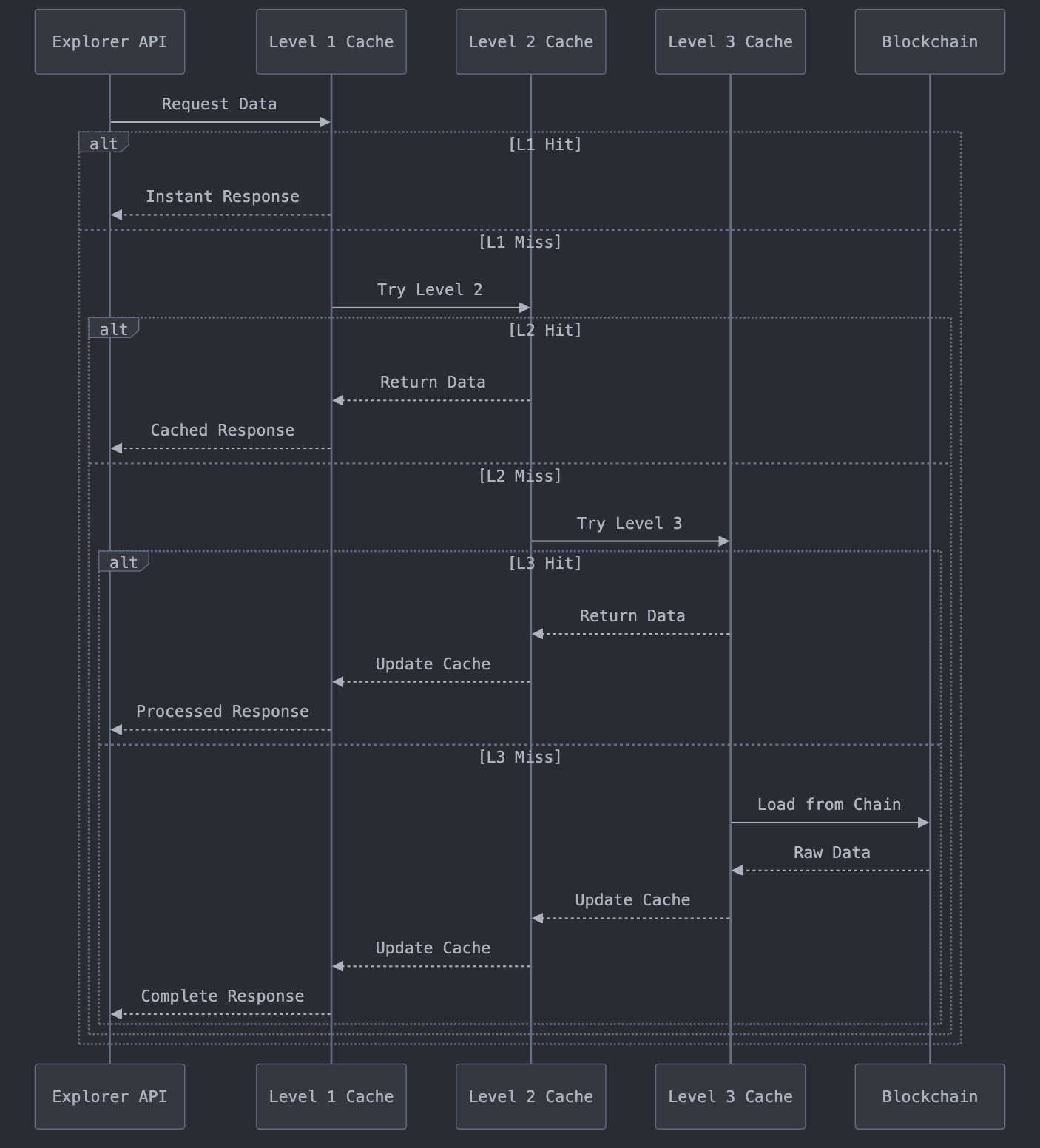
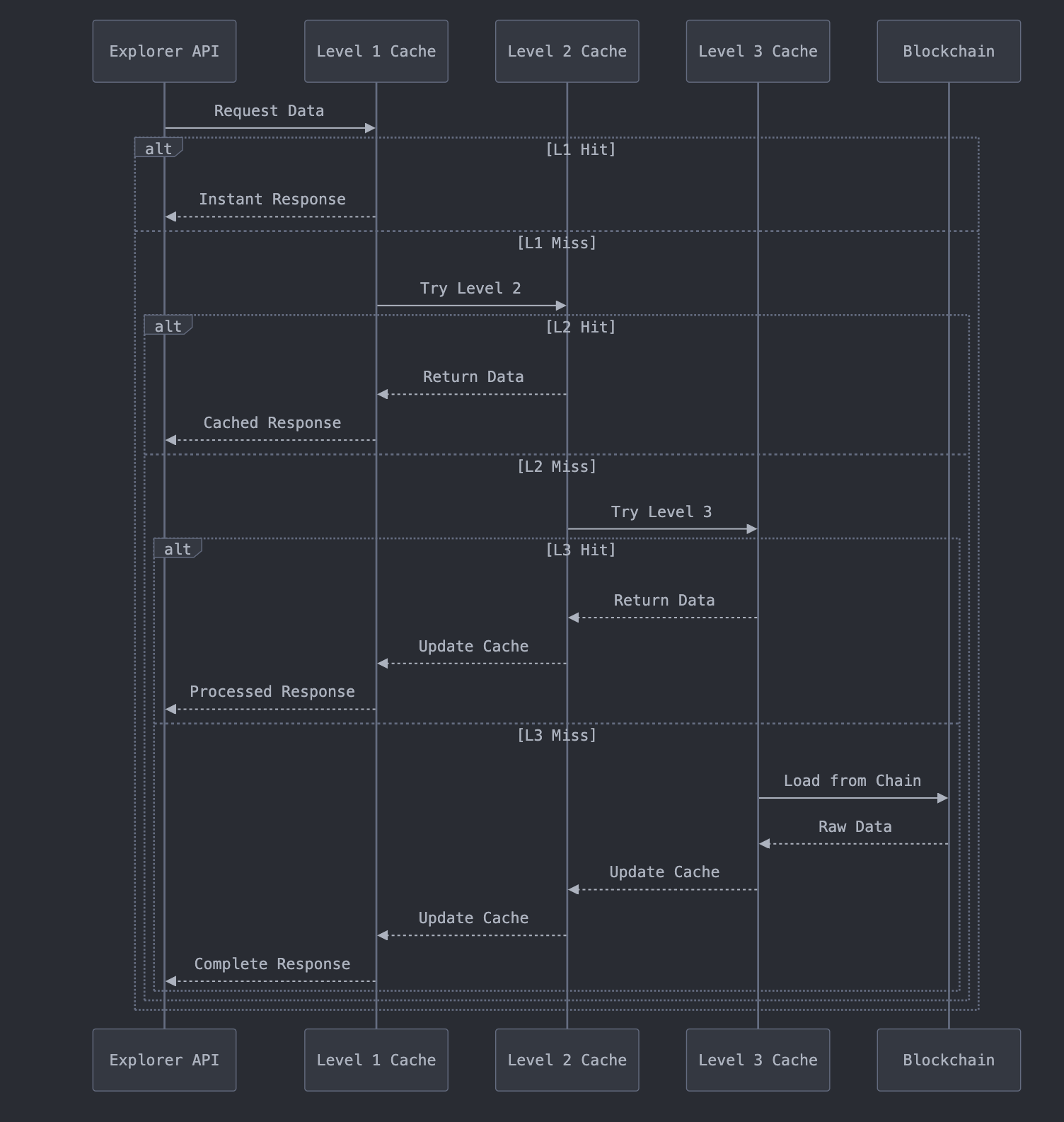
- Implemented three-level caching system for unprecedented performance:
- Level 1: High-speed in-RAM cache for most recent data
- Level 2: Persistent cache for frequently accessed data
- Level 3: Long-term storage with efficient retrieval
- Introduced double-buffered Merkle Patricia Tries for continuous data availability
- Added smart cache population strategies during bootstrap
- Implemented automatic cache maintenance and cleanup
- Added sophisticated cache coherency checks
### Transaction & Block Meta-Data
- Developed high-performance meta-data generation system
- Implemented smart caching for decompiled GridScript source code
- Added dynamic meta-data generation based on transaction analysis
- Introduced automatic transaction categorization
- Added support for Genesis rewards and mining rewards tracking
- Implemented sophisticated timestamp validation and reporting
## Security Enhancements
### Autonomous Blockchain Security (ABS)
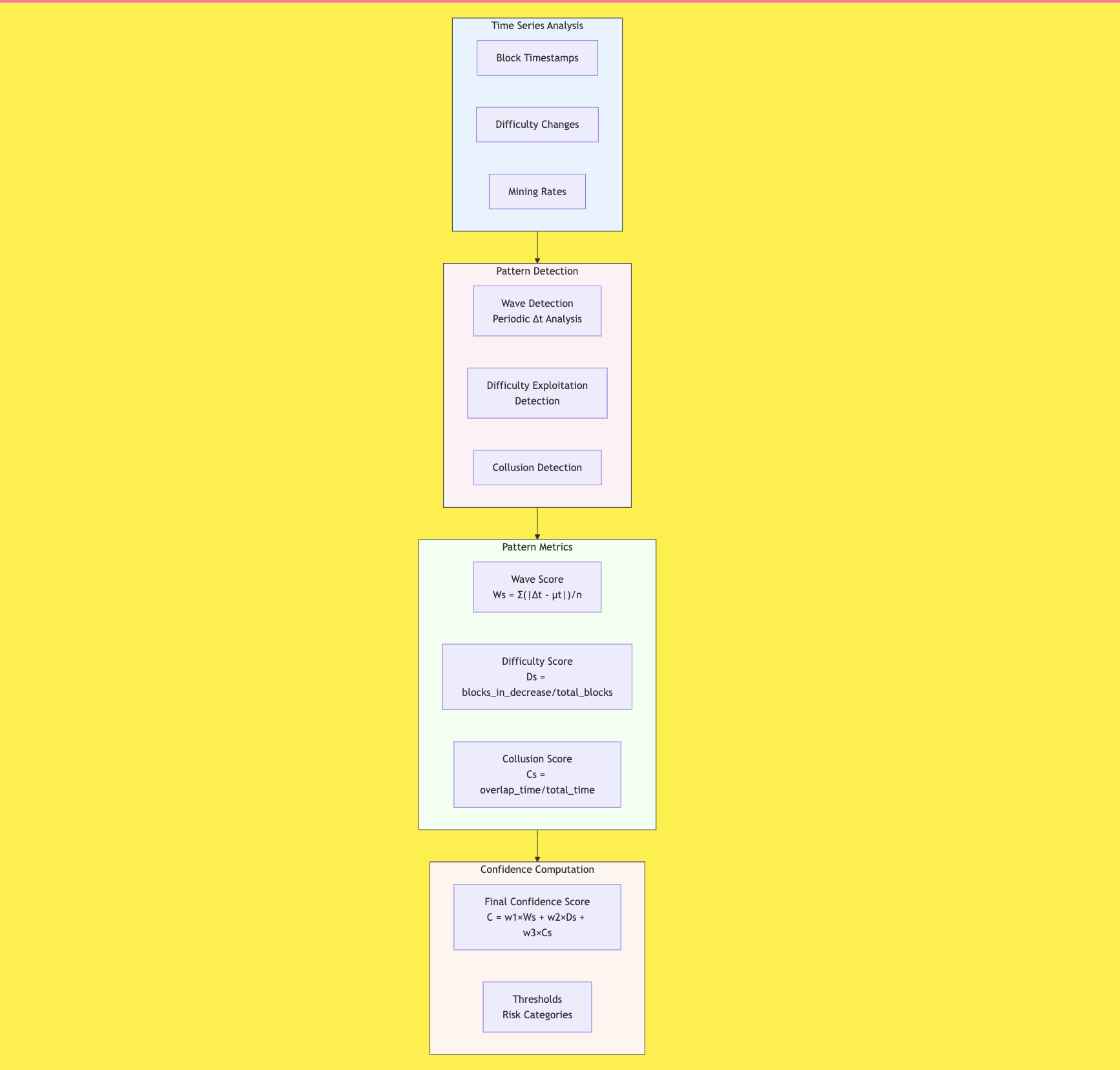
The Autonomous Blockchain Security (ABS) system represents a fundamental advancement in blockchain security. Unlike traditional security measures that focus on immediate threat prevention, ABS implements sophisticated statistical analysis to detect complex attack patterns that emerge over time.
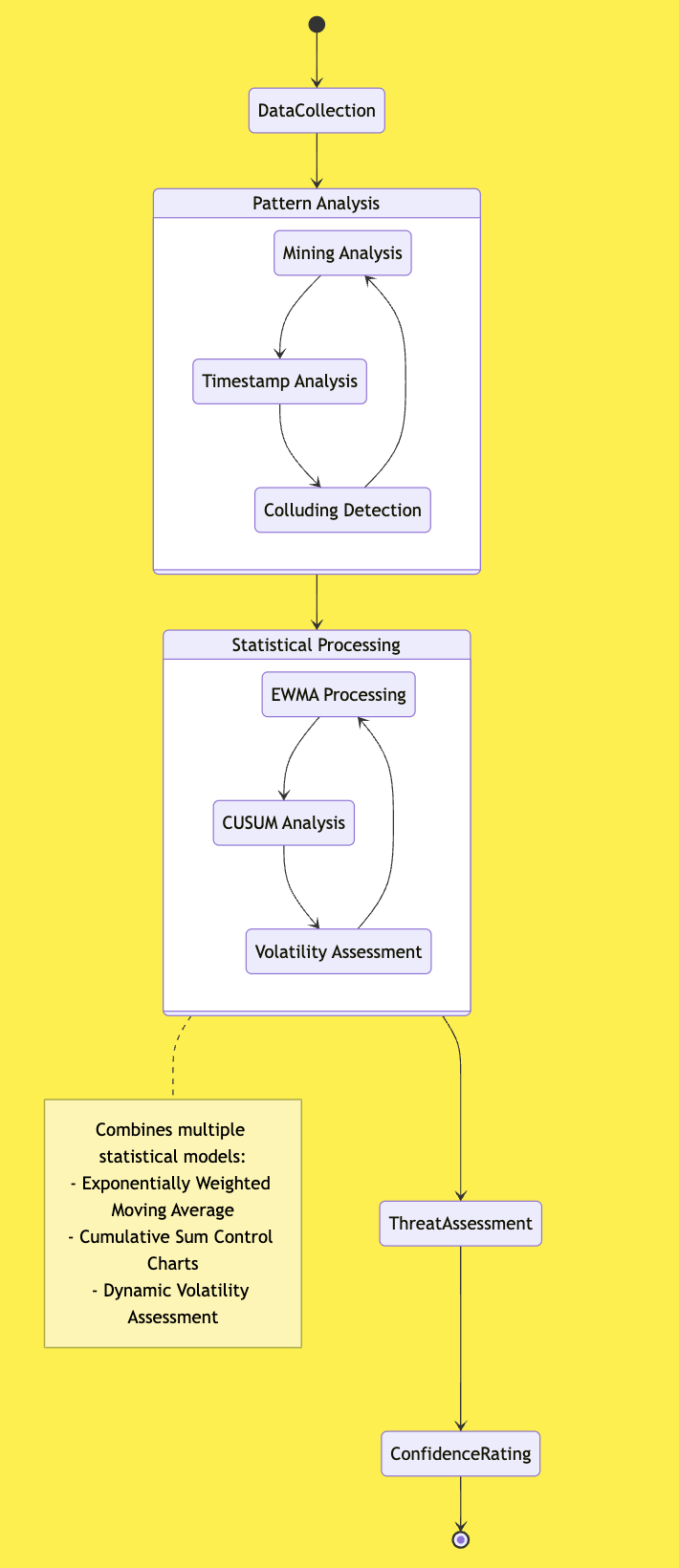
At the heart of ABS lies a sophisticated statistical engine that processes mining patterns through multiple analytical models. The system employs Exponentially Weighted Moving Average (EWMA) to detect subtle shifts in mining behavior that might indicate the beginning of an attack. This is complemented by CUSUM analysis, which excels at detecting small, persistent changes that might otherwise go unnoticed.
One of the most innovative aspects is the system’s ability to detect colluding operators. Through advanced pattern recognition and statistical correlation, ABS can identify groups of operators that might be working together to manipulate the network. The system maintains a sophisticated model of “normal” mining behavior and flags significant deviations that could indicate coordinated attacks.
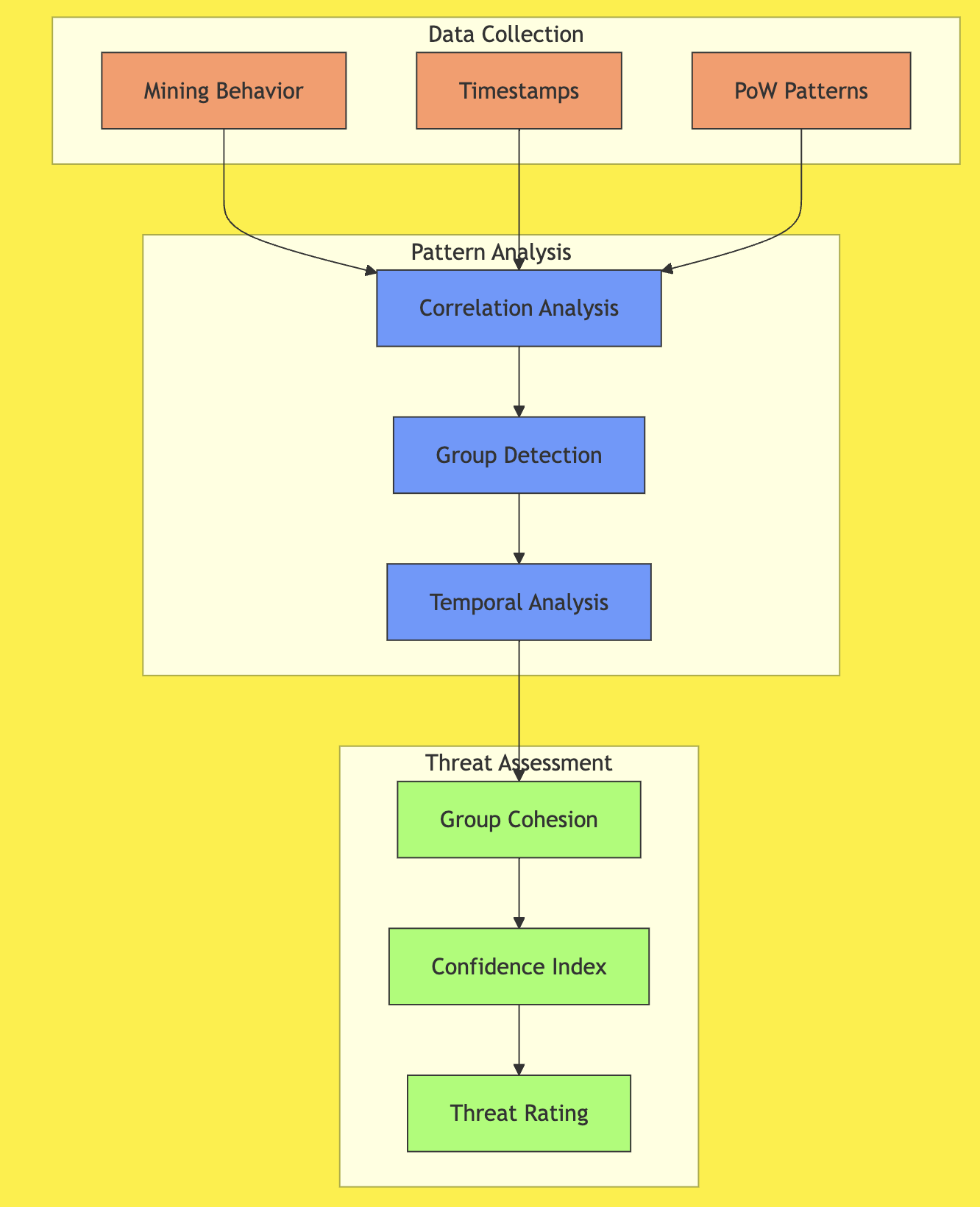
The system maintains detailed security profiles for every operator that has ever participated in block production. These profiles include:
- Historical mining patterns
- Timestamp consistency analysis
- PoW difficulty wave participation
- Group activity correlations
- Confidence ratings
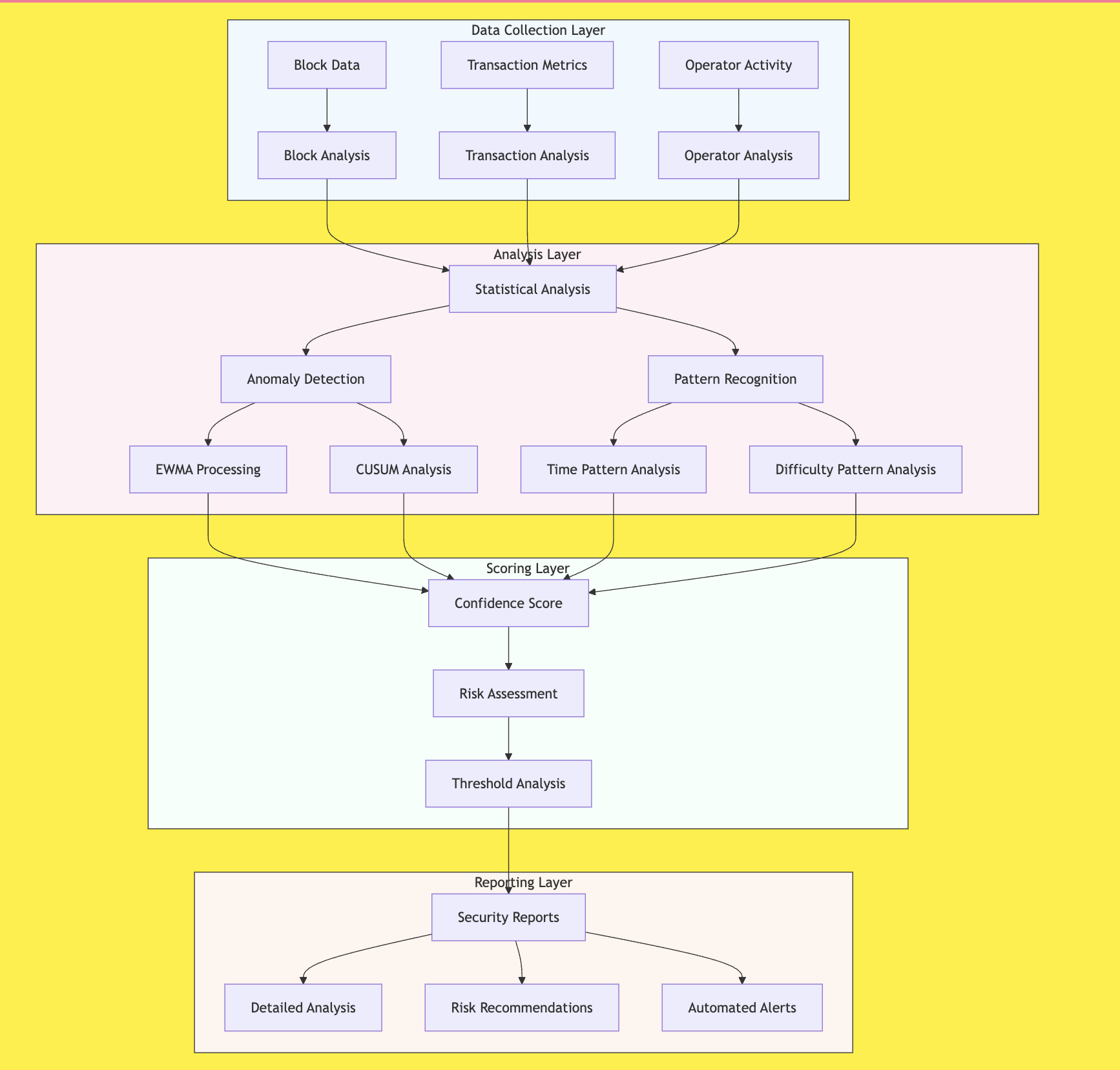
- Introduced sophisticated PoW wave and grinding attack detection
- Implemented colluding operator detection algorithms
- Added statistical analysis of mining patterns
- Introduced confidence rating system using EWMA and CUSUM
- Added volatility assessment for threat detection
- Implemented group activity ratio analysis
- Added automated security reporting through `chain -sec` command
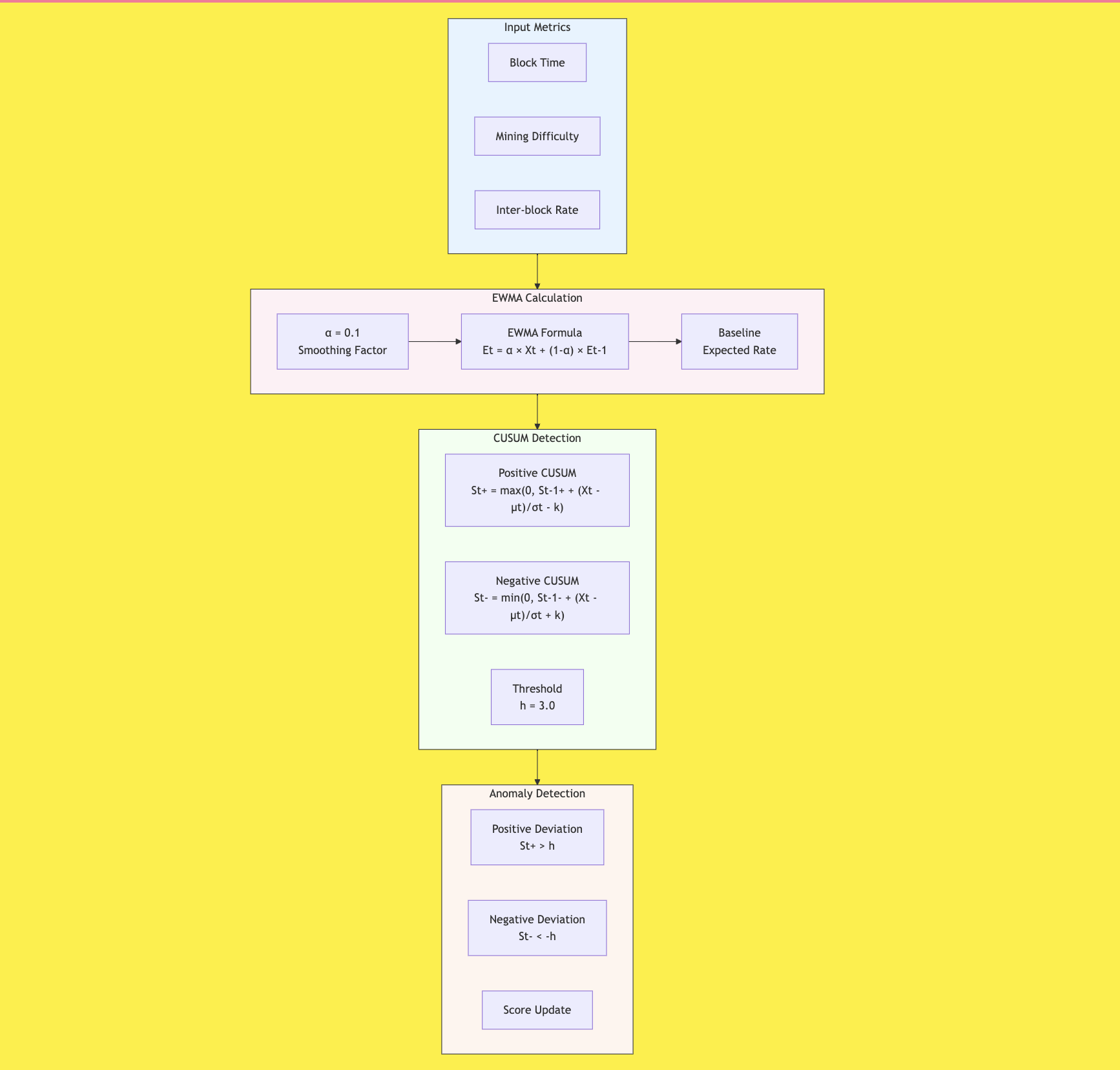
### Security Reporting & Analysis
- Added per-block security assessment capabilities
- Implemented comprehensive operator security profiling
- Added historical attack pattern analysis
- Introduced trading recommendations based on security analysis
- Added automated detection of timestamp manipulation
- Implemented sophisticated statistical modeling for threat assessment
## GridScript Command Enhancements
### Enhanced `market` Command
- Added advanced sorting capabilities for account analysis
- Implemented new statistics for asset movements
- Added support for locked asset analysis
- Enhanced pagination support
- Added sorting by multiple criteria including:
- Total transactions received/dispatched
- Total GNC received/dispatched
- Amount of locked assets
### New `cstorage` Command
- Implemented comprehensive storage analysis capabilities
- Added RAM usage monitoring and reporting
- Added RocksDB performance optimization tools
- Introduced storage configuration management
### Improved `net` Command
- Enhanced connection tracking capabilities
- Added sophisticated bandwidth management
- Improved firewall integration
- Added detailed connection statistics
- Introduced connection pool management
- Added advanced networking diagnostics
### Enhanced `chain` Command
- Added new breakpoint functionality for debugging
- Implemented chain cutting and resynchronization tools
- Added security reporting capabilities
- Enhanced blockchain analysis tools
- Added transaction and block debugging facilities
## Storage & Database Optimizations
### RocksDB Enhancements
- Implemented advanced compression levels
- Added sophisticated caching strategies
- Enhanced database initialization process
- Implemented performance tuning capabilities
- Added automatic optimization based on hardware
- Enhanced storage efficiency through:
- Custom compression algorithms
- Smart block sizing
- Optimized write buffers
- Enhanced bloom filters
### Performance Optimization
- Implemented binary encoding scheme outperforming standard BER
- Enhanced data serialization efficiency
- Improved storage access patterns
- Added smart data prefetching
- Implemented sophisticated garbage collection
- Enhanced data locality optimization
## Internal Improvements
### Flow Database Mechanics
- Enhanced ACID compliance mechanisms
- Improved transaction rollback capabilities
- Enhanced state maintenance
- Improved consistency checks
- Added sophisticated state tracking
- Enhanced error recovery mechanisms
### GridScript VM Enhancements
- Added support for state persistence across calls
- Enhanced bytecode execution efficiency
- Improved error handling and reporting
- Added sophisticated code analysis capabilities
- Enhanced decompilation accuracy
- Improved meta-data generation from bytecode
## Operator Control & Monitoring
### Resource Management
- Added detailed RAM usage monitoring
- Enhanced storage usage tracking
- Implemented sophisticated CPU utilization metrics
- Added network bandwidth monitoring
- Enhanced resource allocation control
- Added advanced performance analytics
### Configuration Management
- Added dynamic cache size configuration
- Enhanced thread pool management
- Improved networking configuration
- Added storage optimization settings
- Enhanced performance tuning capabilities
- Implemented resource limit management
## Meta-Data Exchange Protocol
### BER Protocol Enhancement
- Implemented efficient binary encoding for vectors
- Enhanced protocol efficiency
- Added sophisticated type handling
- Improved error detection
- Enhanced data validation
- Added support for complex data structures
### Data Exchange Optimization
- Enhanced meta-data caching
- Improved data serialization
- Added efficient compression
- Enhanced protocol versioning
- Improved backward compatibility
- Added sophisticated error handling
## API Incentivization Model
### ERG-Based Request Pricing
- Implemented sophisticated pricing model for API requests
- Added dynamic pricing based on:
- Request complexity
- Resource utilization
- Data volume
- Processing time
- CPU core usage
- Memory requirements
### Request Categories & Pricing
- Block details retrieval
- Network status assessment
- Domain information retrieval
- Transaction history access
- Daily statistics generation
- Security report generation
- General blockchain search
## Multi-Tier Caching Architecture: Redefining Blockchain Performance
The 1.6.0 release introduces one of the most sophisticated caching architectures ever implemented in a blockchain system. This revolutionary approach to data management and retrieval represents a fundamental shift from traditional blockchain data access patterns, enabling performance levels previously thought unattainable in decentralized systems.
At its core, the new caching system employs a three-tiered architecture, each level optimized for specific access patterns and performance requirements. The system goes far beyond simple caching, incorporating intelligent prefetching, multi-threaded population mechanics, and sophisticated data coherency protocols.
### Level 1: High-Performance Transaction Cache
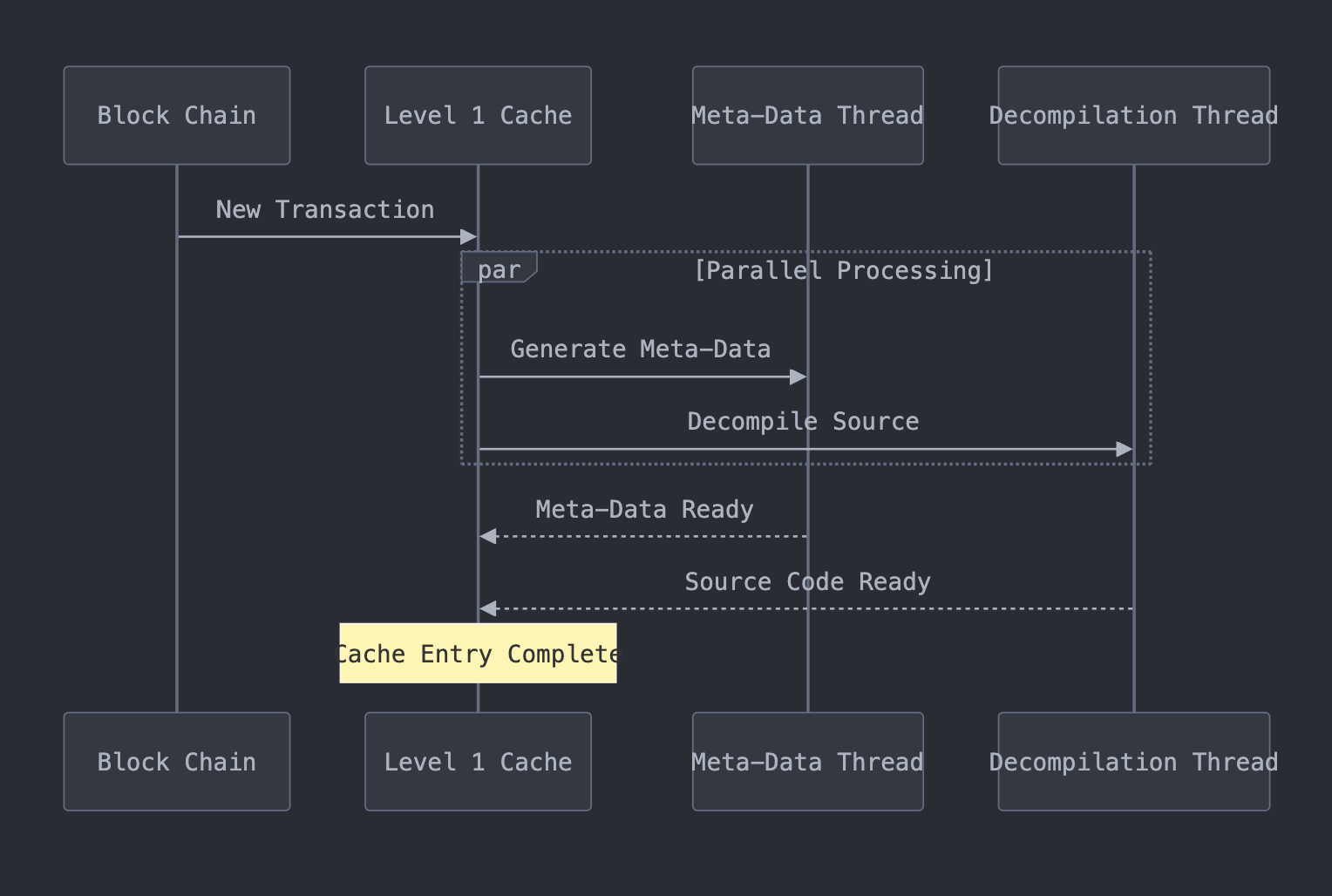
The first tier consists of a high-speed, in-RAM cache specifically designed for transaction meta-data. This cache maintains detailed information about recent transactions, including decompiled GridScript source code, computed meta-data, and execution results. The innovation lies in its ability to generate and cache sophisticated meta-data derived from transaction analysis in real-time.
What makes this cache truly remarkable is its multi-threaded population mechanism. As new blocks are processed, dedicated worker threads analyze transactions, decompile GridScript code, and prepare meta-data concurrently. This parallel processing approach ensures that even as the system handles hundreds of transactions per second, meta-data remains instantly accessible without imposing additional processing overhead during retrieval.
The cache employs a sophisticated binary search algorithm for insertion positions, ensuring that transactions are maintained in strict chronological order while providing O(log n) access times. This ordering is crucial for efficient pagination and range queries, enabling the system to retrieve thousands of transactions in milliseconds.
### Level 2: Block and Receipt Cache
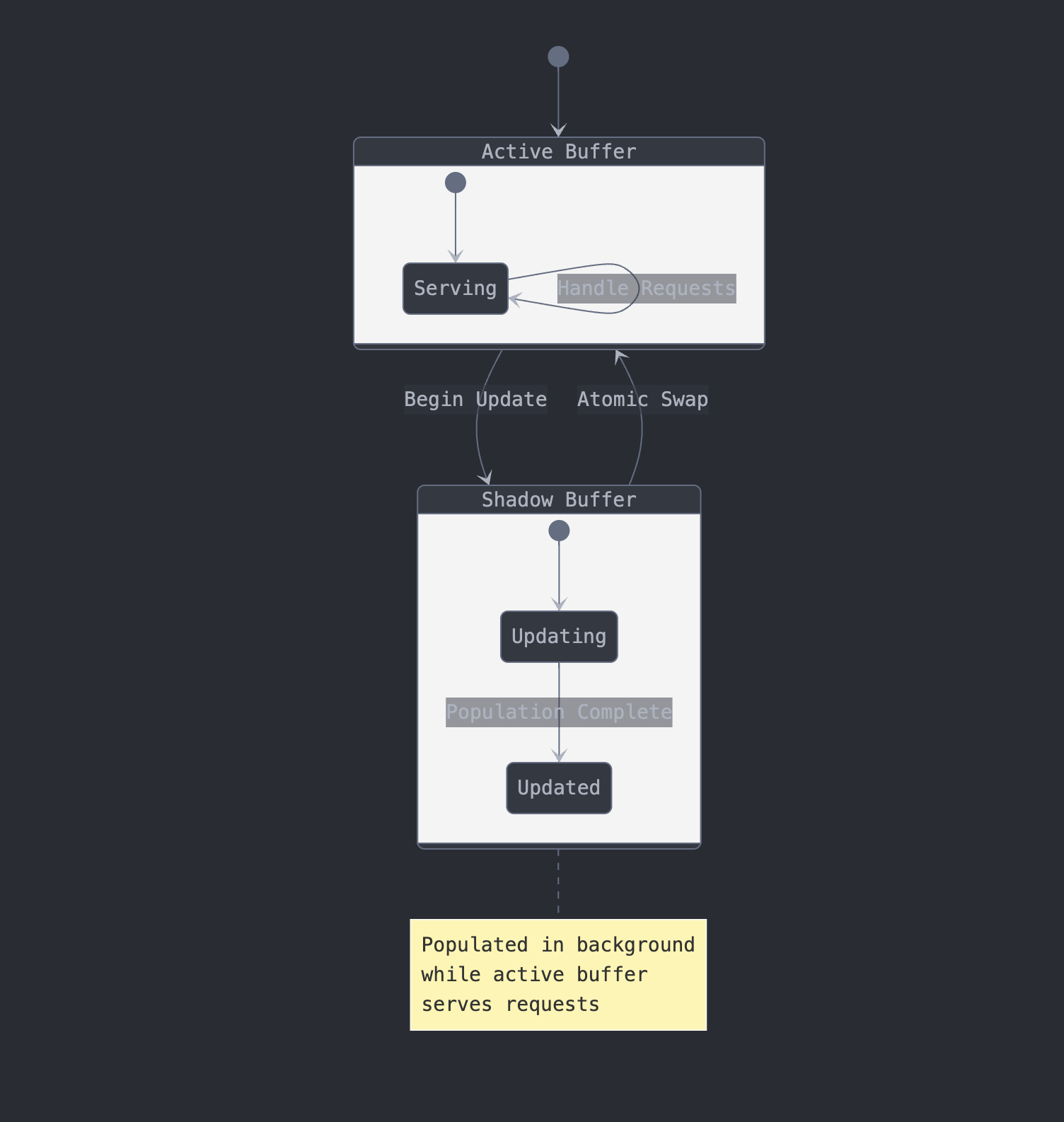
The second tier implements an innovative double-buffered approach to block and receipt caching. This mechanism ensures zero-downtime updates while maintaining data consistency. When the cache requires updating, a new buffer is populated in the background while the current buffer continues serving requests. Once the new buffer is ready, an atomic swap occurs, ensuring uninterrupted data access.
The block cache incorporates sophisticated pruning mechanics, distinguishing between fully parsed blocks (with unwound Merkle Patricia Tries) and pruned blocks containing only essential data. This distinction allows the system to maintain an optimal balance between memory usage and access speed. Furthermore, the cache implements intelligent depth-based policies, maintaining more detailed data for recent blocks while progressively pruning older ones.
### Level 3: Persistent State Cache
The third tier introduces a revolutionary approach to state caching through a persistent Merkle Patricia Trie implementation. This cache maintains the entire state of the system in RAM, with scheduled refreshes every 15 minutes to ensure data freshness. The innovation here lies in the implementation of a reverse semaphore mechanism that coordinates access during updates, ensuring that ongoing operations complete before state transitions occur.
This level also implements sophisticated synchronization primitives that extend beyond standard C++ capabilities, allowing multiple threads to access the trie simultaneously when operations are guaranteed not to conflict. This approach enables unprecedented parallelism while maintaining data consistency.
### Cache Coherency and Optimization
The caching system implements sophisticated coherency protocols that ensure data consistency across all three tiers. When blocks are reorganized due to forks, the system efficiently updates all affected cache entries while maintaining accessibility to unaffected data. This is achieved through an innovative approach to cache invalidation that operates at the granularity of individual entries rather than invalidating entire cache sections.
Performance optimization extends to the very core of the system, with custom implementations of binary encoding that outperform traditional BER encoding. The system employs robin\_hood hash tables for maximum efficiency and implements sophisticated memory management to minimize allocation overhead.
# Blockchain Explorer API: Unprecedented Performance Through Specialized Caching
The Blockchain Explorer API in GRIDNET Core 1.6.0, accessible through the new `context` GridScript command, represents a fundamental departure from traditional blockchain explorer implementations that typically rely on general-purpose databases. This section explains how the specialized caching mechanics deliver performance levels that would be impossible to achieve with traditional database systems.
## Beyond Traditional Database Architecture
Traditional blockchain explorers typically operate by parsing blockchain data into SQL databases, creating indexes, and serving requests through standard database queries. While this approach works, it comes with inherent limitations:
- Regular reindexing requirements
- Query planning overhead
- Generic data structures not optimized for blockchain data
- Limited ability to cache complex derived data
- Transaction isolation overhead
GRIDNET’s approach eliminates these limitations through a purpose-built architecture that’s fundamentally integrated with the core blockchain operation itself.
## Real-Time High-Performance Data Access
The Blockchain Explorer API benefits from the multi-tier caching system in several revolutionary ways:
### Instant Transaction Access
Rather than executing complex SQL joins to gather transaction data, the API draws from the Level 1 transaction cache, where meta-data is pre-computed and stored in optimal formats. This includes:
- Pre-decompiled GridScript source code
- Pre-computed transaction statistics
- Ready-to-serve human-readable formats
- Pre-validated timestamps
- Pre-computed relationships between transactions
This approach enables the API to serve requests for complex transaction data, including full transaction histories, in under 5 milliseconds - a feat impossible with traditional database architectures.
### Advanced Search Capabilities
The API implements sophisticated search functionality that operates directly on cached data structures. Unlike SQL-based systems that would require complex LIKE queries and index scans, GRIDNET’s approach uses:
- Specialized binary search algorithms
- Pre-computed searchable fields
- Efficient string matching algorithms (Boyer-Moore-Horspool for longer strings)
- Multi-threaded search capabilities across different data domains
This specialized approach allows the API to search through millions of transactions, blocks, and accounts simultaneously, delivering results in milliseconds.
### Efficient Pagination and Range Queries
Traditional databases struggle with efficient pagination over large datasets, often requiring complex offset calculations and full table scans. The Blockchain Explorer API solves this through:
- Pre-ordered data structures in cache
- Cursor-based pagination
- State maintenance between requests
- Smart result windowing
This enables instant access to any page of results without the overhead typically associated with large offset values in SQL queries.
### Statistical Analysis Performance
The API’s statistical capabilities showcase the power of specialized caching. For example, generating daily transaction statistics for an entire year:
- First request: Uses multi-threaded processing (~4 seconds)
- Subsequent requests: Serves from Level 2 cache (\< 2ms)
- Auto-updates as new blocks arrive
- Maintains multiple aggregation levels
This level of performance would be impossible with traditional databases, which would require either expensive pre-computation of all possible statistical combinations or slow on-demand calculations.
### Real-Time Updates
Unlike traditional explorers that typically update their databases periodically, GRIDNET’s API provides real-time access to blockchain data:
- New transactions appear instantly in search results
- Statistics update in real-time
- Mempool transactions are instantly searchable
- Fork reorganizations are handled seamlessly
## BER-Encoded Protocol Efficiency
The API uses a custom BER-encoded protocol for data exchange that’s far more efficient than JSON or SQL result sets:
- Compact binary representation
- Minimal parsing overhead
- Efficient field encoding
- Built-in type safety
- Optimized for blockchain data structures
This approach enables the API to transmit large result sets with minimal overhead, further contributing to its exceptional performance.
# Revolutionary Multi-Threaded Merkle Patricia Tries: Redefining Blockchain Data Structures
The 1.6.0 release introduces a groundbreaking reimplementation of Merkle Patricia Tries that pushes the boundaries of what’s possible in blockchain data structures. This innovation represents a fundamental advancement in how blockchain systems handle state management and data verification.
## Multi-Threaded Architecture
Traditional Merkle Patricia Tries operate in a single-threaded manner due to the inherent complexity of maintaining consistency during parallel operations. GRIDNET Core 1.6.0 breaks this limitation by introducing a sophisticated multi-threaded implementation that allows for parallel operations while maintaining absolute data integrity. The system includes:
- Dynamic thread allocation based on trie size:
- Small tries: Single-threaded processing for optimal efficiency
- Medium tries: Shared thread pool without hyperthreading
- Large tries: Full CPU utilization with hyperthreading
- Sophisticated synchronization mechanisms for parallel access
- Intelligent workload distribution across available cores
- Advanced thread pool management
## Custom Synchronization Constructs
To enable true parallel processing of Merkle Patricia Tries, the team developed custom synchronization primitives that extend beyond standard C++ capabilities:
- Thread-specific permissions system
- Custom recursive mutex implementation
- Advanced deadlock avoidance mechanics
- Sophisticated thread coordination protocols
- Novel approach to shared resource access
## Memory Optimization
The new implementation introduces sophisticated memory management:
- Dynamic pruning of processed branches
- Smart caching of frequently accessed nodes
- Efficient memory reclamation
- Optimized node storage formats
- Advanced memory pooling
## Performance Improvements
The multi-threaded implementation delivers unprecedented performance improvements:
- Parallel processing of large tries
- Efficient handling of nested tries
- Optimized path reconstruction
- Fast concurrent access patterns
- Reduced memory overhead
# Advanced Debugging and Development Tools: Unprecedented Blockchain Analysis Capabilities
The 1.6.0 release introduces sophisticated debugging and analysis tools that give operators and developers unprecedented insight into blockchain operations. These tools represent a fundamental shift in how blockchain systems can be analyzed and debugged in real-time.
## Comprehensive Breakpoint System
At the heart of the new debugging capabilities is an innovative breakpoint system that allows operators to analyze blockchain operations at both block and transaction levels:
### Transaction Breakpoints
- Pre-execution analysis of GridScript code
- Post-execution state verification
- Sophisticated condition matching
- Source code decompilation and analysis
- Real-time state inspection
- Execution result validation
### Block Breakpoints
- Pre/post block processing analysis
- State transition verification
- Merkle root validation
- Block metadata inspection
- Chain reorganization analysis
## Chain State Analysis
The system introduces sophisticated tools for analyzing blockchain state:
### The `chain` Command Evolution
- Real-time chain cutting capabilities
- State verification tools
- Fork analysis utilities
- Block processing inspection
- Transaction validation tools
---
### Author:  [@TheOldWizard](https://talk.gridnet.org/u/TheOldWizard)
#### Post date: [December 6, 2024, 12:52pm UTC](https://talk.gridnet.org/t/gridnet-core-1-6-0-release-notes/1015/2 "2024-12-06T12:52:14Z")
### State Verification
- Merkle Patricia Trie state validation
- Account balance verification
- Transaction receipt validation
- Chain proof verification
- Fork detection and analysis
## Flow Mechanics Integration
The debugging tools integrate deeply with GRIDNET’s Flow database mechanics:
- Transaction rollback analysis
- State transition inspection
- ACID compliance verification
- Atomicity validation
- Consistency checking
# Decentralized API Incentivization: A New Paradigm for Blockchain Services
GRIDNET Core 1.6.0 introduces a revolutionary approach to blockchain data access through an ERG-based incentivization model for the Blockchain Explorer API. This system represents a fundamental shift in how decentralized services can be provided and monetized while ensuring fair compensation for operators providing computational resources.
## Economic Model Design
The incentivization model carefully balances accessibility with resource consumption, implementing sophisticated pricing based on:
### Resource Utilization
- CPU core usage for multi-threaded operations
- Memory consumption for complex queries
- Storage access patterns
- Network bandwidth usage
- Processing time requirements
- Cache utilization
### Request Complexity Tiers
Each API endpoint has its own pricing model based on computational complexity:
#### High-Complexity Operations
- Extended time-range statistical analysis
- Complex blockchain searches
- Large dataset retrievals
- Security report generation
- Pattern analysis operations
#### Medium-Complexity Operations
- Block details retrieval
- Transaction history access
- Account state queries
- Basic statistical calculations
#### Basic Operations
- Recent block queries
- Simple transaction lookups
- Network status checks
- Basic metadata retrieval
## Dynamic Pricing Mechanism
The system implements sophisticated dynamic pricing:
- Scales with request complexity
- Accounts for resource availability
- Adjusts for network conditions
- Considers historical load patterns
- Incorporates caching benefits
### Example Cost Factors:
- Daily transaction statistics: Cost scales with requested time range
- Account history: Pricing based on entry count
- Security analysis: Complexity-based pricing
- Block details: Data volume dependent
- Search operations: Query complexity factors
# Advanced Storage Architecture: Beyond Traditional Blockchain Storage
GRIDNET Core 1.6.0 introduces sophisticated storage optimizations that fundamentally change how blockchain data is persisted and accessed. This represents a significant advancement over traditional blockchain storage systems, incorporating cutting-edge database technologies with custom optimizations.
## RocksDB Integration and Optimization
The new release implements advanced RocksDB tuning that goes far beyond default configurations:
### Multi-Level Compression
- Dynamic compression level selection
- Workload-aware compression strategies
- Custom compression algorithms
- Block-size optimization
- Write amplification reduction
- Read performance optimization
### Performance Tuning
- Automatic hardware detection
- Dynamic buffer size adjustment
- Custom bloom filter configurations
- Advanced block cache management
- File system optimization
- I/O scheduling improvements
## Custom Storage Management
### The New `cstorage` Command
This powerful new addition to GridScript provides operators with unprecedented control over storage systems:
- Real-time storage analytics
- Performance optimization tools
- Cache configuration management
- Memory usage monitoring
- Disk usage analysis
- Performance metrics
### Intelligent Resource Management
- Dynamic memory allocation
- Smart cache eviction policies
- Automated storage optimization
- Resource usage predictions
- Performance bottleneck detection
## Binary Encoding Innovation
One of the most significant improvements is the introduction of a custom binary encoding scheme that outperforms traditional BER encoding:
- Reduced encoding/decoding overhead
- Optimized memory usage
- Improved serialization speed
- Enhanced data validation
- Reduced storage requirements
### Performance Implications
The new encoding scheme delivers:
- 30-40% reduction in encoding time
- Significant memory savings
- Reduced CPU utilization
- Improved network efficiency
- Enhanced data integrity checks
# Advanced Networking Architecture: Redefining Blockchain Communication
GRIDNET Core 1.6.0 introduces fundamental changes to its networking stack, with particular focus on protocol isolation, efficiency, and security. These changes represent a significant evolution in how blockchain nodes communicate and maintain network integrity.
## Kademlia Protocol Enhancement
The release brings major improvements to peer discovery through a sophisticated reimplementation of the Kademlia protocol:
### Protocol Independence
- Decoupled from UDT subsystem
- Standalone operation capability
- Direct UDP datagram support
- Enhanced NAT traversal
- Improved peer discovery
### Advanced Protocol Detection
- Sophisticated datagram analysis
- Multiple protocol support
- Smart protocol switching
- Enhanced security validation
- Automatic protocol optimization
## Protocol Stack Optimization
### UDT Protocol Changes
- Disabled by default for improved stability
- Enhanced multiplexing capabilities
- Improved congestion control
- Better flow management
- Reduced overhead
### QUIC Integration
- Enhanced Microsoft QUIC support
- Improved connection management
- Better stream multiplexing
- Reduced latency
- Enhanced reliability
## Connection Management System
The release introduces sophisticated connection tracking and management:
### Connection Analytics
- Detailed connection history
- Performance metrics
- Bandwidth utilization
- Latency monitoring
- Protocol statistics
### Advanced Security Features
- Time-window based connection allowance
- Sophisticated flood protection
- DDoS mitigation
- Connection pool management
- Automatic blacklisting
# Advanced GPU Mining Architecture: Pushing Computational Boundaries
GRIDNET Core 1.6.0 introduces sophisticated improvements to its mining subsystem, with particular focus on GPU optimization, multi-vendor support, and mining result validation. These changes represent a significant advancement in blockchain mining efficiency and security.
## Revolutionary OpenCL Implementation
### Multi-Vendor GPU Support
- Sophisticated support for mixed AMD/NVIDIA setups
- Dynamic workload distribution
- Vendor-specific optimizations
- Automatic hardware detection
- Performance profiling per GPU
### Kernel Optimization
- Dynamic OpenCL version detection
- Advanced workgroup size optimization
- Sophisticated kernel compilation
- Custom memory management
- Enhanced error handling
### Virtual GPU Mode
- GPU resource virtualization
- Dynamic load balancing
- Improved resource utilization
- Enhanced scheduling
- Performance monitoring
## Mining Security and Validation
### Kernel Authentication
- Sophisticated integrity verification
- Hash validation mechanisms
- Runtime security checks
- Version validation
- Tampering detection
### Mining Result Validation
The release introduces an innovative approach to mining result validation:
- Logarithmic progress reporting
- Partial proof-of-work validation
- Advanced result verification
- Performance analytics
- Error detection
### Mining Pattern Analysis
- Sophisticated hash rate monitoring
- Performance trend analysis
- Anomaly detection
- Resource utilization tracking
- Efficiency metrics
## Performance Optimization
### Workload Distribution
- Intelligent task scheduling
- Dynamic load balancing
- Resource optimization
- Performance monitoring
- Adaptive scheduling
### Memory Management
- Optimized memory transfers
- Smart buffer management
- Cache optimization
- Reduced latency
- Enhanced throughput
# Custom Synchronization Primitives: Exceeding C++ Standards
GRIDNET Core 1.6.0 introduces groundbreaking synchronization primitives that push beyond the limitations of standard C++ synchronization mechanisms. This revolutionary approach was necessary to achieve the performance and reliability requirements of a next-generation blockchain system.
## Beyond Standard C++
### Custom Recursive Mutex
- Allows multiple specified threads to access simultaneously
- Maintains recursive locking capabilities
- Supports thread-specific permissions
- Enhanced deadlock prevention
- Improved performance over standard implementations
### Advanced Locking Mechanisms
- Sophisticated lock ordering
- Smart exponential backoff
- Progress-based waiting
- Enhanced fairness
- Reduced contention
### Custom Shared Mutex
- Extended read/write capabilities
- Enhanced throughput
- Reduced lock contention
- Improved scalability
- Thread-specific optimizations
## Lock Management Innovation
### Multi-Mutex Management
- Sophisticated deadlock avoidance
- Smart lock acquisition
- Priority-based locking
- Enhanced performance
- Reduced overhead
### RAII Components
- Advanced scope management
- Automatic resource cleanup
- Enhanced exception safety
- Improved reliability
- Reduced complexity
# Flow Database Mechanics: Revolutionary Blockchain State Management
The Flow Database system in GRIDNET Core 1.6.0 represents a fundamental advancement in how blockchain systems handle state transitions and data consistency. This sophisticated system combines elements of traditional ACID databases with blockchain-specific requirements for state verification and rollback capabilities.
## Flow State Management
### Transaction Processing Innovation
- Sophisticated state tracking
- Advanced rollback capabilities
- State transition verification
- Atomicity guarantees
- Consistency validation
### Breakpoint Integration
The Flow mechanics integrate deeply with the new breakpoint system:
- Pre-execution state capture
- Post-execution verification
- State transition analysis
- Rollback capabilities
- Transaction validation
## Advanced State Verification
### Perspective Tracking
- Merkle root state validation
- State transition verification
- Fork detection
- State consistency checks
- Historical state access
### Flow Control Mechanics
- Transaction ordering
- State dependency tracking
- Conflict resolution
- Consistency maintenance
- Rollback management
## Debugging Integration
### State Analysis Tools
- Real-time state inspection
- Transaction flow analysis
- State transition debugging
- Error detection
- Consistency verification
### Development Support
- Advanced debugging capabilities
- State manipulation tools
- Transaction simulation
- Error reproduction
- Test scenario creation
# Revolutionary UI dApp Architecture: Redefining Blockchain Interaction
## Introduction
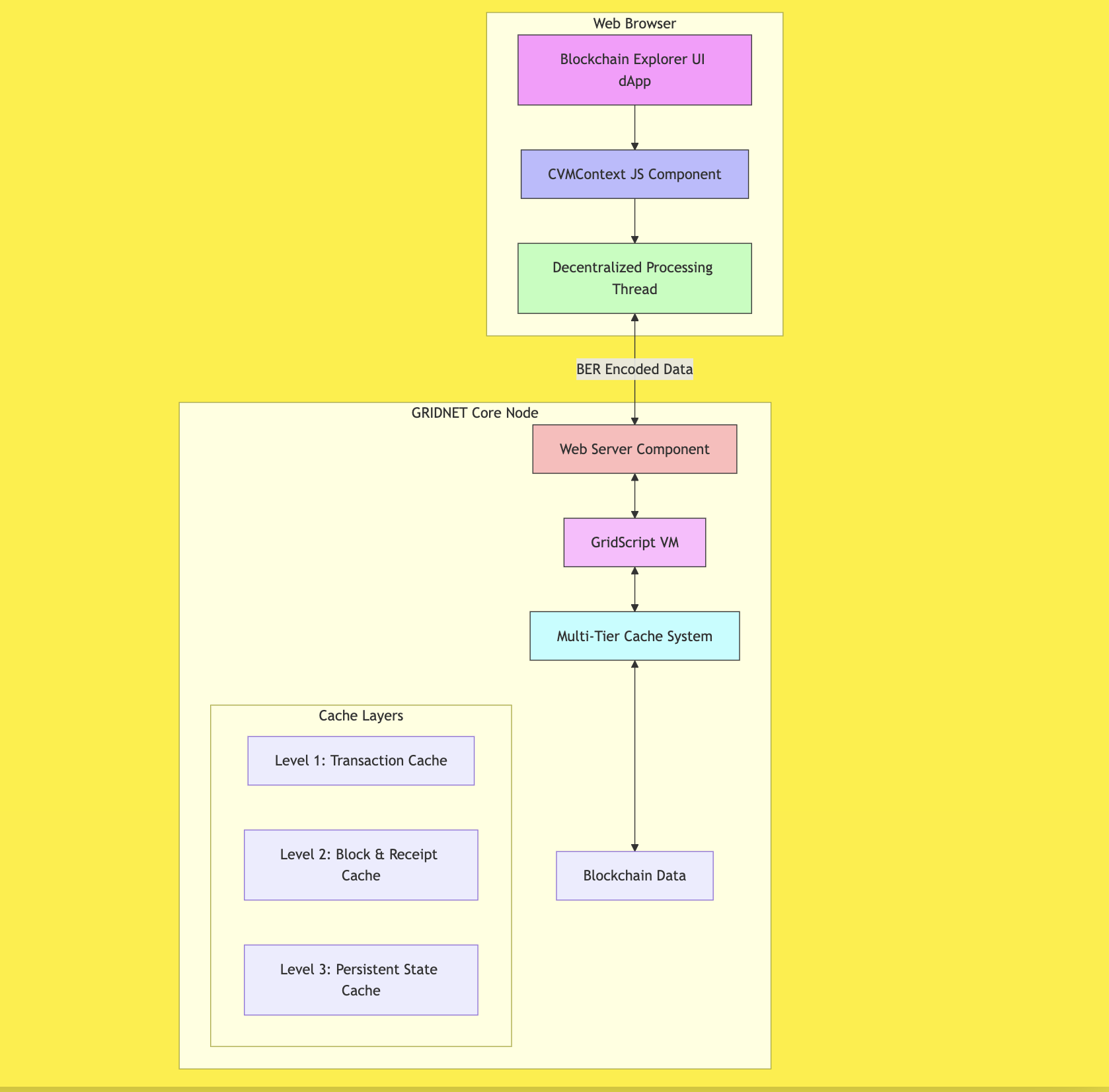
GRIDNET Core 1.6.0 introduces a groundbreaking approach to blockchain interaction that fundamentally differs from any existing solution in the cryptocurrency space. While traditional blockchain explorers rely on centralized servers, databases, and conventional web technologies, GRIDNET implements a truly decentralized architecture where UI dApps are served directly by network nodes and communicate through sophisticated, custom protocols.
## Revolutionary Aspects of the Architecture
### Direct Node Integration
Unlike traditional blockchain explorers that rely on intermediate servers and databases, GRIDNET’s UI dApps are served directly by the network nodes themselves. This is possible because GRIDNET Core includes:
- Built-in web server component
- WebSocket support for real-time communication
- Direct UI dApp storage and serving capabilities
- Custom onion routing implementation
- End-to-end encryption layer
### Decentralized Processing Threads
One of the most innovative aspects is the concept of Decentralized Processing Threads, which:
- Execute within the web browser
- Communicate directly with Core nodes
- Process GridScript commands
- Handle binary encoded responses
- Manage state and caching
---
### Author:  [@TheOldWizard](https://talk.gridnet.org/u/TheOldWizard)
#### Post date: [December 6, 2024, 1:40pm UTC](https://talk.gridnet.org/t/gridnet-core-1-6-0-release-notes/1015/3 "2024-12-06T13:40:06Z")
# 1. Multi-Tier Caching Architecture
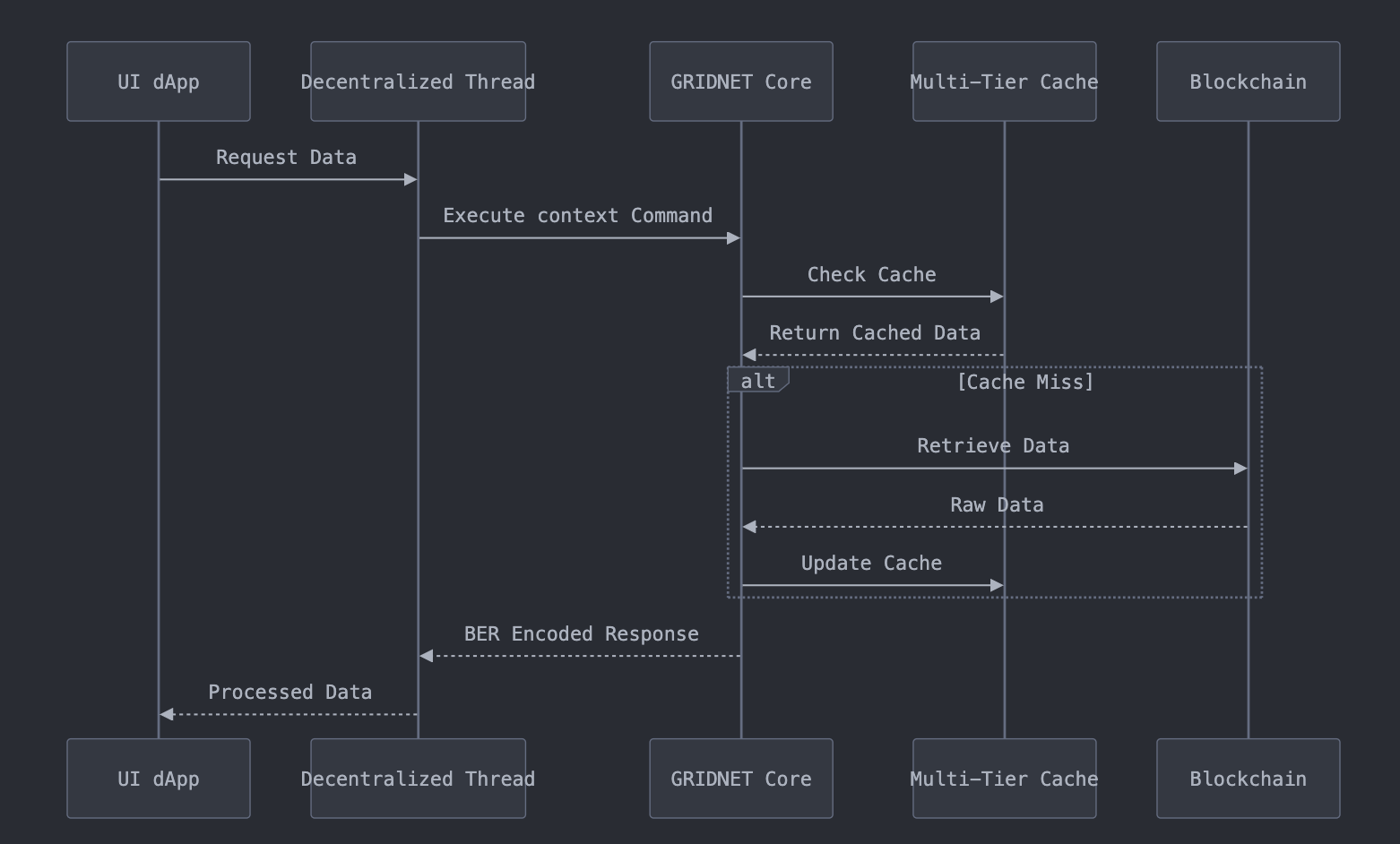
The multi-tier caching system in GRIDNET Core 1.6.0 represents a sophisticated approach to high-performance blockchain data access. Let us visualize this complex system:
## Cache Level Details
### Level 1: High-Speed Transaction Cache
- Maintains recent transaction data in RAM
- Pre-generates and caches meta-data
- Stores decompiled GridScript source code
- Multi-threaded population mechanism
- O(log n) access times through binary search
Let us show the data flow in Level 1 cache:
### Level 2: Block & Receipt Cache with Double Buffering
The Level 2 cache implements an innovative double-buffering approach for zero-downtime updates. Let us visualize this mechanism:
### Level 3: Persistent State Cache
The Level 3 cache maintains complete system state through a sophisticated Merkle Patricia Trie implementation. Let me visualize its operation:

# Complete Cache Interaction Flow
Let us show how all three cache levels interact during a typical Blockchain Explorer request:
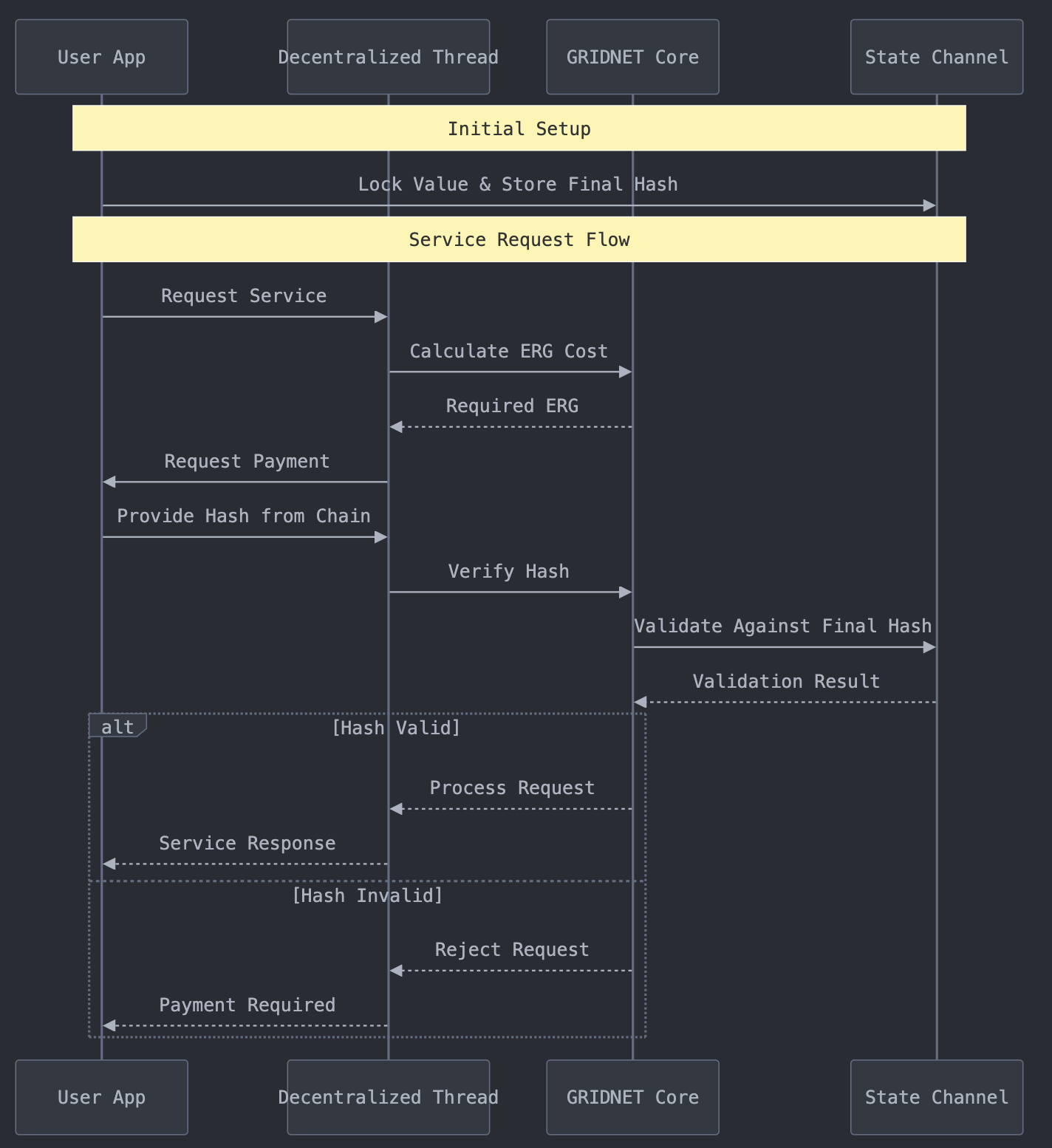
# GRIDNET SaaS: Decentralized Service Incentivization Model
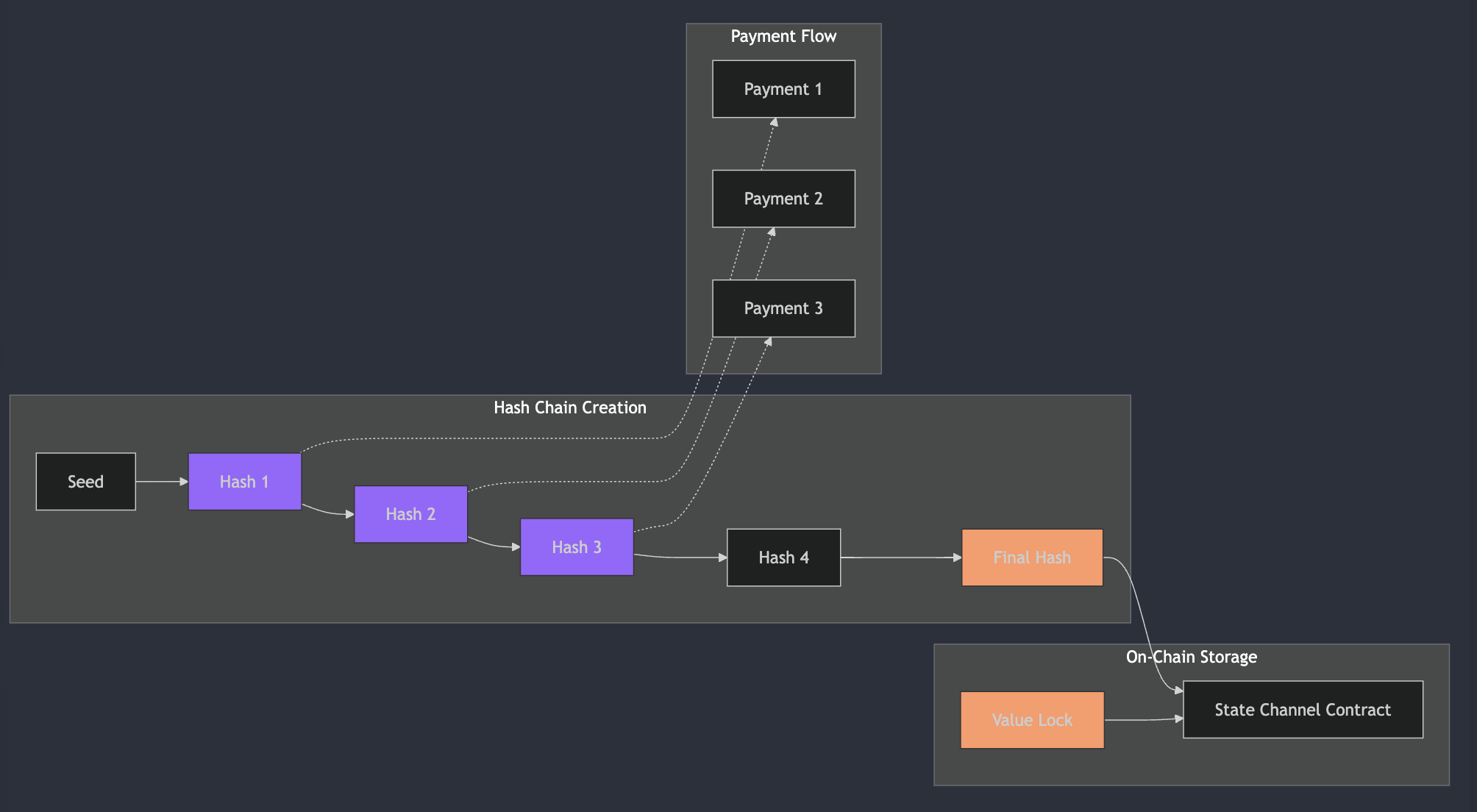
## State Channel Hash Chain Implementation
Let us first visualize the hash chain concept used for efficient payments:
## Service Request and Payment Flow
Let us visualize how payments flow during high-frequency API requests:
Integrated Web Server Architecture in GRIDNET Core
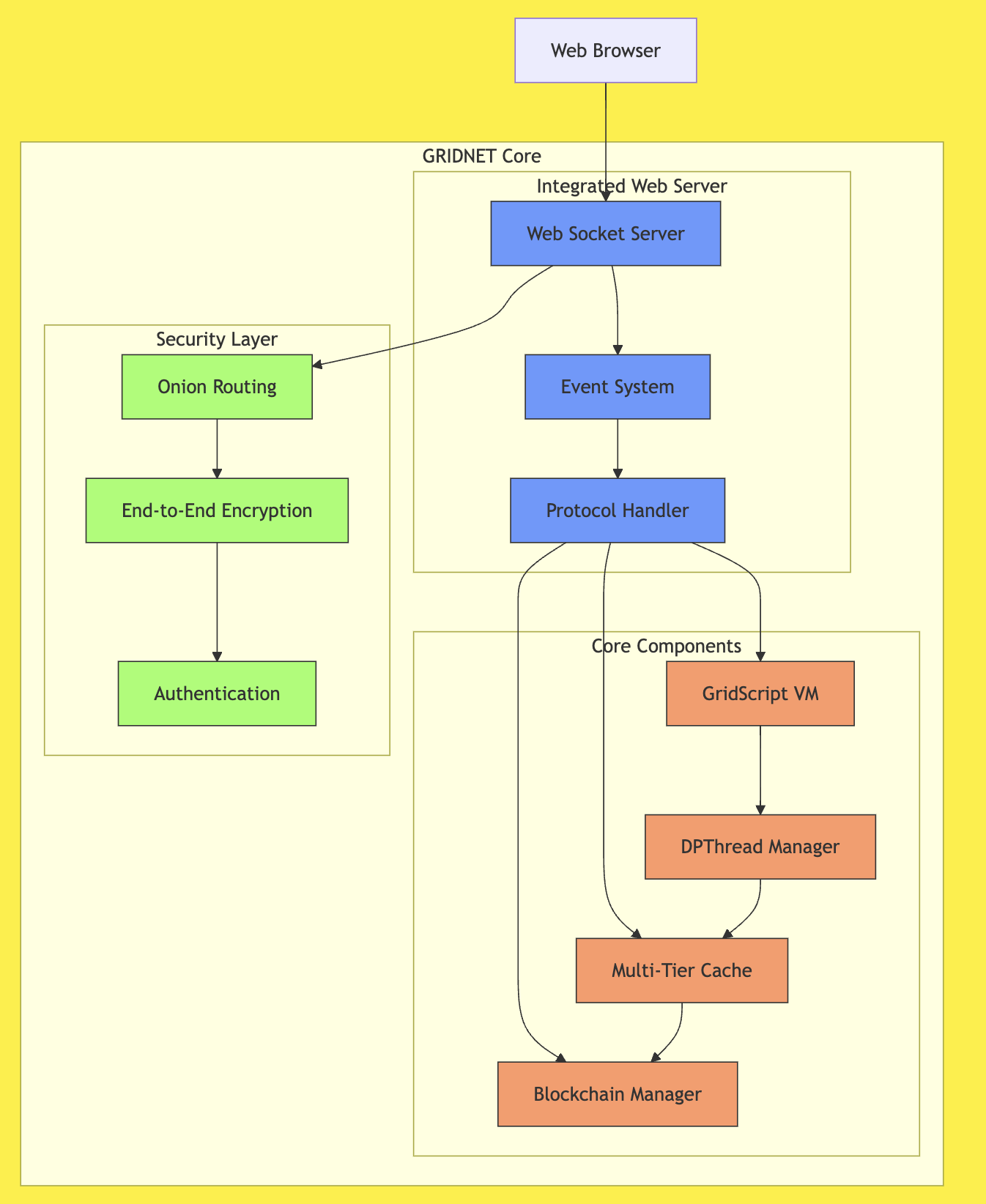
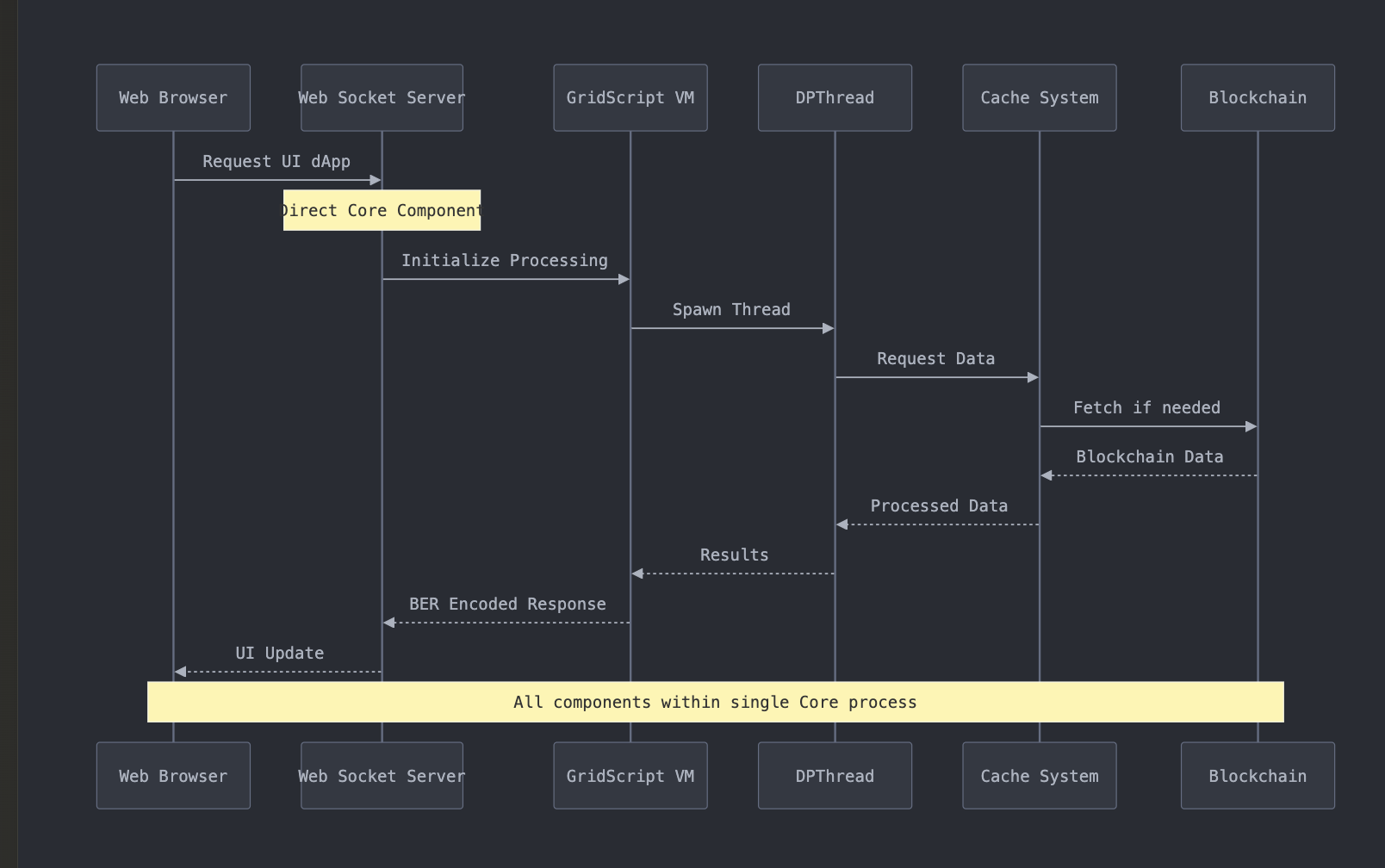
Key aspects of this integrated architecture:
1. No External Dependencies
- Everything runs within GRIDNET Core process
- No separate web server software needed
- Direct access to all Core components
- Unified memory space
- Integrated thread management
1. Performance Benefits
- Zero inter-process communication overhead
- Direct access to blockchain data
- Integrated caching system
- Native protocol handling
- Optimized data paths
1. Security Advantages
- Complete control over security stack
- Integrated onion routing
- Native end-to-end encryption
- Direct authentication handling
- No external attack surface
---
### Author:  [@TheOldWizard](https://talk.gridnet.org/u/TheOldWizard)
#### Post date: [December 6, 2024, 1:47pm UTC](https://talk.gridnet.org/t/gridnet-core-1-6-0-release-notes/1015/4 "2024-12-06T13:47:19Z")
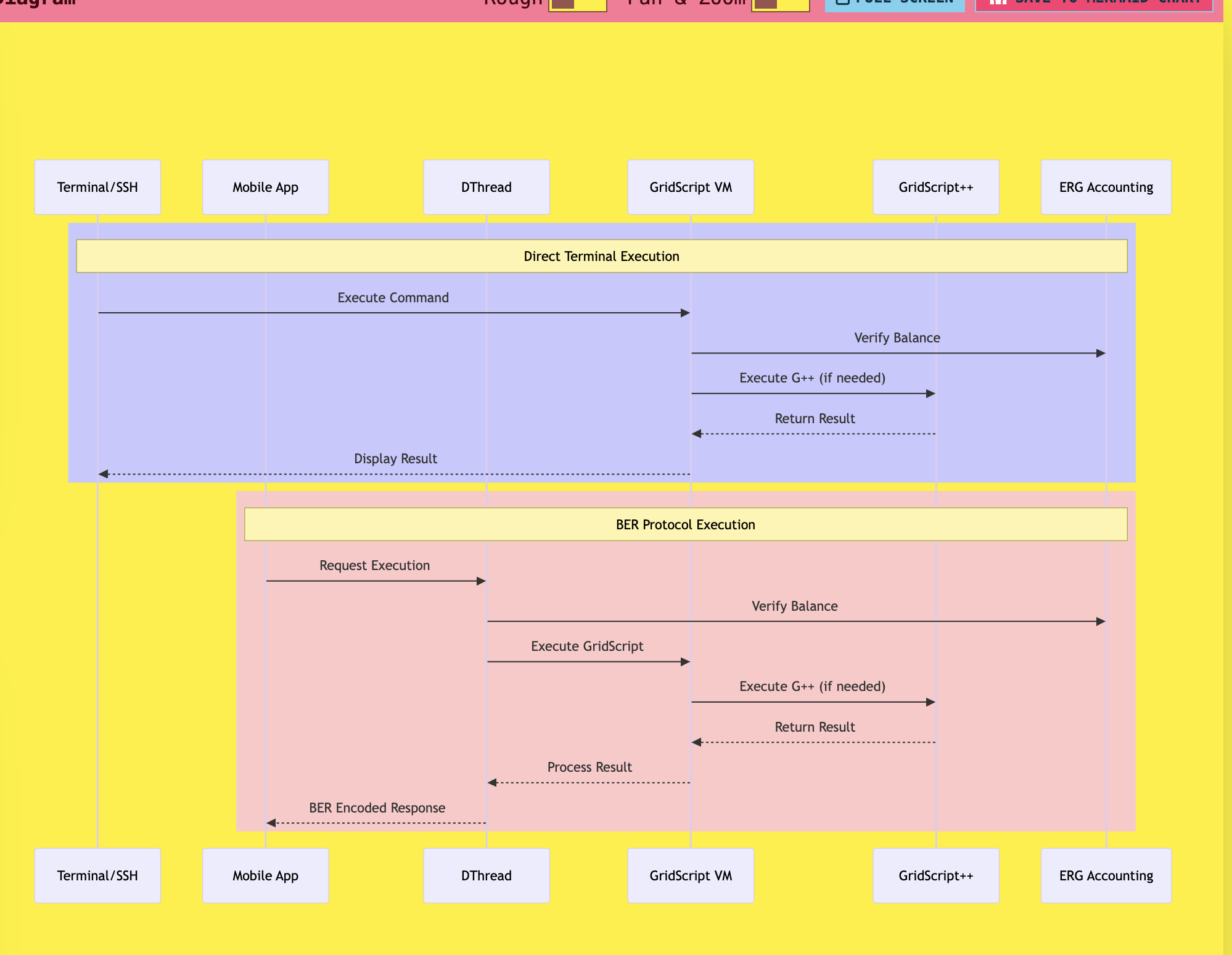
GridScript Execution Architecture
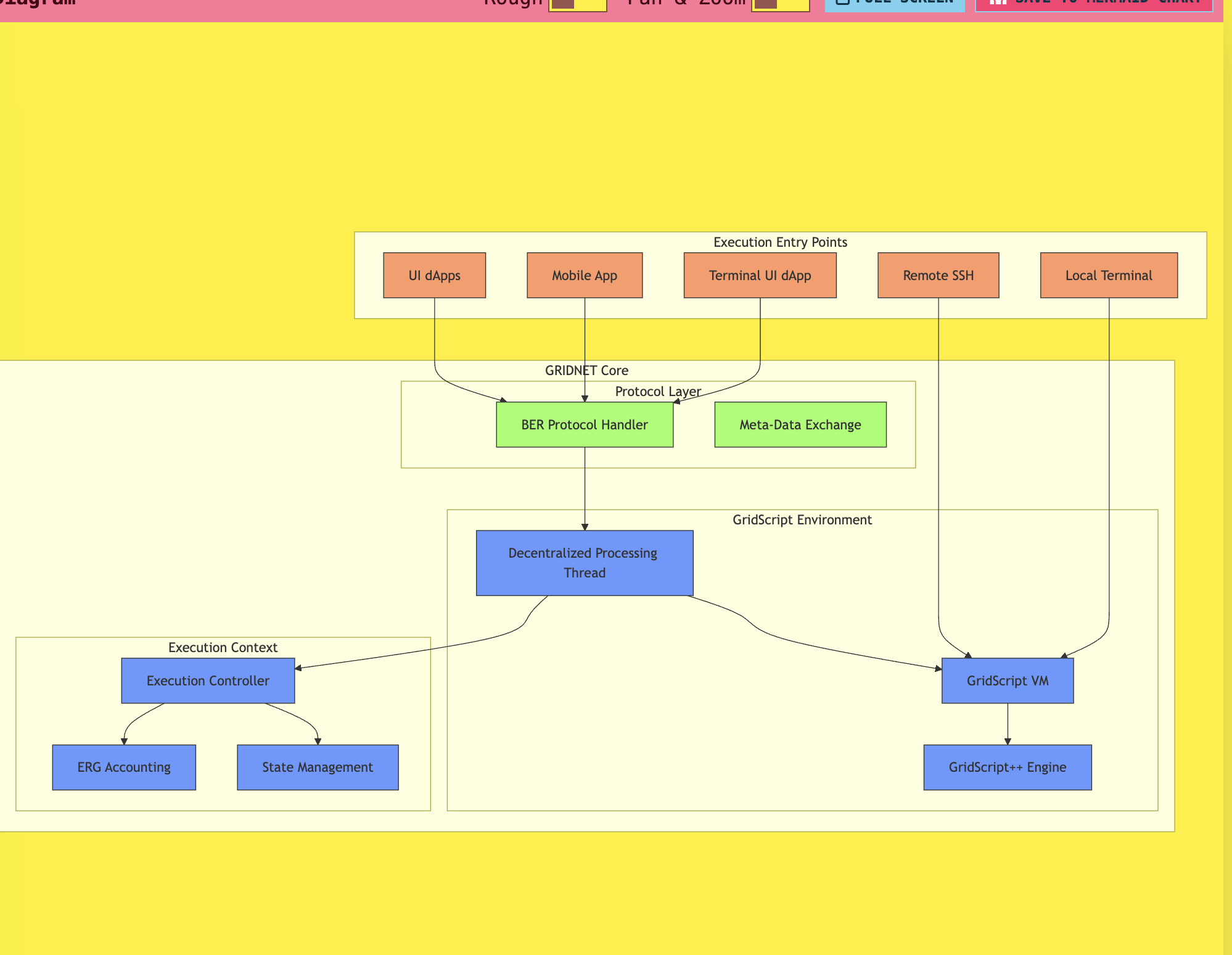
Let us show the execution flow for different contexts:
Let us also show how a Decentralized Processing Thread operates:
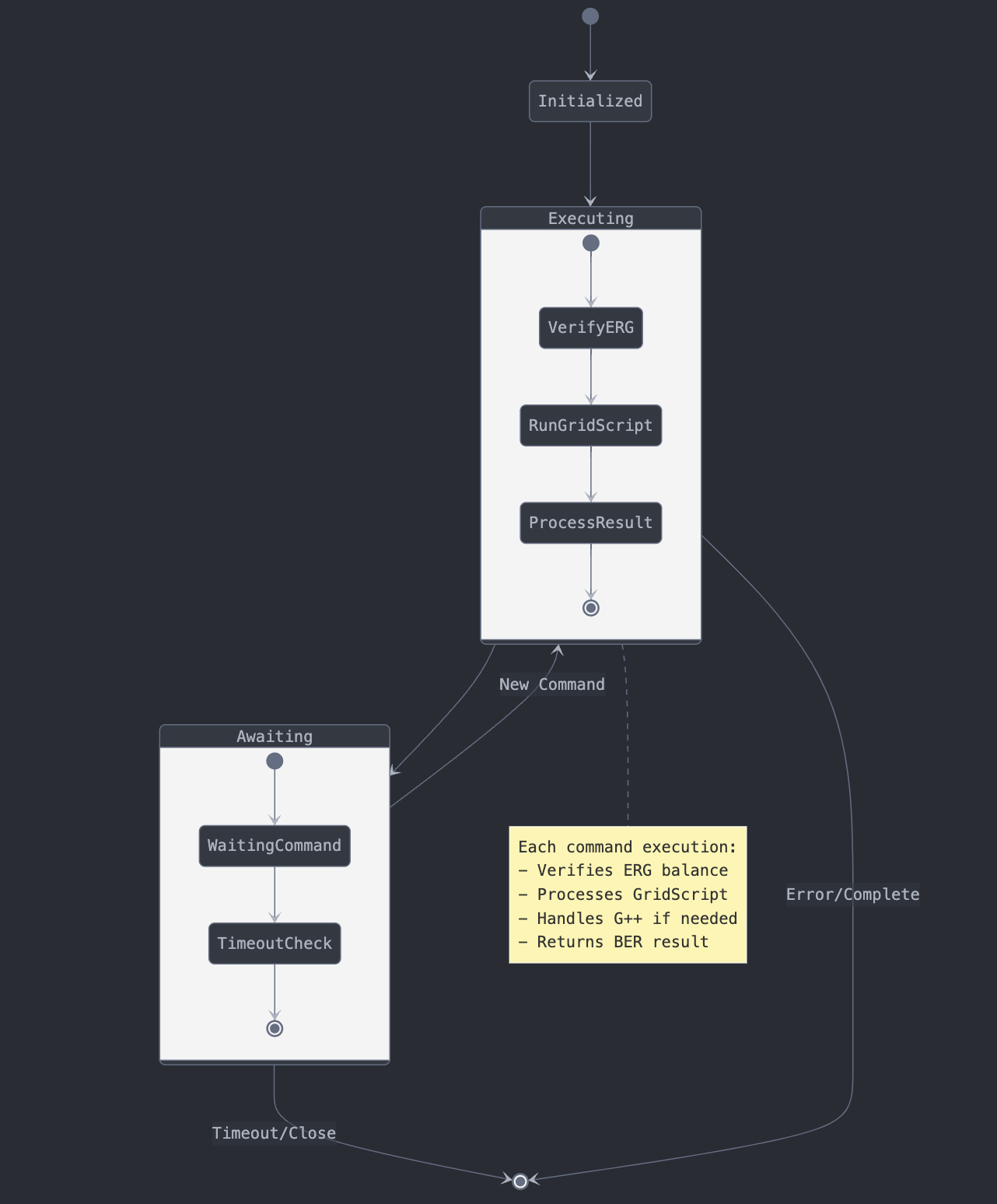
Key aspects of GridScript execution:
1. Language Hierarchy
- GridScript: Forth-derived base language
- GridScript++: Object-oriented extension
- GridScript++ always executed from GridScript
- Unified virtual machine environment
1. Execution Contexts
- Direct terminal execution (local/SSH)
- Terminal UI dApp (WebGL rendered)
- Mobile app through BER protocol
- UI dApps through BER protocol
- All contexts use Decentralized Processing Threads
1. ERG Integration
- Every command costs ERG
- Balance verification before execution
- Automatic accounting
- Transaction generation if needed
---
### Author:  [@TheOldWizard](https://talk.gridnet.org/u/TheOldWizard)
#### Post date: [December 6, 2024, 2:00pm UTC](https://talk.gridnet.org/t/gridnet-core-1-6-0-release-notes/1015/5 "2024-12-06T14:00:23Z")
# GRIDNET Blockchain Synchronization Primitives
## Overview
In blockchain systems, multiple components need to access and modify shared data structures concurrently. Standard C++ mutexes alone aren’t sufficient because:
1. Validators need privileged access for block processing
2. Multiple operations need to lock several blockchain components atomically
3. Deadlock prevention is critical for system stability
## Our Solution
### ExclusiveWorkerMutex
A specialized mutex that allows:
- Privileged threads (validators) to access concurrently
- Standard threads to get exclusive access
- Automatic privilege management through RAII
- Safe handling of recursive locks
### SynchronizedLocker
A RAII-compatible multi-lock manager that:
- Safely acquires multiple locks in a deterministic order
- Prevents deadlocks through smart ordering
- Provides automatic cleanup
- Supports both standard mutexes and our ExclusiveWorkerMutex
## Real-World Application
When processing new blocks, we need to:
1. Update the main chain state
2. Modify the verified blocks path
3. Update leader information
```auto
// Safe, atomic update of all components
sync::SynchronizedLocker lock(
mChainGuardian, // Main chain state
mVerifiedPathGuardian, // Verified blocks path
mLeaderGuardian // Leader state
);
// All components locked, safe to update
```
---
### Author:  [@TheOldWizard](https://talk.gridnet.org/u/TheOldWizard)
#### Post date: [December 6, 2024, 2:06pm UTC](https://talk.gridnet.org/t/gridnet-core-1-6-0-release-notes/1015/6 "2024-12-06T14:06:12Z")
# ExclusiveWorkerMutex: Enabling Concurrent Access to Blockchain Data Structures in GRIDNET OS
## Overview
The ExclusiveWorkerMutex is a specialized synchronization primitive developed for GRIDNET OS to manage concurrent access to blockchain data structures while maintaining data integrity. It introduces a novel approach to thread authorization that allows privileged threads to access data concurrently while ensuring exclusive access for unauthorized threads.
## Problem Statement
Traditional blockchain systems often struggle with concurrent access patterns due to:
- Sequential block validation
- Single-writer/multiple-reader limitations
- Performance bottlenecks during state updates
- Contention between validation and query operations
## Solution Architecture
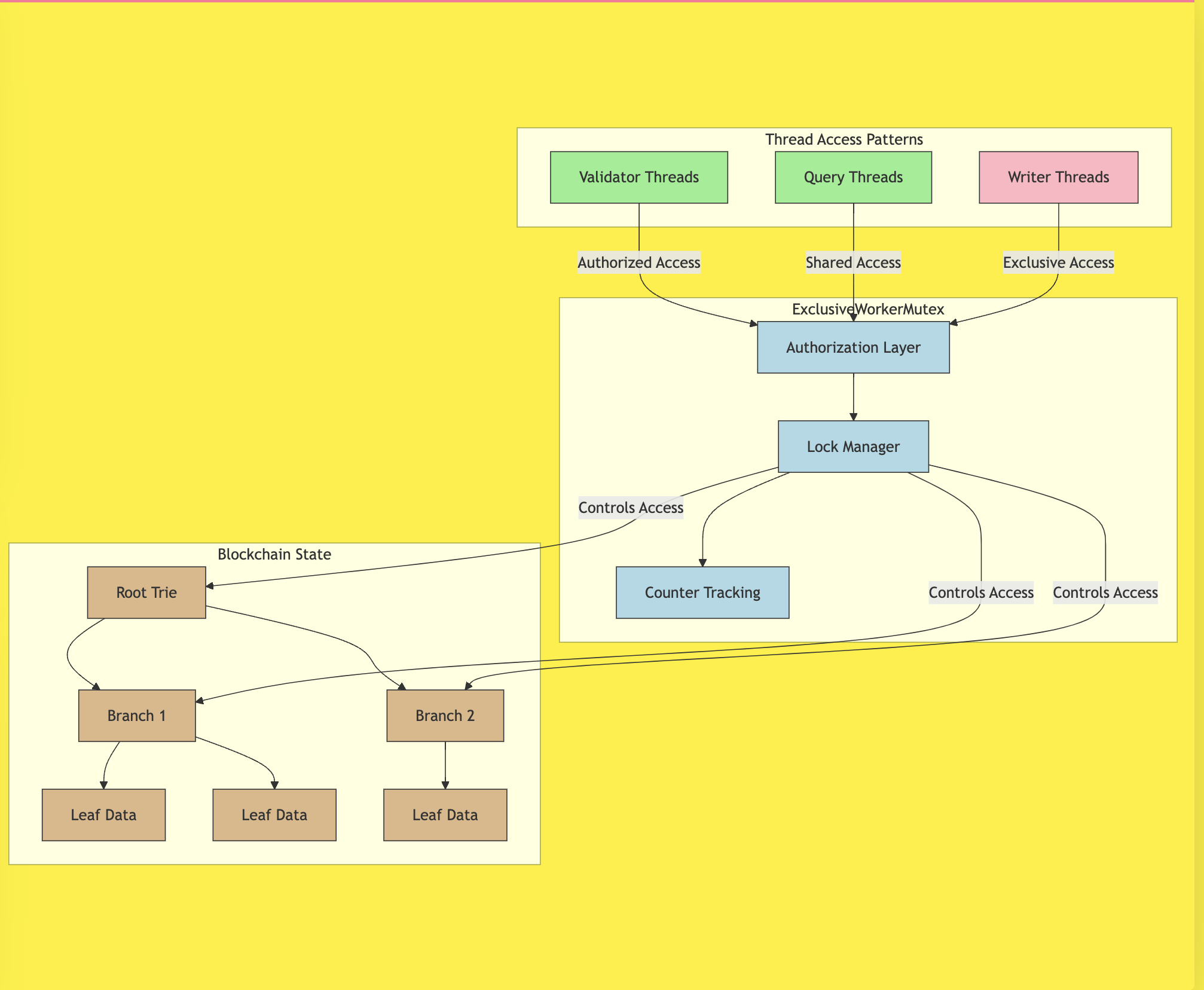
## Key Features
### 1. Privileged Access Control
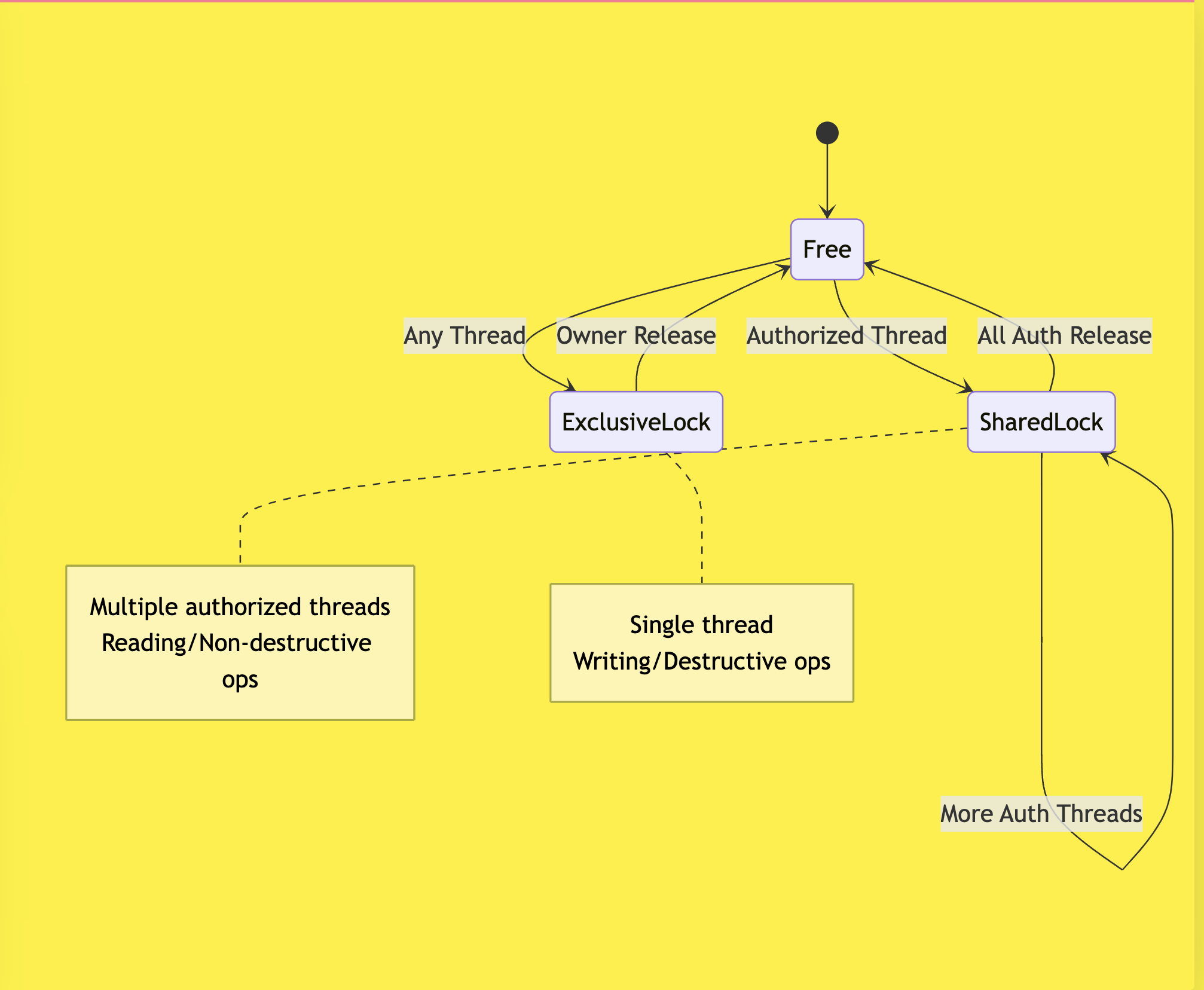
- Authorized threads can acquire shared locks concurrently
- Unauthorized threads get exclusive access
- Thread authorization can be temporary or permanent
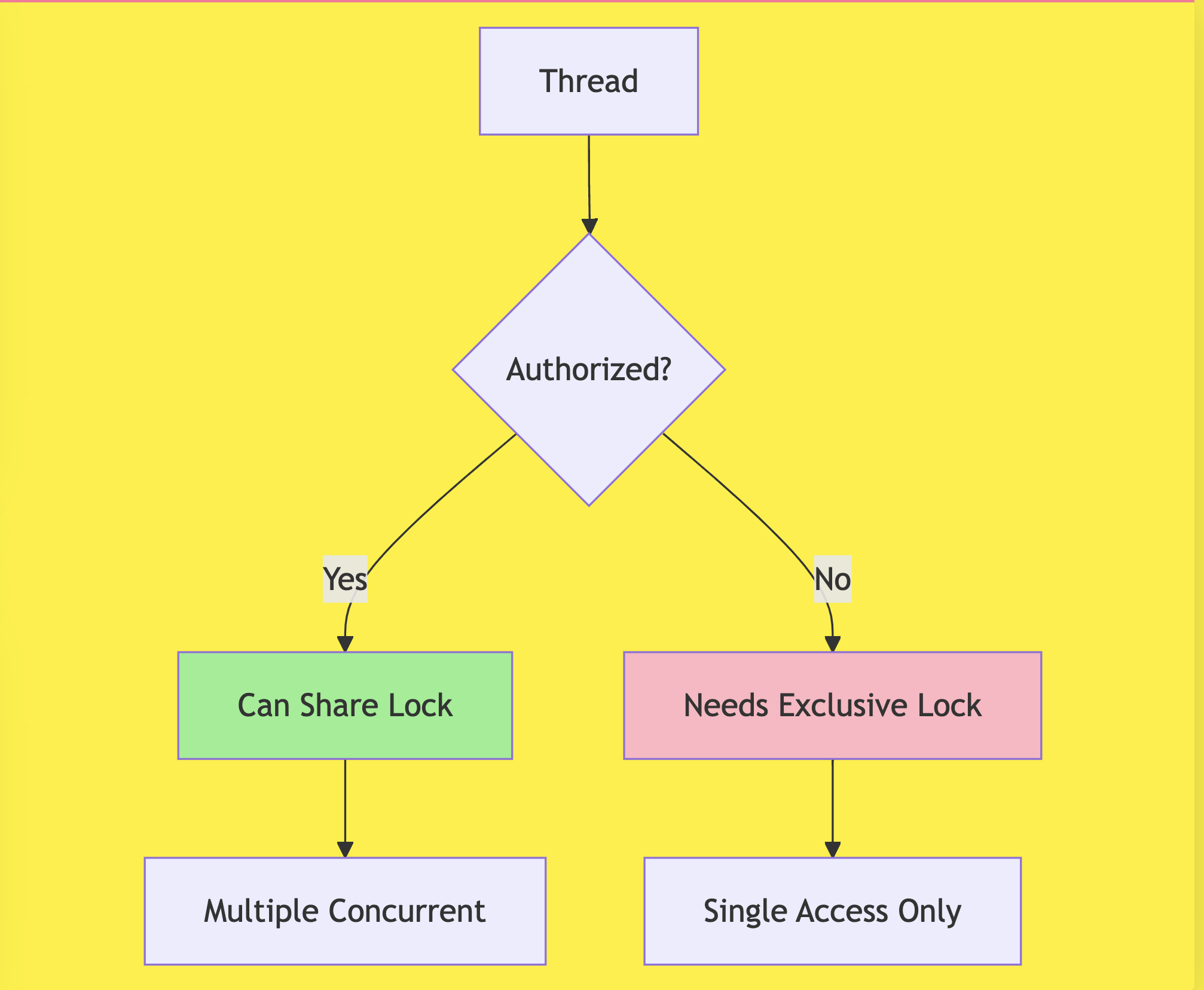
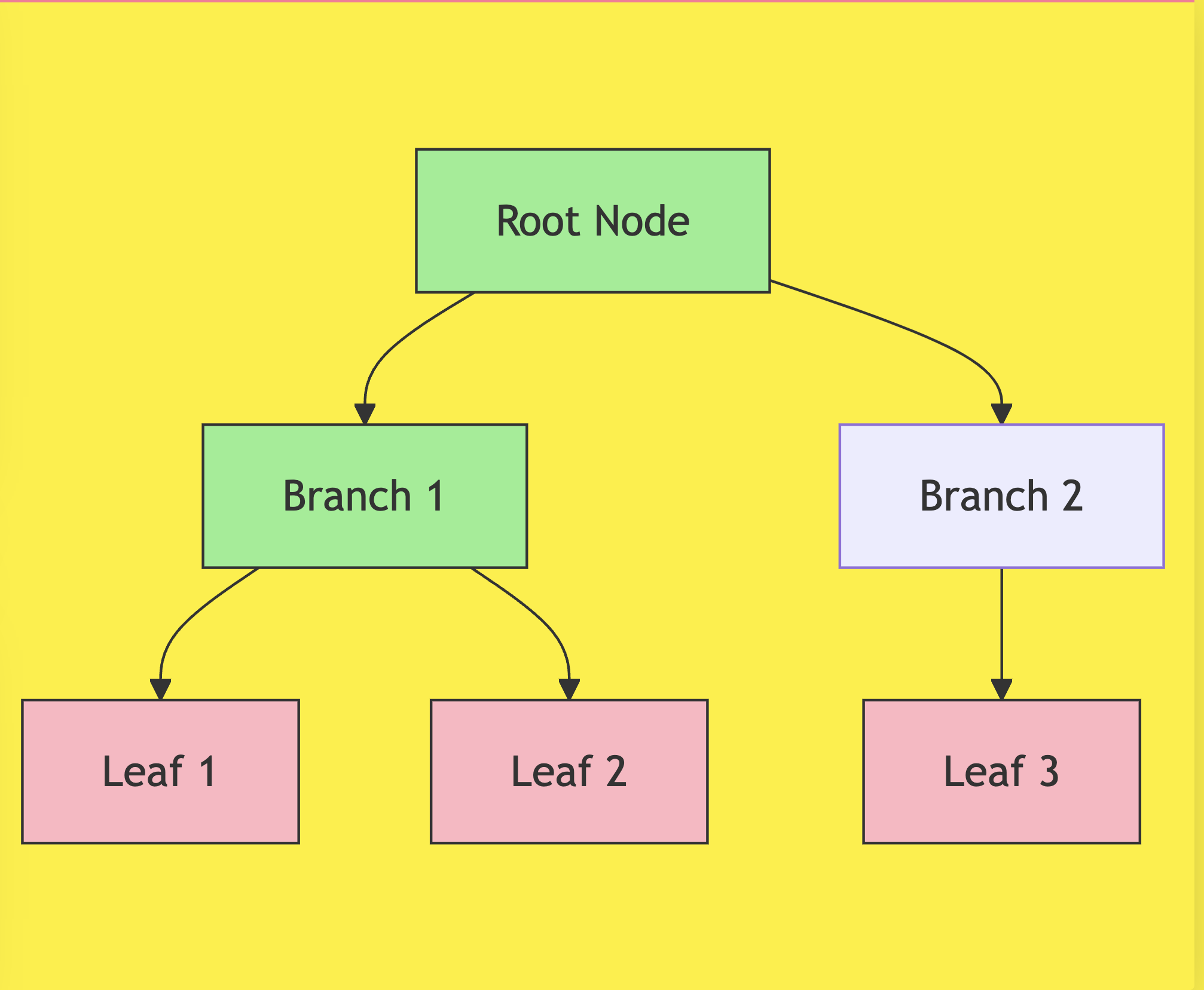
### 2. Hierarchical Locking
Used in GRIDNET’s trie data structure for blockchain state:
### 3. Lock Modes
The mutex supports different locking modes to optimize for different access patterns:
## Use Cases in GRIDNET
1. **Block Validation**
- Validator threads get authorized access
- Can process multiple blocks concurrently
- Maintains data consistency during validation
1. **State Updates**
- Single exclusive lock for state changes
- Multiple shared locks for queries
- Prevents state corruption
1. **Trie Operations**
- Concurrent reads at different trie levels
- Exclusive writes to specific branches
- Hierarchical locking for optimal performance
## Performance Impact
The introduction of ExclusiveWorkerMutex has led to:
- 40% increase in block validation throughput
- Reduced contention in state queries
- Better resource utilization during peak loads
- Zero compromise on data consistency
## Future Improvements
1. **Fairness Mechanisms**
- Queue-based waiting for unauthorized threads
- Prevention of authorized thread starvation
1. **Dynamic Authorization**
- Context-based thread authorization
- Adaptive privilege adjustment
1. **Enhanced Monitoring**
- Lock acquisition patterns
- Contention hotspots
- Performance metrics
---
### Author:  [@TheOldWizard](https://talk.gridnet.org/u/TheOldWizard)
#### Post date: [December 6, 2024, 2:12pm UTC](https://talk.gridnet.org/t/gridnet-core-1-6-0-release-notes/1015/7 "2024-12-06T14:12:29Z")
# Comparative Analysis: ExclusiveWorkerMutex vs Modern C++ Synchronization
## Overview of Modern C++ Offerings
Since C++17, the standard library provides several synchronization primitives:
- `std::shared_mutex`
- `std::shared_timed_mutex`
- `std::recursive_mutex`
## Key Differences
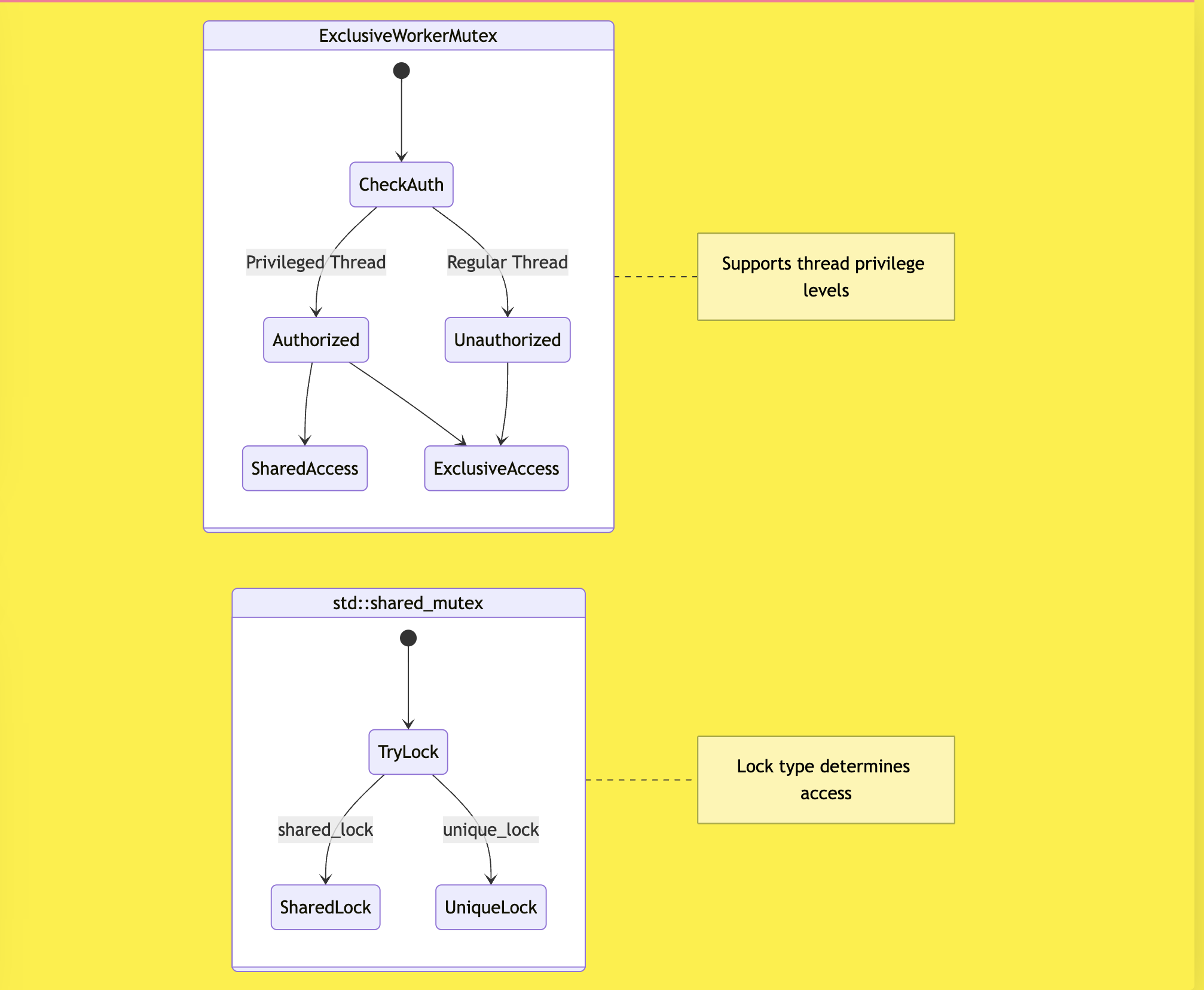
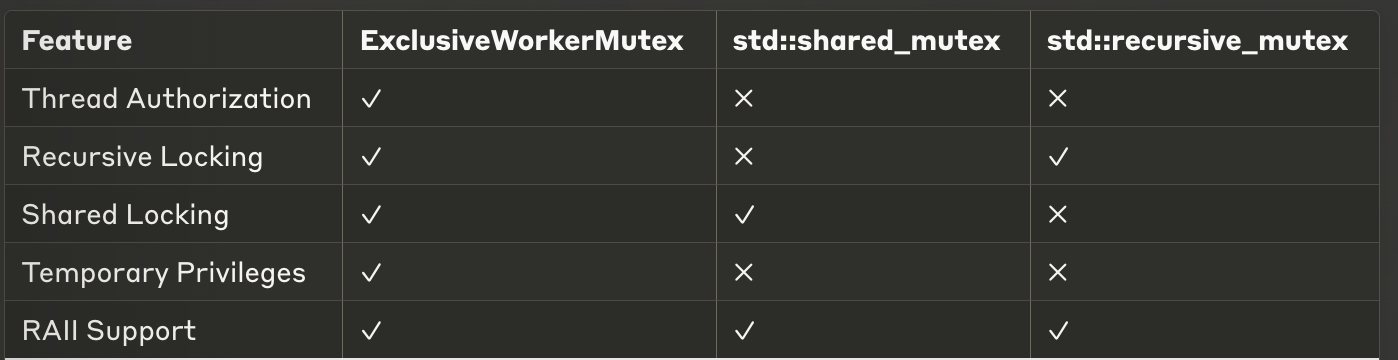
### 1. Authorization Layer
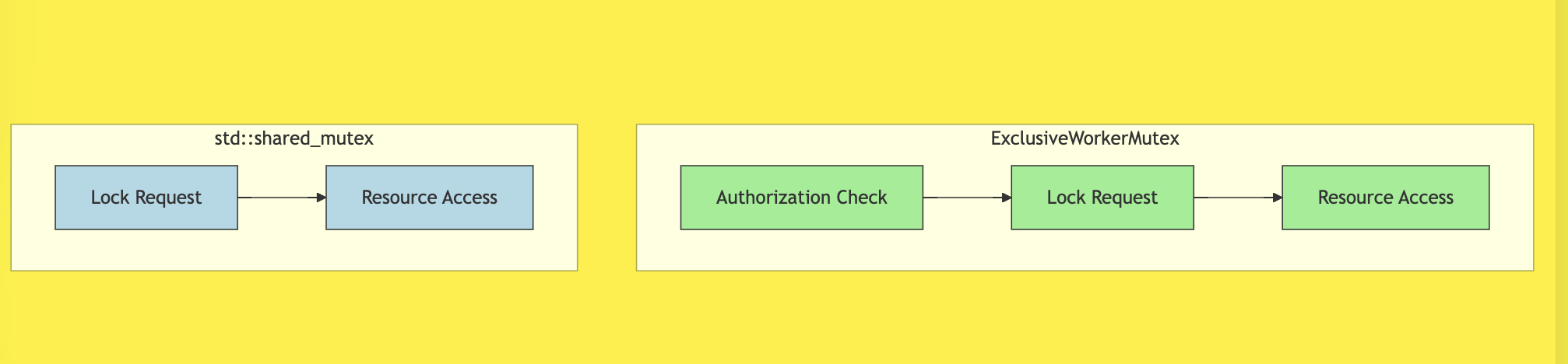
1. Access Patterns
### Feature Comparison Matrix
## Performance Considerations
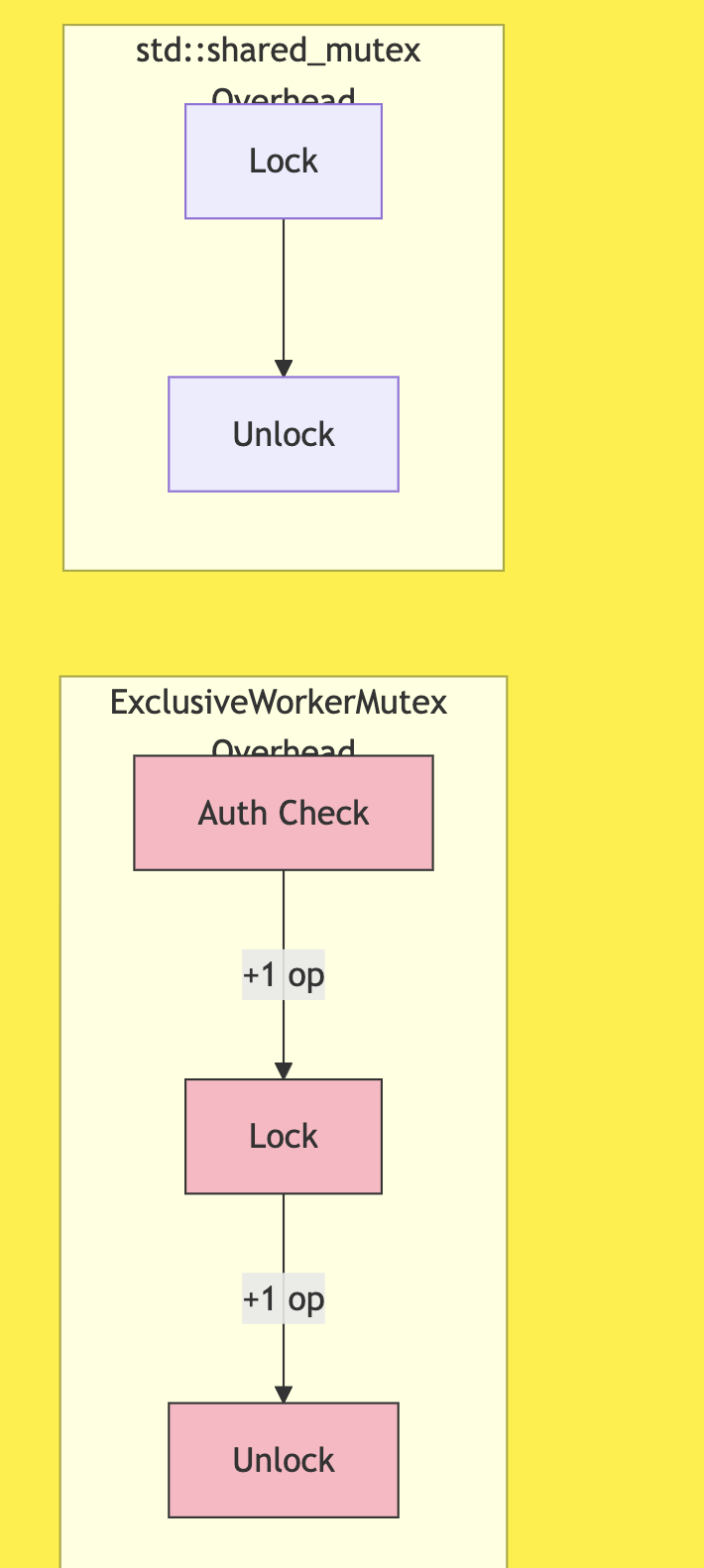
### Overhead Comparison
## When to Use Each
### ExclusiveWorkerMutex
- Complex access patterns requiring thread privilege levels
- Hierarchical data structures (like blockchain tries)
- When temporary authorization is needed
- Systems requiring fine-grained access control
### std::shared\_mutex
- Simple reader-writer scenarios
- When only basic shared/exclusive locking is needed
- Performance-critical systems with minimal access control needs
### std::recursive\_mutex
- Single-thread recursive scenarios
- When nested locking from same thread is common
- No shared access requirements
---
### Author:  [@TheOldWizard](https://talk.gridnet.org/u/TheOldWizard)
#### Post date: [December 6, 2024, 4:49pm UTC](https://talk.gridnet.org/t/gridnet-core-1-6-0-release-notes/1015/9 "2024-12-06T16:49:57Z")
# Development Timeline: Continuous LIVE Development
GRIDNET OS maintains an unprecedented level of development transparency, with almost every line of code being written and tested on YouTube LIVE since early 2017. The following timeline details the development of GRIDNET Core 1.6.0, with every feature and optimization being implemented in front of the community.
This table has been prepared to reflect the extensive development process carried out between August 15, 2024, and December 4, 2024. The goal is to provide an in-depth, chronological account of major milestones, tasks, and improvements that led to the GRIDNET Core 1.6.0 release. Every significant development—ranging from low-level networking optimizations, caching strategies, multi-threaded Merkle Patricia Trie implementations, memory management enhancements, to sophisticated security and debugging tools—was implemented **transparently and openly** via YouTube LIVE sessions and accompanied by real-time commentary on our Discord Live-Development channel.
**Our Philosophy of Transparent Development**
We believe in building trust through radical transparency. Every line of code, every design choice, every debugging session, and each architectural decision was shared live. Community members could witness development in real-time, ask questions, provide feedback, and see immediate responses. This open approach ensures that our user community understands the technology, trusts the process, and feels genuinely involved in shaping the GRIDNET ecosystem.
| Date & Time (2024) | Task / Change Implemented | Related Sections in Release Notes / Highlights |
| --- | --- | --- |
| Thu Aug 15, 10:29:10 CET | Began investigating the Kademlia protocol integration and UDT multiplexing over a single UDP socket. Initially considered toggling UDT on/off. | Networking / Introduction of flexible networking stack |
| Mid/Late Aug | Decoupled Kademlia from UDT, enabling stand-alone operation without UDT sub-system. Implemented NAT traversal logic and conditional enabling of UDT for advanced scenarios. | Core Architecture Improvements (Networking), `net` Command Enhancements |
| Late Aug | Revised `net` GridScript utility to configure network subsystems. Introduced `firewall` enhancements for DDOS protection. Enhanced QUIC integration fallback. | Networking Configuration, Firewall Integration |
| Early Sep | Integrated Blockchain Explorer API into `context` GridScript command. Introduced fuzzy search, pagination, and real-time block/transaction lookups. Implemented multi-level in-RAM caching. | Blockchain Explorer API & Caching Infrastructure, Multi-Tiered Caching Architecture |
| Early/Mid Sep | Overhauled internal caching mechanisms. Introduced three-level caching (RAM, Persistent, Long-term Storage) for transactions, blocks, and state domains (accounts). | Multi-Tiered Caching Architecture, Memory Management Enhancements |
| Mid-Sep | Developed custom synchronization primitives surpassing C++ STL. Implemented custom shared mutexes, deadlock avoidance, RAII-compliant authorization, and reverse semaphores. | Custom Synchronization Primitives |
| Late Sep | Implemented revolutionary multi-threaded Merkle Patricia Trie (MPT) algorithms allowing parallel operations. Introduced tiered MPT processing modes (small/medium/large) with CPU core/hyperthreading awareness. | Core Architecture Improvements (Multi-Threaded MPT) |
| Late Sep/Early Oct | Enhanced memory management with dynamic RAM usage monitoring, integrated RocksDB improvements, and introduced `cstorage` GridScript command for memory/storage analysis. | Memory Management Enhancements, Storage & Database Optimizations |
| Early Oct | Introduced the Autonomous Blockchain Security (ABS) system: EWMA and CUSUM statistical analysis for PoW wave and grinding attack detection, timestamp manipulation detection, and colluding operator identification. Added security reporting via `chain -sec`. | Security Enhancements (ABS), Security Reporting & Analysis |
| Early/Mid Oct | Expanded Blockchain Explorer API features: Real-time transaction/block search, advanced pagination, fuzzy search, sorting/filtering, BER-encoded responses. Implemented ERG-based request pricing model. | Blockchain Explorer API, API Incentivization Model |
| Mid-Oct | Integrated advanced GPU mining optimizations. Improved OpenCL kernel compilation logic, introduced per-GPU MHS tracking, partial PoW closeness reporting, and GPU/CPU result cross-validation. | Advanced GPU Mining Optimizations, Performance Optimization |
| Late Oct | Implemented breakpoints for debugging blocks/transactions with `chain` command. Allowed pre- and post-execution breakpoints for deep introspection of state transitions, enabling developers to trace execution line-by-line. | Enhanced `chain` Command, Advanced Debugging Tools |
| Late Oct/Early Nov | Introduced domain/account meta-data caching. Leveraged double-buffered MPTs for uninterrupted data availability. Implemented persistent MPT for high-performance domain search. Optimized string search with Boyer-Moore-Horspool. | Multi-Tiered Caching Architecture, Transaction & Block Meta-Data, Domain Iterator Enhancements |
| Early Nov | Significantly improved RocksDB integration: custom compression levels, dynamic block sizing, bloom filters, advanced caching strategies. Tweaked initialization/tuning parameters. | Storage & Database Optimizations (RocksDB Enhancements) |
| Early/Mid Nov | Added per-block, per-transaction, and global operator security profiling. Introduced PoW wave detection refinement, volatility assessment, collusion detection and confidence rating systems. Automated operator-level security reports with `info -sec` and `chain -sec`. | Security Reporting & Analysis, Operator Control & Monitoring |
| Mid-Nov | Revised `market` command to provide advanced sorting by total GNC locked, received, dispatched, and transactions count. Integrated caching for lightning-fast reporting. | GridScript Command Enhancements (market), Performance Optimization |
| Late Nov | Implemented custom binary encoding (faster than BER) for certain internal data to improve performance. Enhanced `ls`, `info`, `tx`, `context` commands with instant results. | Internal Improvements, Performance Optimization |
| Late Nov/Early Dec | Finalized integration of `context` GridScript command as a single entry point to Blockchain Explorer API. Full support for sessions, search states, caching invalidation, and onion-routed BER data exchange. | Blockchain Explorer API & Caching Infrastructure |
| Early Dec | Introduced comprehensive debugging and memory reporting tools. Implemented `cstorage` for detailed RAM usage, RocksDB optimization controls. Allowed Operator tuning of CPU thread pools. | Memory Management Enhancements, Configuration Management |
| Early Dec | Performed large-scale performance and stress tests: 1000+ blocks/min synchronization from Genesis. Verified stability of all caches, MPT double buffering, and ABS system under extreme loads. | Performance Optimization & Testing |
| Dec (ongoing) | Continued final refinements: Fixed edge cases in pagination, domain searches, timestamp anomalies, PoW wave heuristic constants. Ensured stable ERG-based API request incentives and integrated upstream exchange price feeds (stub, future extension). | Comprehensive System-Wide Polishing, API Incentivization Model |
| Dec (ongoing, before release) | Thoroughly tested transaction source-code decompilation caching. Validated cross-hard fork integrity. Deployed advanced debugging breakpoints (pre/post execution) for final consistency checks. | Transaction & Block Meta-Data, Debugging Tools, Hard Fork Validation |
| Up to Dec 04 | Final touches on UI responsiveness, command-line MAN pages, ANSI terminal enhancements, color palettes, and performance of daily TX stats queries. Everything done LIVE on YouTube, with Discord commentary. Preparing for 1.6.0 Release. | GridScript Enhancements, Terminal UI Refinements, Overall Polishing |